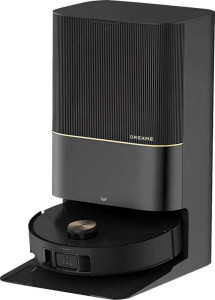
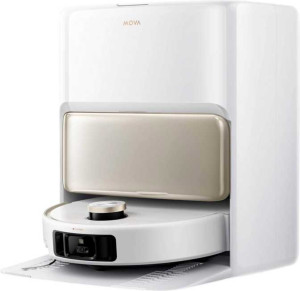
In terms of physical design and smart home compatibility, these two robots are nearly identical twins. Both share the exact same 350 × 350 mm footprint and a near-identical height (89 mm vs 89.5 mm), meaning they will navigate under furniture equally well. Weight is also a wash at roughly 4.5 kg each. Both carry a HEPA and allergy filter, and both integrate natively with Google Assistant and Alexa, so neither has an edge on ecosystem compatibility.
Where the two diverge meaningfully is on noise and long-term ownership value. The Dreame X50 Ultra operates at 60 dB, while the Mova V50 Ultra reaches 70 dB — a 10-decibel gap that, in acoustic terms, is perceived as roughly twice as loud. For users who run their robot during calls, naps, or TV time, this is a tangible quality-of-life difference. On the maintenance side, the X50 Ultra′s dock requires emptying only every 100 days versus 75 days for the V50 Ultra, meaning fewer interactions with the dust bin over a cleaning season. The V50 Ultra′s docking station is marginally more compact (90,409 cm³ vs 91,674 cm³), but the difference is negligible in practice.
The clearest long-term differentiator is the warranty period: the X50 Ultra ships with 2 years of coverage versus just 1 year for the V50 Ultra — a significant advantage given the complexity and cost of these devices. Taken together, the Dreame X50 Ultra holds a clear edge in this category: it is quieter, needs less frequent maintenance attention, and is backed by a longer warranty, while matching its rival on every shared feature.