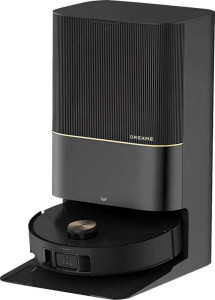
Both the Dreame X50 Ultra and the Narwal Flow share a strong foundation: each carries a HEPA and allergy filter, integrates with both Google Assistant and Alexa, and arrives at a nearly identical robot weight — 4530 g versus 4600 g respectively. That 70 g gap is negligible in practice, as neither unit is ever moved frequently by hand. Where physical dimensions start to matter more is in the robot's profile: the X50 Ultra is noticeably flatter at 89 mm tall compared to the Flow's 95 mm, giving it a better chance of clearing lower furniture clearances. The Flow is marginally wider and deeper, translating to a larger overall robot volume (12,127 cm³ vs 10,902 cm³), which could affect navigation in tighter spaces.
On acoustics, the Narwal Flow holds a measurable advantage at 57 dB versus the X50 Ultra's 60 dB. A 3 dB reduction represents roughly half the acoustic energy, so in a quiet home environment this difference is genuinely perceptible — the Flow will seem meaningfully quieter during operation. Regarding the dock footprint, the situation flips: despite having a larger robot body, the Flow's docking station is actually more compact at approximately 84,893 cm³ against the X50 Ultra's bulkier 91,674 cm³ station, a real consideration for users placing the dock in a living room or hallway.
Two practical ownership factors separate these products clearly. The Narwal Flow can go up to 120 days between dustbin empties versus the X50 Ultra's 100 days — a 20% extension that means fewer maintenance interventions per year. Countering that, the Dreame X50 Ultra offers a 2-year warranty compared to just 1 year on the Flow, doubling the covered protection period and reducing long-term ownership risk. Overall, the Flow edges ahead on day-to-day comfort (quieter, longer auto-empty cycle, smaller dock), while the X50 Ultra's superior warranty and lower robot profile provide a meaningful counterbalance for buyers prioritizing longevity assurance and under-furniture reach.