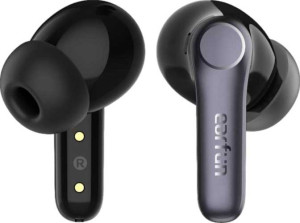
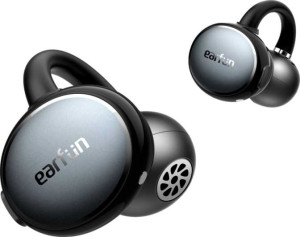
The most consequential difference in this group is noise isolation. The EarFun Air Pro 4 Plus offers both Active Noise Cancellation (ANC) and passive noise reduction — a combination that actively suppresses external sound via microphone-driven processing while the in-ear seal physically blocks ambient noise. The EarFun Clip, as an open-ear design, has neither: no ANC and no passive noise reduction. In practical terms, this means the Clip is entirely transparent to surrounding sound, which suits commuters or outdoor users who need situational awareness, but makes it unsuitable for noisy environments where focus or immersion matters.
On raw driver specs, the Clip's 10.8 mm driver is marginally larger than the Air Pro 4 Plus's 10 mm unit. Driver size alone is not a reliable predictor of audio quality — tuning, materials, and enclosure design matter far more — but a slightly larger driver can have more surface area to move air, which may contribute to bass presence. Both products share an identical frequency range of 20 Hz to 20,000 Hz, covering the full extent of human hearing, and neither supports spatial audio, Dolby Atmos, or Dirac Virtuo, so there is no processing-based soundstage advantage on either side.
Overall, the Air Pro 4 Plus holds a clear edge in sound quality versatility for this group. The addition of ANC fundamentally expands the range of environments in which it can deliver a controlled, immersive listening experience — something the Clip simply cannot replicate by design. The Clip's marginally larger driver is a minor footnote against that structural disadvantage.