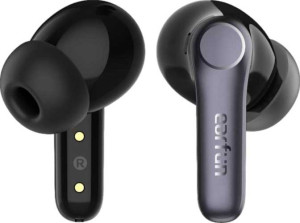
EarFun Air Pro 4 Plus
OnePlus Buds 4

EarFun Air Pro 4 Plus OnePlus Buds 4

Overview

Welcome to our in-depth spec comparison between the EarFun Air Pro 4 Plus and the OnePlus Buds 4. Both true wireless earbuds share a solid IP55 rating, active noise cancellation, and 6-microphone setups, but they take notably different paths when it comes to audio codec support, battery endurance, and high-frequency sound reproduction. Read on to see exactly how these two contenders stack up across every key specification.

Common Features

  • Both have an in-ear fit.
  • Both carry an IP55 ingress protection rating.
  • Both are water resistant.
  • Neither product uses wires or cables.
  • Neither product is a neckband earbud design.
  • Neither product includes wingtips.
  • Neither product has RGB lighting.
  • Both feature stereo speakers.
  • Both support active noise cancellation (ANC).
  • Both offer passive noise reduction.
  • Neither product supports Dolby Atmos.
  • Neither product supports Dirac Virtuo.
  • Neither product uses a neodymium magnet.
  • Neither product has a solar power battery.
  • Both have a battery level indicator.
  • Both have a rechargeable battery.
  • Both support fast pairing.
  • Both use USB Type-C charging.
  • Neither product supports aptX Low Latency.
  • Neither product supports aptX HD.
  • Neither product supports aptX.
  • Neither product supports aptX Voice.
  • Both have a maximum Bluetooth range of 10 m.
  • Neither product supports Bluetooth pairing using NFC.
  • Both support ambient sound mode.
  • Both feature in/on-ear detection.
  • Both support fast charging.
  • Both support multipoint connection with 2 devices.
  • Neither product can read notifications.
  • Both have a built-in translator.
  • Both have a mute function.
  • Both can be used as a headset.
  • Both are equipped with 6 microphones.
  • Both have a noise-canceling microphone.

Main Differences

  • Driver unit size is 10 mm on EarFun Air Pro 4 Plus and 11 mm on OnePlus Buds 4.
  • Lowest frequency response is 20 Hz on EarFun Air Pro 4 Plus and 15 Hz on OnePlus Buds 4.
  • Highest frequency response is 20000 Hz on EarFun Air Pro 4 Plus and 40000 Hz on OnePlus Buds 4.
  • Spatial audio support is present on OnePlus Buds 4 but not available on EarFun Air Pro 4 Plus.
  • Battery life is 12 hours on EarFun Air Pro 4 Plus and 11 hours on OnePlus Buds 4.
  • Battery life of the charging case is 42 hours on EarFun Air Pro 4 Plus and 34 hours on OnePlus Buds 4.
  • Battery life with ANC enabled is 8 hours on EarFun Air Pro 4 Plus and 6 hours on OnePlus Buds 4.
  • Charge time is 1.5 hours on EarFun Air Pro 4 Plus and approximately 1.33 hours on OnePlus Buds 4.
  • Wireless charging is supported on EarFun Air Pro 4 Plus but not available on OnePlus Buds 4.
  • Bluetooth version is 6 on EarFun Air Pro 4 Plus and 5.4 on OnePlus Buds 4.
  • LDAC support is present on EarFun Air Pro 4 Plus but not available on OnePlus Buds 4.
  • LDHC support is present on OnePlus Buds 4 but not available on EarFun Air Pro 4 Plus.
  • Bluetooth LE Audio support is present on EarFun Air Pro 4 Plus but not available on OnePlus Buds 4.
  • aptX Adaptive support is present on EarFun Air Pro 4 Plus but not available on OnePlus Buds 4.
  • aptX Lossless support is present on EarFun Air Pro 4 Plus but not available on OnePlus Buds 4.
  • Audio latency is 50 ms on EarFun Air Pro 4 Plus and 47 ms on OnePlus Buds 4.
  • Auracast support is present on EarFun Air Pro 4 Plus but not available on OnePlus Buds 4.
Specs Comparison
EarFun Air Pro 4 Plus

EarFun Air Pro 4 Plus

OnePlus Buds 4

OnePlus Buds 4

Design:
Fit In-ear In-ear
Ingress Protection (IP) rating IP55 IP55
water resistance Water resistant Water resistant
has no wires or cables
are neckband earbuds
wingtips included
has RGB lighting
has stereo speakers
has UV light
Has a display

In terms of design, the EarFun Air Pro 4 Plus and the OnePlus Buds 4 are virtually identical across every measured specification. Both use an in-ear fit, are fully wireless with no cables or neckband, carry an IP55 rating for water and dust resistance, and share the same set of omitted extras — no RGB lighting, no UV light, no display, and no wingtips included.

The IP55 rating is worth noting: the first digit (5) means protection against dust ingress sufficient for everyday use, while the second digit (5) means protection against low-pressure water jets from any direction. In practical terms, both earbuds can handle sweat, rain, and splashes comfortably, making them suitable for workouts and commutes, though neither is rated for submersion.

Given the complete parity across all design specs, this category is a tie. Neither product holds a structural or protection advantage over the other — a buyer choosing between them on design criteria alone will find no differentiating factor here.

Sound quality:
has active noise cancellation (ANC)
has passive noise reduction
driver unit size 10 mm 11 mm
lowest frequency 20 Hz 15 Hz
highest frequency 20000 Hz 40000 Hz
supports spatial audio
has Dolby Atmos
has Dirac Virtuo
has a neodymium magnet

Both earbuds share a strong foundation for sound quality: active noise cancellation, passive noise reduction, and identical lower-bound sensitivity starting at a standard 20 Hz for the EarFun Air Pro 4 Plus. However, the OnePlus Buds 4 pulls ahead on nearly every measurable audio spec. Its driver is marginally larger at 11 mm versus 10 mm, which can contribute to fuller low-end reproduction, but the more significant gap lies in frequency range — the Buds 4 extends down to 15 Hz and up to 40,000 Hz, compared to a standard 20 Hz–20,000 Hz range on the Air Pro 4 Plus.

The extended high-frequency ceiling of 40 kHz on the OnePlus is relevant primarily for hi-res audio playback over compatible codecs — human hearing typically tops out around 20 kHz, but a wider driver bandwidth often correlates with cleaner, lower-distortion reproduction within the audible range. The sub-20 Hz bass extension, meanwhile, adds the kind of physical rumble felt more than heard in bass-heavy music and cinematic content. Additionally, the Buds 4 supports spatial audio, which the Air Pro 4 Plus lacks entirely — this enables a more immersive, three-dimensional soundstage, particularly noticeable when watching video content or gaming.

The OnePlus Buds 4 holds a clear edge in this category. Its broader frequency response, larger driver, and spatial audio support give it a measurably wider technical capability on paper, and those advantages translate to real listening scenarios where depth, detail, and immersion matter.

Power:
Battery life 12 hours 11 hours
Battery life of charging case 42 hours 34 hours
Battery life (ANC) 8 hours 6 hours
charge time 1.5 hours 1.333 hours
has wireless charging
Has a solar power battery
has a battery level indicator
has a rechargeable battery

Battery endurance is where the EarFun Air Pro 4 Plus builds a meaningful lead. It delivers 12 hours of earbud playback versus 11 hours on the OnePlus Buds 4 — a modest gap in standard use — but the difference widens considerably with ANC enabled: 8 hours versus just 6 hours. For users who rely on noise cancellation throughout a workday, that two-hour gap is the difference between making it through a full shift on a single charge or not.

The case reserves tell a similar story. The Air Pro 4 Plus offers a total combined battery life of 42 hours compared to 34 hours for the Buds 4 — an 8-hour advantage that means fewer trips to a wall outlet over the course of a week. On top of that, the Air Pro 4 Plus supports wireless charging, a convenience feature the OnePlus entirely lacks. The Buds 4 does edge out a marginally faster wired charge time at roughly 1 hour 20 minutes versus 1.5 hours, but this is a slim consolation given the broader battery gaps.

The EarFun Air Pro 4 Plus wins this category clearly. It lasts longer per charge, holds more reserve capacity in its case, sustains ANC use significantly better, and adds wireless charging — a combination that makes it the more practical choice for heavy daily use.

Connectivity:
has fast pairing
Has USB Type-C
Bluetooth version 6 5.4
has LDAC
has LDHC
has Bluetooth LE Audio
has aptX Adaptive
has aptX Low Latency
has aptX HD
has aptX
has aptX Lossless
audio latency 50 ms 47 ms
has aptX Voice
has Auracast
maximum Bluetooth range 10 m 10 m
supports Bluetooth pairing using NFC
Can be used wirelessly
has AAC

The codec landscape is where these two earbuds diverge most sharply. The EarFun Air Pro 4 Plus supports LDAC, aptX Adaptive, and aptX Lossless — a powerful trio that covers high-resolution wireless audio across Sony, Qualcomm, and Android ecosystems. The OnePlus Buds 4 counters with LDHC, a hi-res codec primarily found in Huawei and select Android devices, but foregoes LDAC and aptX entirely. For most users outside the LDHC ecosystem, the Air Pro 4 Plus simply offers broader compatibility with high-quality audio sources.

Beyond codecs, the Air Pro 4 Plus runs on Bluetooth 6 versus the Buds 4's Bluetooth 5.4 — a generational step that brings improved connection stability, lower power overhead, and future-readiness. It also supports Bluetooth LE Audio and Auracast, the latter enabling broadcast audio sharing to multiple listeners simultaneously — a feature the OnePlus lacks entirely. Audio latency is functionally equivalent at 50 ms versus 47 ms, a 3 ms difference imperceptible in real-world use.

The EarFun Air Pro 4 Plus wins this category by a wide margin. Its newer Bluetooth version, richer codec support, LE Audio compatibility, and Auracast capability represent a substantially more capable and forward-looking connectivity package — the OnePlus Buds 4 only holds a meaningful codec advantage for users already invested in the LDHC ecosystem.

Features:
release date January 2025 July 2025
has ambient sound mode
has in/on-ear detection
Supports fast charging
multipoint count 2 2
can read notifications
Has a built-in translator
has a mute function
can be used as a headset
control panel placed on a device
Has voice prompts
travel bag is included
Has an in-line control panel
Has a temperature sensor
Has a built-in camera remote control function

Across the full features checklist, the EarFun Air Pro 4 Plus and the OnePlus Buds 4 are in complete lockstep. Both support ambient sound mode, in-ear detection, fast charging, and 2-device multipoint connections — the latter meaning you can stay paired to a phone and laptop simultaneously without manually switching, a genuinely useful quality-of-life feature for multitaskers.

A few standout shared capabilities are worth highlighting for their practical value. Both earbuds include a built-in translator, which enables real-time language translation without a companion app on screen — a differentiating feature in this price tier. Mute function support, headset capability, and on-device touch controls round out a feature set that covers the bases for calls, media, and everyday use. The inclusion of a travel bag with both products is a small but appreciated addition for portability.

With no divergence anywhere in this specification group, the verdict is a tie. Buyers prioritizing features specifically will find no reason to choose one over the other here — both deliver an identical and well-rounded set of practical capabilities.

Microphone:
number of microphones 6 6
has a noise-canceling microphone

Microphone hardware is identical across both earbuds. Each packs 6 microphones total alongside noise-canceling mic processing — a configuration typically distributed across feedforward and feedback positions on each earbud to enable both effective ANC and clean call capture in noisy environments.

A 6-mic array is a competitive count at this tier, allowing for more sophisticated beamforming algorithms that isolate the speaker's voice while suppressing wind, crowd, and ambient noise during calls. Combined with dedicated noise-canceling microphone processing, both products are spec'd to perform well in real-world calling scenarios beyond just quiet indoor settings.

With no differentiation on any data point in this group, this category is a tie. On paper, both earbuds bring equivalent microphone hardware to the table, and neither holds a measurable structural advantage over the other.

Comparison Summary & Verdict

After examining all the evidence, both earbuds prove to be capable options, but each shines in a distinct area. The EarFun Air Pro 4 Plus stands out for power users who demand future-ready connectivity, offering Bluetooth 6, aptX Lossless, aptX Adaptive, LDAC, Bluetooth LE Audio, and Auracast, along with superior battery life of 12 hours (8 hours with ANC) and a 42-hour charging case — plus the added convenience of wireless charging. The OnePlus Buds 4, on the other hand, appeals to audiophiles who prioritize extended frequency range (15 Hz to 40,000 Hz), spatial audio support, and a slightly larger 11 mm driver, making it the stronger choice for immersive, high-fidelity listening. Neither product is a clear-cut winner; the right choice depends entirely on whether connectivity and endurance or raw audio performance matters more to you.

EarFun Air Pro 4 Plus
Buy EarFun Air Pro 4 Plus if...

Buy the EarFun Air Pro 4 Plus if you want longer battery life, wireless charging, and the most advanced Bluetooth connectivity including aptX Lossless, LDAC, and Auracast support.

OnePlus Buds 4
Buy OnePlus Buds 4 if...

Buy the OnePlus Buds 4 if you prioritize a wider frequency response, spatial audio support, and a larger driver for a richer, more immersive listening experience.