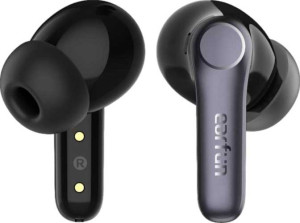
EarFun Air Pro 4 Plus
Oppo Enco Free 4

EarFun Air Pro 4 Plus Oppo Enco Free 4

Overview

Welcome to our in-depth specification comparison between the EarFun Air Pro 4 Plus and the Oppo Enco Free 4. Both earbuds share a strong foundation — IP55 water resistance, active noise cancellation, and a six-microphone setup — but they diverge sharply when it comes to connectivity options, battery endurance, and audio codec support. Read on to discover which of these true wireless earbuds best matches your listening needs.

Common Features

  • Both products use an in-ear fit design.
  • Both products carry an IP55 ingress protection rating.
  • Both products are water resistant.
  • Neither product uses wires or cables.
  • Neither product is a neckband earbud style.
  • Neither product includes wingtips.
  • Neither product features RGB lighting.
  • Both products have stereo speakers.
  • Both products support active noise cancellation (ANC).
  • Both products offer passive noise reduction.
  • Both products have a lowest frequency of 20 Hz and a highest frequency of 20000 Hz.
  • Spatial audio is not supported on either product.
  • Dolby Atmos is not available on either product.
  • A neodymium magnet is not used in either product.
  • Neither product has a solar power battery.
  • Both products have a battery level indicator.
  • Both products have a rechargeable battery.
  • Both products include a USB Type-C port.
  • AAC audio codec is supported on both products.
  • Neither product supports Bluetooth pairing using NFC.
  • Both products can be used wirelessly.
  • aptX Low Latency is not supported on either product.
  • Both products have an ambient sound mode.
  • Both products support fast charging.
  • Neither product can read notifications.
  • Both products have a built-in translator.
  • Both products have a mute function.
  • Both products can be used as a headset.
  • Both products have a control panel placed on the device.
  • Both products have voice prompts.
  • Both products feature 6 microphones.
  • Both products have a noise-canceling microphone.

Main Differences

  • Driver unit size is 10 mm on EarFun Air Pro 4 Plus and 11 mm on Oppo Enco Free 4.
  • Battery life is 12 hours on EarFun Air Pro 4 Plus and 11 hours on Oppo Enco Free 4.
  • Battery life of the charging case is 42 hours on EarFun Air Pro 4 Plus and 34 hours on Oppo Enco Free 4.
  • Battery life with ANC enabled is 8 hours on EarFun Air Pro 4 Plus and 6 hours on Oppo Enco Free 4.
  • Charge time is 1.5 hours on EarFun Air Pro 4 Plus and 0.85 hours on Oppo Enco Free 4.
  • Wireless charging is available on EarFun Air Pro 4 Plus but not on Oppo Enco Free 4.
  • Fast pairing is supported on EarFun Air Pro 4 Plus but not on Oppo Enco Free 4.
  • Bluetooth version is 6 on EarFun Air Pro 4 Plus and 5.4 on Oppo Enco Free 4.
  • LDAC codec support is present on EarFun Air Pro 4 Plus but not available on Oppo Enco Free 4.
  • LDHC codec support is present on Oppo Enco Free 4 but not available on EarFun Air Pro 4 Plus.
  • Bluetooth LE Audio is supported on EarFun Air Pro 4 Plus but not on Oppo Enco Free 4.
  • aptX Adaptive is supported on EarFun Air Pro 4 Plus but not on Oppo Enco Free 4.
  • aptX Lossless is supported on EarFun Air Pro 4 Plus but not on Oppo Enco Free 4.
  • Auracast is supported on EarFun Air Pro 4 Plus but not on Oppo Enco Free 4.
  • Maximum Bluetooth range is 10 m on EarFun Air Pro 4 Plus and 40 m on Oppo Enco Free 4.
  • In-ear/on-ear detection is present on EarFun Air Pro 4 Plus but not available on Oppo Enco Free 4.
Specs Comparison
EarFun Air Pro 4 Plus

EarFun Air Pro 4 Plus

Oppo Enco Free 4

Oppo Enco Free 4

Design:
Fit In-ear In-ear
Ingress Protection (IP) rating IP55 IP55
water resistance Water resistant Water resistant
has no wires or cables
are neckband earbuds
wingtips included
has RGB lighting
has stereo speakers
has UV light
Has a display

In terms of design, the EarFun Air Pro 4 Plus and the Oppo Enco Free 4 are virtually identical across every measured dimension. Both adopt an in-ear fit, go fully wireless with no cables or neckband, carry an IP55 ingress protection rating, and offer stereo audio — with no RGB lighting, UV sanitization, or displays on either side.

The IP55 rating is worth noting for both: it means each earbud is protected against low-pressure water jets from any direction and against dust ingress sufficient for most real-world use — sweat during workouts, light rain, or splashes are all handled confidently. This is a solid mid-tier protection level, though neither reaches the higher IP57 or IP68 standards seen on more rugged alternatives.

Given the complete spec-for-spec parity in this category, the Design group is a tie. Neither product holds any measurable edge here; a buyer's decision will need to hinge entirely on other spec groups such as audio performance, battery life, or feature set.

Sound quality:
has active noise cancellation (ANC)
has passive noise reduction
driver unit size 10 mm 11 mm
lowest frequency 20 Hz 20 Hz
highest frequency 20000 Hz 20000 Hz
supports spatial audio
has Dolby Atmos
has Dirac Virtuo
has a neodymium magnet

Both earbuds share the same frequency response range of 20 Hz to 20 kHz — the full extent of human hearing — and each features both active and passive noise cancellation, meaning neither holds an advantage on paper in terms of noise isolation capability or tonal coverage.

The one measurable difference lies in driver size: the Oppo Enco Free 4 uses an 11 mm driver versus the 10 mm unit in the EarFun Air Pro 4 Plus. A larger driver can, in principle, move more air and produce more authoritative low-end response, but a 1 mm difference is marginal and real-world impact depends heavily on tuning, housing acoustics, and driver quality — none of which are captured here. It is a potential edge for the Enco Free 4, but a modest one that should not be treated as definitive.

Neither model supports spatial audio, Dolby Atmos, or Dirac Virtuo, so users seeking an immersive or cinema-like listening experience will find both options equally limited in that regard. On balance, this group is nearly tied, with the Oppo Enco Free 4 holding a very slight theoretical edge due to its larger driver — though the practical difference is unlikely to be dramatic.

Power:
Battery life 12 hours 11 hours
Battery life of charging case 42 hours 34 hours
Battery life (ANC) 8 hours 6 hours
charge time 1.5 hours 0.85 hours
has wireless charging
Has a solar power battery
has a battery level indicator
has a rechargeable battery

Battery endurance is where the EarFun Air Pro 4 Plus pulls ahead convincingly. It offers 12 hours of playback per charge versus 11 hours for the Oppo Enco Free 4 — a modest gap on its own — but the combined case capacity tells a starker story: 54 hours total for the EarFun against 45 hours for the Oppo. For frequent travelers or users who charge infrequently, that extra buffer is meaningful over the course of a week.

The ANC stamina gap is more pronounced. With noise cancellation active, the EarFun holds up for 8 hours compared to just 6 hours on the Enco Free 4 — a 33% difference that could matter on a long-haul flight or an extended workday. The Oppo partially compensates with a significantly faster charge time of roughly 51 minutes versus 1.5 hours for the EarFun, which is a real practical advantage for users who need a quick top-up before heading out.

The EarFun also supports wireless charging, a convenience feature the Oppo lacks entirely. Weighing everything together, the EarFun Air Pro 4 Plus holds a clear edge in this category — superior total endurance, better ANC runtime, and wireless charging — though the Oppo's faster wired charging keeps it from being a clean sweep.

Connectivity:
has fast pairing
Has USB Type-C
Bluetooth version 6 5.4
has LDAC
has LDHC
has Bluetooth LE Audio
has aptX Adaptive
has aptX Low Latency
has aptX HD
has aptX
has aptX Lossless
has aptX Voice
has Auracast
maximum Bluetooth range 10 m 40 m
supports Bluetooth pairing using NFC
Can be used wirelessly
has AAC

Connectivity is where these two products diverge most sharply. The EarFun Air Pro 4 Plus runs on Bluetooth 6 — the latest generation — and backs it up with an exceptional codec lineup: LDAC, aptX Adaptive, and aptX Lossless are all present, alongside Bluetooth LE Audio and Auracast. For audiophiles or users with high-resolution audio libraries, this stack is genuinely impressive, enabling near-lossless wireless transmission and future-proofing the earbuds for next-generation audio sharing scenarios. Fast pairing further smooths the day-to-day experience.

The Oppo Enco Free 4 operates on Bluetooth 5.4 and supports LDHC — a high-quality codec common in Oppo and OnePlus ecosystems — but lacks LDAC, aptX Adaptive, LE Audio, and Auracast entirely. For users outside the Oppo/OnePlus ecosystem, LDHC offers limited compatibility. The Enco Free 4 does claim a significantly wider Bluetooth range of 40 m versus the EarFun's 10 m, which could be useful in open spaces where the source device stays stationary, though in typical use cases the difference rarely materializes.

The EarFun Air Pro 4 Plus wins this category decisively. Its newer Bluetooth version, richer codec support, LE Audio capability, and fast pairing collectively represent a substantially more versatile and future-ready connectivity package — the Oppo's range advantage is real but insufficient to offset those deficits.

Features:
release date January 2025 April 2025
has ambient sound mode
has in/on-ear detection
Supports fast charging
can read notifications
Has a built-in translator
has a mute function
can be used as a headset
control panel placed on a device
Has voice prompts
travel bag is included
Has an in-line control panel
Has a temperature sensor
Has a built-in camera remote control function

Across the features category, these two earbuds are remarkably well-matched. Both offer ambient sound mode, fast charging, a built-in translator, mute function, voice prompts, on-device controls, and even a travel bag — a checklist that covers the vast majority of what most users would look for in a modern premium wireless earbud.

The only functional difference is in/on-ear detection, which the EarFun Air Pro 4 Plus includes and the Oppo Enco Free 4 does not. This feature automatically pauses playback when an earbud is removed from the ear and resumes when reinserted — a quality-of-life convenience that reduces friction in everyday use, particularly for users who frequently take calls or have brief conversations throughout the day.

It is a slim margin, but the EarFun Air Pro 4 Plus edges ahead in this group purely on the strength of in-ear detection. For users who value seamless, automatic playback management, that single omission on the Oppo side is a tangible daily inconvenience. All other features being equal, the EarFun holds a narrow but clear advantage here.

Microphone:
number of microphones 6 6
has a noise-canceling microphone

On paper, both earbuds are perfectly matched in this category: each features 6 microphones and noise-canceling mic technology. A 6-mic array is a strong configuration for consumer earbuds, typically enabling more sophisticated beamforming and wind noise suppression than the 2- or 4-mic setups found on more budget-oriented options — meaning call quality and voice pickup should be competitive on both devices.

With no differentiating data points available between the two, this group is a clear tie. Users prioritizing call clarity or voice assistant performance cannot use the microphone specs alone to distinguish one product from the other.

Comparison Summary & Verdict

After examining all the specifications, both earbuds prove to be competitive contenders, but they cater to different priorities. The EarFun Air Pro 4 Plus stands out for power users and audiophiles, offering Bluetooth 6 with LDAC, aptX Adaptive, aptX Lossless, and LE Audio support, longer battery life of 12 hours (42 hours with the case), wireless charging, and in-ear detection — making it the stronger choice for those who want cutting-edge connectivity and maximum runtime. The Oppo Enco Free 4, on the other hand, appeals to users who value a faster charge time of just 0.85 hours, a larger 11 mm driver, an impressive 40-meter Bluetooth range, and LDHC codec support. If codec versatility and all-day endurance matter most, go with the EarFun; if quick top-ups and extended wireless range are your priorities, the Oppo is the smarter pick.

EarFun Air Pro 4 Plus
Buy EarFun Air Pro 4 Plus if...

Buy the EarFun Air Pro 4 Plus if you want superior codec support including LDAC, aptX Lossless, and Bluetooth LE Audio, longer overall battery life, wireless charging, and in-ear detection.

Oppo Enco Free 4
Buy Oppo Enco Free 4 if...

Buy the Oppo Enco Free 4 if you prioritize a much faster charge time, a wider Bluetooth range of 40 meters, and LDHC codec support over extended battery endurance.