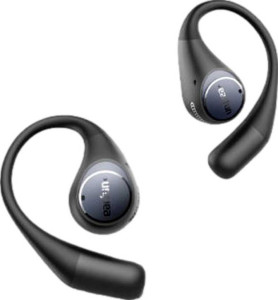
EarFun Clip
EarFun OpenJump

EarFun Clip EarFun OpenJump

Overview

Welcome to our detailed specification comparison between the EarFun Clip and the EarFun OpenJump, two open-ear true wireless earbuds from the same brand that share a surprising amount of DNA yet diverge in meaningful ways. Both are wire-free, support multipoint connectivity, and feature fast charging, but key battlegrounds such as battery life, water resistance, and audio codec support set them apart. Read on to discover which one better suits your lifestyle.

Common Features

  • Both products have an open-ear fit design.
  • Neither product has wires or cables.
  • Neither product is a neckband earbud style.
  • Neither product features RGB lighting.
  • Both products have stereo speakers.
  • Neither product includes a UV light.
  • Neither product has a display.
  • Neither product has active noise cancellation (ANC).
  • Neither product has passive noise reduction.
  • Both products share a lowest frequency of 20 Hz and a highest frequency of 20000 Hz.
  • Neither product supports spatial audio.
  • Neither product has Dolby Atmos or Dirac Virtuo.
  • Neither product uses a neodymium magnet.
  • Both products have a charge time of 1.5 hours.
  • Neither product supports wireless charging.
  • Neither product has a solar power battery.
  • Both products have a battery level indicator.
  • Both products have a rechargeable battery.
  • Both products support fast pairing.
  • Both products have a USB Type-C connector.
  • Neither product supports LDHC, Bluetooth LE Audio, aptX Adaptive, aptX Low Latency, aptX HD, or aptX.
  • Neither product has an ambient sound mode.
  • Neither product has in/on-ear detection.
  • Neither product has a find device feature.
  • Both products support fast charging.
  • Both products support multipoint connection with up to 2 devices.
  • Neither product can read notifications.
  • Both products have a mute function.
  • Both products can be used as a headset.
  • Both products feature a noise-canceling microphone.

Main Differences

  • The ingress protection rating is IP55 on EarFun Clip and IPX7 on EarFun OpenJump.
  • The EarFun Clip is water resistant while the EarFun OpenJump is waterproof.
  • Wingtips are included with the EarFun OpenJump but not with the EarFun Clip.
  • The driver unit size is 10.8 mm on EarFun Clip and 14.2 mm on EarFun OpenJump.
  • Battery life is 7.5 hours on EarFun Clip and 11 hours on EarFun OpenJump.
  • The battery life of the charging case is 22.5 hours on EarFun Clip and 31 hours on EarFun OpenJump.
  • LDAC support is present on EarFun Clip but not available on EarFun OpenJump.
  • A travel bag is included with EarFun Clip but not with EarFun OpenJump.
Specs Comparison
EarFun Clip

EarFun Clip

EarFun OpenJump

EarFun OpenJump

Design:
Fit Open-ear Open-ear
Ingress Protection (IP) rating IP55 IPX7
water resistance Water resistant Waterproof
has no wires or cables
are neckband earbuds
wingtips included
has RGB lighting
has stereo speakers
has UV light
Has a display

Both the EarFun Clip and EarFun OpenJump share the same open-ear, fully wireless form factor — no neckband, no wires, and stereo output on both sides. This makes them direct competitors in the open-ear clip style segment, targeting users who want ambient awareness without sacrificing a cable-free experience.

The most meaningful design differentiator is water resistance. The Clip carries an IP55 rating, meaning it can handle sweat and light splashes from any direction — adequate for workouts and light rain. The OpenJump, however, steps up to IPX7, which means it can survive submersion in up to 1 meter of water for 30 minutes. In practice, this makes the OpenJump significantly more durable for swimming, heavy rain, or accidental drops in water. The second distinction is that the OpenJump includes wingtips for a more secure fit, while the Clip does not — a practical advantage during high-intensity activities where ear stability matters.

The EarFun OpenJump holds a clear edge in this group. Its superior waterproofing and included wingtips make it the more robust and activity-ready option. The Clip is still a capable everyday pair, but if durability and secure fit in demanding conditions are priorities, the OpenJump wins outright.

Sound quality:
has active noise cancellation (ANC)
has passive noise reduction
driver unit size 10.8 mm 14.2 mm
lowest frequency 20 Hz 20 Hz
highest frequency 20000 Hz 20000 Hz
supports spatial audio
has Dolby Atmos
has Dirac Virtuo
has a neodymium magnet

Across most sound quality specs, the EarFun Clip and EarFun OpenJump are identical — both cover the standard 20 Hz–20,000 Hz frequency range, and neither offers ANC, passive noise reduction, spatial audio, or any premium audio processing like Dolby Atmos. For open-ear earbuds, the absence of noise isolation is expected by design, so those omissions are not drawbacks in context.

The one spec that separates them is driver size. The Clip uses a 10.8 mm driver, while the OpenJump steps up to a 14.2 mm driver — a notably larger transducer. In general, a bigger driver moves more air, which tends to translate into stronger low-frequency presence and greater overall loudness potential. For open-ear buds, where bass naturally leaks into the environment, that extra driver area can help compensate for the inherent acoustic losses of the open design.

The EarFun OpenJump has the edge here, strictly on the basis of its larger driver. While driver size alone does not guarantee superior sound — tuning and implementation matter too — it represents a meaningful hardware advantage, particularly for users who prioritize fullness and bass impact from an open-ear form factor.

Power:
Battery life 7.5 hours 11 hours
Battery life of charging case 22.5 hours 31 hours
charge time 1.5 hours 1.5 hours
has wireless charging
Has a solar power battery
has a battery level indicator
has a rechargeable battery

Battery life is where these two diverge most sharply. The EarFun Clip delivers 7.5 hours per charge with 22.5 hours of total case-backed runtime, while the EarFun OpenJump pushes that to 11 hours on the buds and 31 hours total. That gap is substantial — the OpenJump lasts nearly 47% longer per charge, which in practical terms means fewer mid-day top-ups and more confidence heading into long travel days, outdoor events, or back-to-back work sessions without reaching for the case.

Where they are perfectly matched is charge time: both refill in 1.5 hours, and neither offers wireless charging. The presence of a battery level indicator on both models is a small but useful quality-of-life feature that helps avoid unexpected shutdowns.

The EarFun OpenJump wins this category decisively. With meaningfully longer earbud and total runtime at no penalty in recharge speed, it is the stronger choice for users who prioritize endurance.

Connectivity:
has fast pairing
Has USB Type-C
has LDAC
has LDHC
has Bluetooth LE Audio
has aptX Adaptive
has aptX Low Latency
has aptX HD
has aptX
has aptX Lossless
audio latency 50 ms 50 ms
has aptX Voice
has Auracast
maximum Bluetooth range 10 m 10 m
supports Bluetooth pairing using NFC
Can be used wirelessly
has AAC

Connectivity is largely a tie between these two — both support fast pairing, USB-C, wireless operation, a 10 m Bluetooth range, and an identical 50 ms audio latency. Neither supports NFC pairing, aptX in any variant, AAC, or Bluetooth LE Audio, which keeps both products in broadly similar territory for wireless performance.

The single standout differentiator is codec support. The EarFun Clip includes LDAC, Sony's high-resolution wireless codec capable of transmitting up to 990 kbps — roughly three times the data of standard Bluetooth audio. For listeners streaming hi-res audio from compatible Android devices or dedicated DAPs, this is a genuine quality advantage. The EarFun OpenJump lacks LDAC entirely, meaning it is limited to the baseline SBC codec in practice, which is a notable gap for audiophile-leaning users.

The EarFun Clip takes a clear edge here solely on the strength of LDAC. For casual listeners the difference may be subtle, but for anyone invested in high-quality streaming, the Clip's codec support is a meaningful and tangible advantage that the OpenJump simply cannot match.

Features:
release date January 2025 January 2025
has ambient sound mode
has in/on-ear detection
has find device feature
Supports fast charging
multipoint count 2 2
can read notifications
has a mute function
can be used as a headset
control panel placed on a device
Has voice prompts
travel bag is included
Has an in-line control panel
Has a temperature sensor
Has a built-in camera remote control function

Feature parity between the EarFun Clip and EarFun OpenJump is remarkably high in this category. Both support fast charging, multipoint connection to 2 devices simultaneously, on-device controls, voice prompts, a mute function, and headset capability for calls. Multipoint is worth highlighting — being able to stay connected to a phone and laptop at the same time without manual re-pairing is a genuinely useful daily convenience that both models handle equally well.

The only differentiator in this entire group is that the EarFun Clip ships with a travel bag, while the OpenJump does not. It is a minor accessory-level distinction rather than a functional one, but for users who travel frequently or want to keep their case protected in a bag, it is a small practical bonus.

This group is effectively a tie. The Clip earns a marginal nod for the included travel bag, but the functional feature set of both earbuds is identical — neither holds a meaningful advantage over the other here.

Microphone:
has a noise-canceling microphone

With only a single spec in this category, the verdict is straightforward: both the EarFun Clip and EarFun OpenJump feature a noise-canceling microphone. For open-ear earbuds — which by design sit away from the ear canal and are used in environments where ambient sound is ever-present — having mic noise cancellation is particularly relevant. It helps ensure that call recipients hear your voice clearly rather than your surroundings.

This group is a tie. The provided data gives no basis to distinguish one from the other on microphone capability.

Comparison Summary & Verdict

After a thorough look at the specs, both the EarFun Clip and the EarFun OpenJump serve the open-ear market well, but they cater to slightly different users. The EarFun OpenJump pulls ahead for active and outdoor use thanks to its IPX7 waterproof rating, larger 14.2 mm drivers, a longer 11-hour battery life with 31 hours of case backup, and included wingtips for a more secure fit. The EarFun Clip, on the other hand, appeals to audiophiles and frequent travelers with its LDAC high-resolution audio codec support and the convenience of a bundled travel bag, even if its battery life and water resistance fall slightly short. Both charge in just 1.5 hours and support fast charging, so neither will leave you waiting long. Choose based on whether you prioritize audio quality and portability or endurance and ruggedness.

EarFun Clip
Buy EarFun Clip if...

Buy the EarFun Clip if you want LDAC high-resolution audio support and appreciate the added convenience of an included travel bag.

EarFun OpenJump
Buy EarFun OpenJump if...

Buy the EarFun OpenJump if you need a waterproof (IPX7) earbud with longer battery life and a more secure fit thanks to included wingtips.