Ecovacs Deebot T50 Omni
Ecovacs Deebot X8 Pro Omni

Ecovacs Deebot T50 Omni Ecovacs Deebot X8 Pro Omni

Overview

Welcome to our in-depth comparison of the Ecovacs Deebot T50 Omni and the Ecovacs Deebot X8 Pro Omni — two capable robot vacuums from Ecovacs that share a strong feature foundation but diverge in some meaningful ways. In this head-to-head, we examine key battlegrounds including suction power, battery performance, physical dimensions, and smart home compatibility to help you decide which model best fits your home and lifestyle.

Common Features

  • Both products include a HEPA filter.
  • Both products include an allergy filter.
  • Both products work with Alexa.
  • The docking station size is 88984.35 cm³ on both products.
  • Both products support mapping.
  • Both products support no-go zones.
  • Both products support remote smartphone control.
  • Both products have an obstacle sensor.
  • Both products support problem area cleaning.
  • Both products are self-emptying.
  • Both products have carpet detection.
  • Neither product gets stuck.
  • Neither product has a display.
  • Neither product has twin side brushes.
  • Both products include washable filters.
  • Both products automatically adjust their height.
  • Both products use bags.
  • Both products clean all floor types.
  • Both products offer 4 cleaning modes.
  • Both products are capable of mopping.
  • Both products have a dirt sensor.
  • Neither product has UV light.
  • Neither product has a removable battery.

Main Differences

  • Audible noise is 63 dB on Ecovacs Deebot T50 Omni and 65 dB on Ecovacs Deebot X8 Pro Omni.
  • Google Assistant compatibility is available on Ecovacs Deebot T50 Omni but not on Ecovacs Deebot X8 Pro Omni.
  • Weight is 3700 g on Ecovacs Deebot T50 Omni and 4100 g on Ecovacs Deebot X8 Pro Omni.
  • Width is 351.6 mm on Ecovacs Deebot T50 Omni and 353 mm on Ecovacs Deebot X8 Pro Omni.
  • Height is 81 mm on Ecovacs Deebot T50 Omni and 98 mm on Ecovacs Deebot X8 Pro Omni.
  • Thickness is 352.7 mm on Ecovacs Deebot T50 Omni and 351 mm on Ecovacs Deebot X8 Pro Omni.
  • Volume is 10044.75 cm³ on Ecovacs Deebot T50 Omni and 12142.49 cm³ on Ecovacs Deebot X8 Pro Omni.
  • Dustbin capacity is 0.26 l on Ecovacs Deebot T50 Omni and 0.3 l on Ecovacs Deebot X8 Pro Omni.
  • A full dustbin indicator is present on Ecovacs Deebot X8 Pro Omni but not on Ecovacs Deebot T50 Omni.
  • Suction power is 12800 Pa on Ecovacs Deebot T50 Omni and 18000 Pa on Ecovacs Deebot X8 Pro Omni.
  • Battery power is 5200 mAh on Ecovacs Deebot T50 Omni and 6400 mAh on Ecovacs Deebot X8 Pro Omni.
  • Runtime is 175 minutes on Ecovacs Deebot T50 Omni and 145 minutes on Ecovacs Deebot X8 Pro Omni.
  • Charge time is 3.25 hours on Ecovacs Deebot T50 Omni and 4.5 hours on Ecovacs Deebot X8 Pro Omni.
  • Operating power consumption is 75W on Ecovacs Deebot T50 Omni and 45W on Ecovacs Deebot X8 Pro Omni.
Specs Comparison
Ecovacs Deebot T50 Omni

Ecovacs Deebot T50 Omni

Ecovacs Deebot X8 Pro Omni

Ecovacs Deebot X8 Pro Omni

General info:
has HEPA filter
audible noise 63 dB 65 dB
has an allergy filter
compatible with Google Assistant
works with Alexa
release date March 2025 February 2025
weight 3700 g 4100 g
width 351.6 mm 353 mm
height 81 mm 98 mm
thickness 352.7 mm 351 mm
volume 10044.75492 cm³ 12142.494 cm³
docking station size 88984.35 cm³ 88984.35 cm³

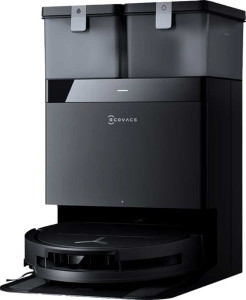
Both robots share a strong filtration foundation, each equipped with a HEPA and allergy filter, making either a solid choice for households with allergy sufferers. They also share the same large docking station footprint (88,984.35 cm³), so neither has an advantage in terms of how much floor space the base will occupy. Alexa voice control is supported by both units as well.

The differences, however, favor the Deebot T50 Omni in several meaningful ways. It operates at 63 dB versus the X8 Pro Omni's 65 dB — a 2 dB gap that, while seemingly small, represents a roughly 25% perceived loudness reduction in real-world use, which matters during nighttime or quiet-hour cleaning. The T50 Omni is also notably more compact: its 81 mm height (versus 98 mm) gives it a better chance of fitting under low-clearance furniture like beds and sofas, and its lower overall volume (~10,045 cm³ vs ~12,142 cm³) means it navigates tighter spaces more easily. The T50 Omni is also lighter at 3,700 g compared to 4,100 g, which is relevant when manually moving or repositioning the unit.

A notable exclusive for the T50 Omni is Google Assistant compatibility, which the X8 Pro Omni lacks entirely. For users embedded in the Google ecosystem, this is a clear functional gap. Overall, based strictly on the general specs provided, the Deebot T50 Omni holds a meaningful edge — it is quieter, more compact, lighter, and offers broader smart home integration.
Features:
has mapping
supports no-go zones
supports a remote smartphone
has an obstacle sensor
has problem area cleaning
is self-emptying
has carpet detection
doesn't get stuck
supports virtual barriers
has route mapping
Has voice prompts
auto docking
has anti-fall sensor
can be scheduled
has a remote control
has water level adjustment
supports Wi-Fi
has mop cleaning
has mop raising
has mop drying

Across the entire features specification group, the Deebot T50 Omni and Deebot X8 Pro Omni are in complete lockstep — every single capability listed is shared identically by both models. This is a rare case of a true feature-for-feature tie at this level of detail.

What makes this parity notable is the sophistication of the shared feature set. Both robots offer a comprehensive autonomous cleaning suite: self-emptying, mop cleaning with raising and drying, carpet detection, no-go zones and virtual barriers, and full route mapping with problem area cleaning. These are not entry-level conveniences — mop raising and drying in particular are hallmarks of premium-tier robots, allowing the unit to handle mixed hard floor and carpet environments without user intervention. The inclusion of anti-fall sensors and anti-stuck logic further reinforces that both are designed for largely unsupervised, whole-home operation.

Since no differentiating features exist within this group, the verdict here is a complete tie. Users prioritizing feature depth can be equally confident in either model — the decision between them should rest on other specification groups such as performance, hardware, or connectivity.

Design:
dustbin capacity 0.26 l 0.3 l
Has a display
has twin side brushes
has included washable filters
automatically adjusts its height
Indicates when full
uses bags

The design specs for these two models are largely aligned, but two differences are worth examining closely. The X8 Pro Omni edges ahead with a slightly larger dustbin capacity — 0.3 l versus 0.26 l on the T50 Omni. While the absolute difference is small, it translates to fewer mid-clean interruptions in high-debris environments, a meaningful consideration for larger homes or pet owners.

More practically significant is the X8 Pro Omni's ability to indicate when the dustbin is full, a feature the T50 Omni lacks. In day-to-day use, this means the X8 Pro Omni can proactively alert users before suction performance degrades, whereas T50 Omni owners would need to check manually or notice a drop in cleaning quality. For a robot designed for autonomous operation, this kind of feedback loop adds genuine convenience.

Both units share the same fundamental design approach — bag-based collection, washable filters, automatic height adjustment, and no display panel — so the overall design philosophy is consistent. Based strictly on this group, the X8 Pro Omni holds a narrow but real advantage, combining slightly greater dustbin capacity with full-bin notification, making it marginally more self-sufficient between maintenance cycles.

Cleaning power:
suction power 12800 Pa 18000 Pa
cleans all floor types
cleaning modes 4 4
mops
has a dirt sensor
has UV light

Suction power is where these two models diverge most dramatically. The X8 Pro Omni delivers 18,000 Pa of suction, compared to 12,800 Pa on the T50 Omni — a gap of over 40%. In practical terms, higher Pascal ratings translate directly to more effective pickup of embedded debris, pet hair, and fine particles from carpets and textured surfaces. For homes with thick-pile rugs or heavy shedding pets, this difference is tangible rather than merely spec-sheet noise.

Everything else in this group is evenly matched. Both robots clean all floor types, offer the same 4 cleaning modes, include a dirt sensor for adaptive intensity adjustments, support mopping, and omit UV sterilization. The dirt sensor is a noteworthy shared strength — it allows both units to automatically concentrate cleaning effort in heavily soiled areas, partially offsetting raw suction differences on hard floors where debris pickup is less demanding.

Still, the single-factor verdict here is clear: the X8 Pro Omni holds a significant edge in cleaning power. Its substantially higher suction rating makes it the stronger performer for carpet-heavy households or anyone dealing with persistent debris, while the T50 Omni remains capable but is outgunned in this specific category.

Power:
battery power 5200 mAh 6400 mAh
runtime 175 min 145 min
charge time 3.25 hours 4.5 hours
operating power consumption 75W 45W
has a removable battery

The power specs here tell a counterintuitive story. Despite carrying a larger battery — 6,400 mAh versus 5,200 mAh — the X8 Pro Omni actually delivers a shorter runtime of 145 minutes, compared to 175 minutes on the T50 Omni. The explanation lies in power consumption: the X8 Pro Omni draws 45W during operation while the T50 Omni consumes 75W. That higher draw on the T50 Omni burns through its smaller battery faster in absolute terms, yet still yields more total cleaning time — suggesting the T50 Omni's efficiency curve is better tuned for sustained runtime despite its heavier power appetite.

Charge time compounds the runtime gap further. The X8 Pro Omni requires 4.5 hours to fully recharge versus 3.25 hours for the T50 Omni. In practical terms, this means the T50 Omni not only runs longer per session but also returns to readiness more quickly — a meaningful advantage for multi-session cleaning days or larger homes that require recharge-and-resume cycles.

Neither unit offers a removable battery, so both are equally constrained when the charge runs out. On balance, the Deebot T50 Omni holds a clear edge in this group: it provides more runtime per charge and recovers faster, making it the more capable option for extended or frequent cleaning sessions despite its smaller battery capacity.

Comparison Summary & Verdict

Both the Ecovacs Deebot T50 Omni and the Ecovacs Deebot X8 Pro Omni deliver a robust, full-featured cleaning experience — sharing self-emptying docking stations, mapping, no-go zones, carpet detection, mopping, and washable filters. However, their differences reveal distinct strengths. The Ecovacs Deebot T50 Omni stands out with a longer runtime of 175 minutes, faster 3.25-hour charging, lower noise at 63 dB, lighter weight, and Google Assistant compatibility. The Ecovacs Deebot X8 Pro Omni counters with a significantly higher 18000 Pa suction power, a larger 0.3 l dustbin with a full indicator, and a bigger 6400 mAh battery — making it the stronger pick for deep-cleaning demanding spaces. Choose based on whether raw cleaning power or efficiency and smart home flexibility matters more to you.

Ecovacs Deebot T50 Omni
Buy Ecovacs Deebot T50 Omni if...

Buy the Ecovacs Deebot T50 Omni if you want a longer runtime, faster charging, quieter operation, and Google Assistant compatibility at a lighter, more compact form factor.

Ecovacs Deebot X8 Pro Omni
Buy Ecovacs Deebot X8 Pro Omni if...

Buy the Ecovacs Deebot X8 Pro Omni if you need superior suction power of 18000 Pa, a larger dustbin with a full indicator, and a bigger battery for tackling heavily soiled or larger floor areas.