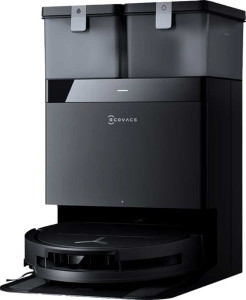
Ecovacs Deebot T50 Omni
Mova P50 Pro Ultra

Ecovacs Deebot T50 Omni Mova P50 Pro Ultra

Overview

Welcome to our in-depth specification comparison between the Ecovacs Deebot T50 Omni and the Mova P50 Pro Ultra, two feature-rich robot vacuums competing in the premium self-emptying segment. Both share a strong foundation of smart mapping, obstacle avoidance, and mopping capabilities, yet they take noticeably different approaches when it comes to suction power, physical dimensions, and overall noise output. Read on to discover which model aligns best with your home and lifestyle.

Common Features

  • Both products include a HEPA filter.
  • Both products include an allergy filter.
  • Both products are compatible with Google Assistant.
  • Both products work with Alexa.
  • Both products support mapping.
  • Both products support no-go zones.
  • Both products support remote smartphone control.
  • Both products have an obstacle sensor.
  • Both products have problem area cleaning.
  • Both products are self-emptying.
  • Both products have carpet detection.
  • Neither product gets stuck during cleaning.
  • Neither product has a display.
  • Neither product has twin side brushes.
  • Both products include washable filters.
  • Both products automatically adjust their height.
  • Neither product indicates when the dustbin is full.
  • Both products use bags.
  • Both products clean all floor types.
  • Both products offer 4 cleaning modes.
  • Both products are capable of mopping.
  • Both products have a dirt sensor.
  • Neither product has UV light.
  • Neither product has a removable battery.
  • Both products have an auto-off feature.

Main Differences

  • Audible noise is 63 dB on Ecovacs Deebot T50 Omni and 74 dB on Mova P50 Pro Ultra.
  • Weight is 3700 g on Ecovacs Deebot T50 Omni and 4600 g on Mova P50 Pro Ultra.
  • Width is 351.6 mm on Ecovacs Deebot T50 Omni and 350 mm on Mova P50 Pro Ultra.
  • Height is 81 mm on Ecovacs Deebot T50 Omni and 103.8 mm on Mova P50 Pro Ultra.
  • Thickness is 352.7 mm on Ecovacs Deebot T50 Omni and 350 mm on Mova P50 Pro Ultra.
  • Volume is 10044.75 cm³ on Ecovacs Deebot T50 Omni and 12715.5 cm³ on Mova P50 Pro Ultra.
  • Docking station size is 88984.35 cm³ on Ecovacs Deebot T50 Omni and 90409.2 cm³ on Mova P50 Pro Ultra.
  • Dustbin capacity is 0.26 l on Ecovacs Deebot T50 Omni and 0.32 l on Mova P50 Pro Ultra.
  • Suction power is 12800 Pa on Ecovacs Deebot T50 Omni and 19000 Pa on Mova P50 Pro Ultra.
  • Battery power is 5200 mAh on Ecovacs Deebot T50 Omni and 6400 mAh on Mova P50 Pro Ultra.
  • Runtime is 175 minutes on Ecovacs Deebot T50 Omni and 170 minutes on Mova P50 Pro Ultra.
  • Charge time is 3.25 hours on Ecovacs Deebot T50 Omni and 3.5 hours on Mova P50 Pro Ultra.
Specs Comparison
Ecovacs Deebot T50 Omni

Ecovacs Deebot T50 Omni

Mova P50 Pro Ultra

Mova P50 Pro Ultra

General info:
has HEPA filter
audible noise 63 dB 74 dB
has an allergy filter
compatible with Google Assistant
works with Alexa
release date March 2025 March 2025
weight 3700 g 4600 g
width 351.6 mm 350 mm
height 81 mm 103.8 mm
thickness 352.7 mm 350 mm
volume 10044.75492 cm³ 12715.5 cm³
docking station size 88984.35 cm³ 90409.2 cm³

Both the Ecovacs Deebot T50 Omni and the Mova P50 Pro Ultra share a strong baseline of smart home compatibility — each supports Google Assistant and Alexa — and both carry HEPA and allergy filtration, making either a viable choice for allergy-sensitive households. Their footprints are nearly identical in diameter (~351 mm), so neither will have a meaningful edge fitting into tight floor spaces or docking areas.

The most significant differentiator in this group is operating noise. The T50 Omni runs at 63 dB versus the Mova's 74 dB — an 11 dB gap that is not subtle. Because the decibel scale is logarithmic, 74 dB is perceived as roughly twice as loud as 63 dB in practice. This matters considerably if you run the robot while working from home, during naps, or in quiet environments. Equally notable is body height: the T50 Omni's 81 mm profile versus the Mova's 103.8 mm means the Ecovacs can slip under low-clearance furniture like beds and sofas that the Mova simply cannot reach. The T50 Omni is also 900 g lighter (3,700 g vs 4,600 g), which makes it easier to lift and reposition manually.

In this general info category, the Ecovacs Deebot T50 Omni holds a clear advantage. Its significantly quieter operation, lower chassis height, and lighter weight translate into a more versatile and less intrusive daily-use experience — without sacrificing any of the smart home integrations or filtration capabilities that the Mova also offers.

Features:
has mapping
supports no-go zones
supports a remote smartphone
has an obstacle sensor
has problem area cleaning
is self-emptying
has carpet detection
doesn't get stuck
supports virtual barriers
has route mapping
Has voice prompts
auto docking
has anti-fall sensor
can be scheduled
has a remote control
has water level adjustment
supports Wi-Fi
has mop cleaning
has mop raising
has mop drying

Across all 20 features in this group, the Ecovacs Deebot T50 Omni and the Mova P50 Pro Ultra are in complete lockstep — every single capability is present on both machines. This is a notably rich shared feature set: both robots offer multi-room mapping with no-go zones and virtual barriers, full smartphone remote control, obstacle sensing, and anti-fall protection. For day-to-day autonomy, they both handle auto docking, scheduled cleaning, and self-emptying, meaning either robot can run largely unsupervised for extended periods.

On the mopping side, both units go beyond basic wet mopping by adding carpet detection, mop raising, and mop drying — a trifecta that matters significantly in mixed-floor homes. Mop raising prevents the wet pad from dragging across rugs, carpet detection triggers suction adjustments automatically, and mop drying reduces the risk of mildew buildup on the pad inside the dock. Water level adjustment gives users additional control over mopping intensity depending on floor type or soil level.

This group is a definitive tie. There is not a single feature advantage for either product here — the decision between the two will have to rest entirely on other specification groups such as cleaning performance, battery life, or hardware design.

Design:
dustbin capacity 0.26 l 0.32 l
Has a display
has twin side brushes
has included washable filters
automatically adjusts its height
Indicates when full
uses bags

The design specs for these two robots are nearly identical, with one meaningful exception: the Mova P50 Pro Ultra has a 0.32 L dustbin compared to the Ecovacs Deebot T50 Omni's 0.26 L. That 23% difference in onboard bin capacity matters most in self-emptying robots not because users are manually emptying the bin frequently, but because a larger bin provides a longer buffer if the dock is unavailable or the robot completes a long run before returning. In heavy-debris households — pets, high foot traffic — the Mova's extra headroom reduces the risk of mid-clean overflow.

Everything else in this group is shared ground. Both robots use bagged collection systems at the dock, include washable filters, automatically adjust their height to transition between floor surfaces, and lack an onboard display or a bin-full indicator on the robot itself. The absence of a bin-full alert on either unit is a minor limitation, though it is largely offset by the self-emptying dock handling debris management automatically.

The Mova P50 Pro Ultra holds a narrow edge in this category purely on dustbin volume. For most users the difference will be inconsequential in daily use, but in larger homes or pet-heavy environments, the extra capacity provides a modest but real practical advantage.

Cleaning power:
suction power 12800 Pa 19000 Pa
cleans all floor types
cleaning modes 4 4
mops
has a dirt sensor
has UV light

Suction power is where this comparison becomes most consequential, and the gap here is substantial. The Mova P50 Pro Ultra delivers 19,000 Pa of suction against the Ecovacs Deebot T50 Omni's 12,800 Pa — a difference of nearly 50%. In practical terms, higher Pascal ratings translate directly into the robot's ability to lift heavier debris, pull embedded particles from carpet fibers, and maintain effective suction across longer cleaning runs. For homes with thick-pile rugs, pet hair, or significant debris loads, this gap is genuinely meaningful rather than a purely spec-sheet distinction.

Where the two machines converge, the picture is straightforward: both clean all floor types, both mop, both include a dirt sensor for automatically intensifying cleaning in soiled zones, and both offer 4 cleaning modes. Neither unit features UV sterilization, so hygiene-focused buyers relying on that capability will find no advantage on either side.

For this group, the Mova P50 Pro Ultra has a clear edge on raw cleaning power. The T50 Omni's 12,800 Pa is a competitive figure in its own right and will handle typical household conditions capably, but users who prioritize maximum suction — particularly for carpeted or pet-heavy homes — will find the Mova's significantly higher output a compelling differentiator.

Power:
battery power 5200 mAh 6400 mAh
runtime 175 min 170 min
charge time 3.25 hours 3.5 hours
has a removable battery
has auto-off

The power specs here tell an interesting story. The Mova P50 Pro Ultra carries a noticeably larger 6,400 mAh battery versus the Ecovacs Deebot T50 Omni's 5,200 mAh — a 23% capacity advantage. Yet despite this, the T50 Omni achieves a marginally longer runtime of 175 minutes compared to the Mova's 170 minutes. This implies the Ecovacs is the more energy-efficient machine, squeezing more cleaning time out of fewer milliamp-hours. For users, the practical takeaway is that both robots offer roughly equivalent real-world coverage per charge, with neither holding a meaningful runtime edge in typical use.

On recharging, the T50 Omni also has a slight advantage, returning to full charge in 3.25 hours versus the Mova's 3.5 hours. In absolute terms the 15-minute difference is minor, but combined with the efficiency finding, it reinforces the picture of the Ecovacs doing more with less. Both robots share auto-off functionality and neither offers a removable battery, which is standard for this product category.

This group is effectively a narrow edge for the Ecovacs Deebot T50 Omni. While the Mova's larger battery capacity looks impressive on paper, the T50 Omni converts its smaller pack into slightly longer runtime and faster charging — making it the more practically efficient option in daily power terms.

Comparison Summary & Verdict

After reviewing every specification, a clear picture emerges for each product. The Ecovacs Deebot T50 Omni stands out for households that value a quieter cleaning experience at just 63 dB, a slimmer 81 mm profile for navigating under low furniture, and a lighter 3700 g build that is easier to handle. It also edges ahead with a slightly longer 175-minute runtime and a faster 3.25-hour charge time. The Mova P50 Pro Ultra, on the other hand, is the stronger choice for users dealing with deeply embedded dirt or pet hair, thanks to its commanding 19000 Pa suction power, larger 0.32-litre dustbin, and bigger 6400 mAh battery. Choose the Ecovacs if quietness and slim design matter most; choose the Mova if raw cleaning performance is your top priority.

Ecovacs Deebot T50 Omni
Buy Ecovacs Deebot T50 Omni if...

Buy the Ecovacs Deebot T50 Omni if you prioritise a quieter operation, a slimmer profile for cleaning under low furniture, and a lighter robot with a faster charge time.

Mova P50 Pro Ultra
Buy Mova P50 Pro Ultra if...

Buy the Mova P50 Pro Ultra if you need maximum suction power, a larger dustbin capacity, and a bigger battery for tackling heavily soiled floors.