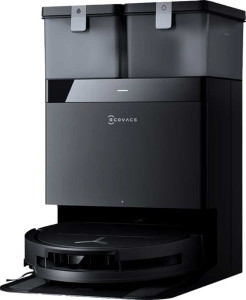
Ecovacs Deebot T50 Omni
Roborock Qrevo L

Ecovacs Deebot T50 Omni Roborock Qrevo L

Overview

Choosing between the Ecovacs Deebot T50 Omni and the Roborock Qrevo L means weighing two highly capable robot vacuums that share a strong common foundation — including HEPA filtration, self-emptying docks, mopping, mapping, and smart home compatibility — while differing meaningfully in areas like suction power, noise level, battery performance, and onboard usability features. This detailed spec comparison breaks down every key metric to help you decide which model best fits your home and lifestyle.

Common Features

  • Both products include a HEPA filter.
  • Both products include an allergy filter.
  • Both products are compatible with Google Assistant.
  • Both products work with Amazon Alexa.
  • Both products have mapping capability.
  • Both products support no-go zones.
  • Both products support remote smartphone control.
  • Both products have an obstacle sensor.
  • Both products support problem area cleaning.
  • Both products are self-emptying.
  • Both products have carpet detection.
  • Neither product gets stuck during operation.
  • Twin side brushes are not present on either product.
  • Both products include washable filters.
  • Both products automatically adjust their height.
  • Both products use bags for dust collection.
  • Both products clean all floor types.
  • Both products are capable of mopping.
  • Both products have a dirt sensor.
  • UV light is not available on either product.
  • The battery is not removable on either product.

Main Differences

  • Audible noise level is 63 dB on Ecovacs Deebot T50 Omni and 45 dB on Roborock Qrevo L.
  • Weight is 3700 g on Ecovacs Deebot T50 Omni and 3900 g on Roborock Qrevo L.
  • Width is 351.6 mm on Ecovacs Deebot T50 Omni and 353 mm on Roborock Qrevo L.
  • Height is 81 mm on Ecovacs Deebot T50 Omni and 96.5 mm on Roborock Qrevo L.
  • Thickness is 352.7 mm on Ecovacs Deebot T50 Omni and 350 mm on Roborock Qrevo L.
  • Volume is 10044.75 cm³ on Ecovacs Deebot T50 Omni and 11922.58 cm³ on Roborock Qrevo L.
  • Docking station size is 88984.35 cm³ on Ecovacs Deebot T50 Omni and 85936.02 cm³ on Roborock Qrevo L.
  • Dustbin capacity is 0.26 l on Ecovacs Deebot T50 Omni and 0.27 l on Roborock Qrevo L.
  • A display is present on Roborock Qrevo L but not on Ecovacs Deebot T50 Omni.
  • A full-bin indicator is present on Roborock Qrevo L but not on Ecovacs Deebot T50 Omni.
  • Suction power is 12800 Pa on Ecovacs Deebot T50 Omni and 10000 Pa on Roborock Qrevo L.
  • Battery power is 5200 mAh on Ecovacs Deebot T50 Omni and 6400 mAh on Roborock Qrevo L.
  • Runtime is 175 minutes on Ecovacs Deebot T50 Omni and 180 minutes on Roborock Qrevo L.
  • Charge time is 3.25 hours on Ecovacs Deebot T50 Omni and 2.5 hours on Roborock Qrevo L.
  • Operating power consumption is 75 W on Ecovacs Deebot T50 Omni and 60 W on Roborock Qrevo L.
Specs Comparison
Ecovacs Deebot T50 Omni

Ecovacs Deebot T50 Omni

Roborock Qrevo L

Roborock Qrevo L

General info:
has HEPA filter
audible noise 63 dB 45 dB
has an allergy filter
compatible with Google Assistant
works with Alexa
release date March 2025 April 2025
weight 3700 g 3900 g
width 351.6 mm 353 mm
height 81 mm 96.5 mm
thickness 352.7 mm 350 mm
volume 10044.75492 cm³ 11922.575 cm³
docking station size 88984.35 cm³ 85936.02 cm³

Both the Ecovacs Deebot T50 Omni and the Roborock Qrevo L share a strong baseline for smart-home integration — both support Google Assistant and Alexa, and both include a HEPA-grade allergy filter, meaning neither has an edge on air-quality credentials or voice-control compatibility.

Where the two diverge meaningfully is in noise output and physical profile. The Qrevo L operates at just 45 dB, compared to the T50 Omni's 63 dB — a difference of 18 dB that is not subtle. Because decibels follow a logarithmic scale, 63 dB is perceived as roughly four times louder than 45 dB in real-world listening conditions. For anyone running cleaning cycles during work calls, nap times, or in open-plan living spaces, this gap is genuinely significant. On physical size, the T50 Omni is notably slimmer at 81 mm tall versus the Qrevo L's 96.5 mm, giving it a better chance of fitting under low-clearance furniture like bed frames or sofas. The Qrevo L is slightly heavier (3900 g vs 3700 g) and has a larger overall robot volume, though the difference in footprint (width and thickness) is negligible in practice.

Overall, the Roborock Qrevo L holds a clear advantage in this group primarily due to its dramatically quieter operation, which has a direct, everyday quality-of-life impact. The T50 Omni counters with a slimmer chassis that improves under-furniture reach — a worthwhile edge if low clearance is a priority in your home. Docking station sizes are comparable, with neither offering a compelling footprint advantage.
Features:
has mapping
supports no-go zones
supports a remote smartphone
has an obstacle sensor
has problem area cleaning
is self-emptying
has carpet detection
doesn't get stuck
supports virtual barriers
has route mapping
Has voice prompts
auto docking
has anti-fall sensor
can be scheduled
has a remote control
has water level adjustment
supports Wi-Fi
has mop cleaning
has mop raising
has mop drying

Across all 20 features tracked in this group, the Ecovacs Deebot T50 Omni and the Roborock Qrevo L are in complete lockstep — every capability present on one is present on the other, and neither has a remote control. This is a meaningful baseline to acknowledge: both robots cover the full modern feature set expected of a premium autonomous vacuum-mop hybrid.

The feature combination that matters most here is the trio of mop cleaning, mop raising, and mop drying, shared by both. Mop raising ensures the wet pad lifts automatically when carpet is detected — preventing moisture damage to rugs — while mop drying reduces odor and bacterial buildup between cycles. Paired with self-emptying, auto docking, and scheduling, both units are genuinely hands-off machines capable of running and maintaining themselves for extended periods. The presence of obstacle sensors, anti-fall protection, no-go zones, and virtual barriers further means both handle complex home layouts with comparable sophistication.

This group is a clear tie. There is no feature-based differentiator to separate the two products here — a buyer choosing between them on automation and functionality alone will find identical capability on paper. The decision in this category comes down entirely to how well each robot executes these shared features in practice, which falls outside the scope of these specs.

Design:
dustbin capacity 0.26 l 0.27 l
Has a display
has twin side brushes
has included washable filters
automatically adjusts its height
Indicates when full
uses bags

The design specs for these two robots are largely aligned, with a few targeted differences worth unpacking. Dustbin capacity is essentially identical — 0.26 l for the T50 Omni versus 0.27 l for the Qrevo L — a gap so small it has no practical impact, especially given that both units use bags and are self-emptying, meaning the onboard bin rarely reaches capacity before being cleared automatically.

The more consequential divergence lies in user-facing feedback. The Roborock Qrevo L includes a display and the ability to indicate when the dustbin is full, while the Ecovacs T50 Omni has neither. A physical display provides at-a-glance status without requiring a phone, and a full-bin indicator is a practical safeguard that prevents the robot from continuing to operate at reduced suction efficiency — a real-world nuisance if the unit is running unsupervised. Both robots share automatic height adjustment and washable included filters, which are solid baseline design features that keep long-term maintenance costs down.

The Roborock Qrevo L holds a modest but genuine edge in this group. Its display and full-bin notification add tangible convenience that the T50 Omni simply lacks — particularly relevant for users who prefer not to rely exclusively on a smartphone app to monitor their robot's status.

Cleaning power:
suction power 12800 Pa 10000 Pa
cleans all floor types
mops
has a dirt sensor
has UV light

Suction power is the headline differentiator here. The Ecovacs Deebot T50 Omni delivers 12,800 Pa of suction against the Roborock Qrevo L's 10,000 Pa — a gap of 28% in raw pulling force. In practical terms, higher Pascal ratings translate to more effective pickup of fine dust, pet hair embedded in carpet fibers, and debris lodged in textured flooring. For homes with thick-pile rugs or heavy shedding pets, this difference is noticeable rather than merely theoretical.

Beyond suction, the two robots are evenly matched on every other cleaning-power metric. Both handle all floor types, both mop, and both include a dirt sensor — the latter being a useful feature that triggers more intensive cleaning passes in areas where the sensor detects concentrated soiling, rather than treating the entire floor uniformly. Neither unit includes UV light sanitization, so germ-killing claims are off the table for both.

The Ecovacs Deebot T50 Omni takes a clear edge in this group on the strength of its significantly higher suction output. For hard floors with light debris the advantage is less critical, but on carpets or in high-traffic areas, that additional suction headroom gives the T50 Omni a meaningful lead in raw cleaning performance.

Power:
battery power 5200 mAh 6400 mAh
runtime 175 min 180 min
charge time 3.25 hours 2.5 hours
operating power consumption 75W 60W
has a removable battery

Runtime tells only part of the power story here. The Roborock Qrevo L carries a notably larger 6,400 mAh battery versus the T50 Omni's 5,200 mAh, yet both robots deliver nearly identical cleaning sessions — 180 minutes versus 175 minutes respectively. The reason becomes clear when looking at operating power consumption: the T50 Omni draws 75W during operation compared to the Qrevo L's 60W. In other words, the T50 Omni burns through its smaller battery at a faster rate, and its higher-wattage motor is what ultimately levels the runtime playing field.

Where the efficiency gap becomes more tangible is in charging. The Qrevo L returns to full charge in 2.5 hours, while the T50 Omni requires 3.25 hours — a 45-minute difference. For users who run multiple cleaning cycles per day or rely on a mid-session recharge-and-resume workflow, that faster turnaround has a direct impact on scheduling flexibility. Neither robot offers a removable battery, so charging speed is the only lever available when the unit needs to top up.

The Roborock Qrevo L holds the advantage in this group. Its combination of a larger battery capacity, lower power draw, and significantly faster charging makes it the more efficient and operationally flexible machine — even though real-world runtime ends up nearly equal. The T50 Omni's higher wattage compensates for its smaller battery but at the cost of slower recharging and less energy-efficient operation overall.

Comparison Summary & Verdict

Both robots are premium, feature-rich performers, but they cater to slightly different priorities. The Ecovacs Deebot T50 Omni stands out with its class-leading 12800 Pa suction power and a more compact body volume, making it the stronger pick for deep carpet cleaning and tighter spaces. However, it runs noticeably louder at 63 dB and takes longer to recharge at 3.25 hours. The Roborock Qrevo L counters with a whisper-quiet 45 dB operation, a larger 6400 mAh battery, faster 2.5-hour charging, a built-in display, and a full-bin indicator for added convenience. If raw cleaning muscle is your top concern, the Ecovacs wins; if a quieter, smarter day-to-day experience matters more, the Roborock is the better companion.

Ecovacs Deebot T50 Omni
Buy Ecovacs Deebot T50 Omni if...

Buy the Ecovacs Deebot T50 Omni if maximum suction power is your top priority and you want a lighter robot with a more compact footprint for deep, thorough cleaning sessions.

Roborock Qrevo L
Buy Roborock Qrevo L if...

Buy the Roborock Qrevo L if you value quieter operation, faster recharging, a longer battery runtime, and the added convenience of an onboard display with a full-bin indicator.