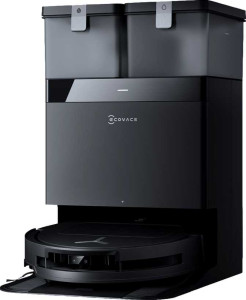
Ecovacs Deebot T50 Pro Omni
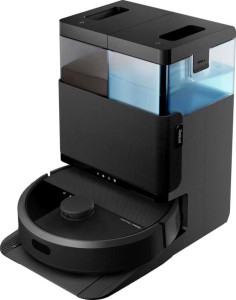
iRobot Roomba Plus 405 (G181)

Ecovacs Deebot T50 Pro Omni iRobot Roomba Plus 405 (G181)

Overview

Welcome to our in-depth comparison between the Ecovacs Deebot T50 Pro Omni and the iRobot Roomba Plus 405 (G181) — two capable robot vacuums that share a surprising amount of common ground, yet diverge in meaningful ways. Both handle all floor types, support mopping, and integrate with smart home platforms, but the real story lies in their self-emptying capability, physical design, and charging and power characteristics. Read on to find out which one fits your home and lifestyle best.

Common Features

  • Both products include a HEPA filter.
  • Both products include an allergy filter.
  • Both products are compatible with Google Assistant.
  • Both products work with Amazon Alexa.
  • Both products support no-go zones.
  • Both products support remote smartphone control.
  • Both products have an obstacle sensor.
  • Neither product gets stuck during cleaning.
  • Both products support virtual barriers.
  • Both products have route mapping.
  • Both products have voice prompts.
  • Both products support auto docking.
  • Neither product has a display.
  • Neither product has twin side brushes.
  • Neither product indicates when the dustbin is full.
  • Both products clean all floor types.
  • Both products offer 4 cleaning modes.
  • Both products are capable of mopping.
  • Both products have a dirt sensor.
  • Neither product has UV light.
  • Both products have an auto-off feature.

Main Differences

  • Audible noise is 63 dB on the Ecovacs Deebot T50 Pro Omni and 60 dB on the iRobot Roomba Plus 405 (G181).
  • Weight is 3700 g on the Ecovacs Deebot T50 Pro Omni and 4100 g on the iRobot Roomba Plus 405 (G181).
  • Width is 351.6 mm on the Ecovacs Deebot T50 Pro Omni and 351 mm on the iRobot Roomba Plus 405 (G181).
  • Height is 81 mm on the Ecovacs Deebot T50 Pro Omni and 106 mm on the iRobot Roomba Plus 405 (G181).
  • Thickness is 352.7 mm on the Ecovacs Deebot T50 Pro Omni and 357 mm on the iRobot Roomba Plus 405 (G181).
  • Volume is 10044.75 cm³ on the Ecovacs Deebot T50 Pro Omni and 13282.54 cm³ on the iRobot Roomba Plus 405 (G181).
  • Docking station size is 88984.35 cm³ on the Ecovacs Deebot T50 Pro Omni and 13282.54 cm³ on the iRobot Roomba Plus 405 (G181).
  • Self-emptying capability is present on the Ecovacs Deebot T50 Pro Omni but not available on the iRobot Roomba Plus 405 (G181).
  • Dustbin capacity is 0.26 l on the Ecovacs Deebot T50 Pro Omni and 0.4 l on the iRobot Roomba Plus 405 (G181).
  • Included washable filters are provided with the Ecovacs Deebot T50 Pro Omni but not with the iRobot Roomba Plus 405 (G181).
  • Automatic height adjustment is present on the Ecovacs Deebot T50 Pro Omni but not available on the iRobot Roomba Plus 405 (G181).
  • Battery power is 5200 mAh on the Ecovacs Deebot T50 Pro Omni and 5000 mAh on the iRobot Roomba Plus 405 (G181).
  • Runtime is 175 minutes on the Ecovacs Deebot T50 Pro Omni and 180 minutes on the iRobot Roomba Plus 405 (G181).
  • Charge time is 3.25 hours on the Ecovacs Deebot T50 Pro Omni and 4 hours on the iRobot Roomba Plus 405 (G181).
  • Operating power consumption is 75W on the Ecovacs Deebot T50 Pro Omni and 33W on the iRobot Roomba Plus 405 (G181).
Specs Comparison
Ecovacs Deebot T50 Pro Omni

Ecovacs Deebot T50 Pro Omni

iRobot Roomba Plus 405 (G181)

iRobot Roomba Plus 405 (G181)

General info:
has HEPA filter
audible noise 63 dB 60 dB
has an allergy filter
compatible with Google Assistant
works with Alexa
release date March 2025 April 2025
weight 3700 g 4100 g
width 351.6 mm 351 mm
height 81 mm 106 mm
thickness 352.7 mm 357 mm
volume 10044.75492 cm³ 13282.542 cm³
docking station size 88984.35 cm³ 13282.542 cm³

Both the Ecovacs Deebot T50 Pro Omni and the iRobot Roomba Plus 405 share a strong common foundation: both carry HEPA and allergy filtration, and both integrate fully with Google Assistant and Alexa, meaning neither has a meaningful edge in smart-home compatibility or air-quality performance on paper.

Where they diverge is in physical design. The T50 Pro Omni is notably slimmer at 81 mm tall versus the Roomba's 106 mm — a 25 mm difference that translates directly into the ability to clean under lower-clearance furniture like beds and sofas. The T50 Pro Omni is also lighter (3700 g vs 4100 g), which matters during manual handling or relocation. On noise, the Roomba edges ahead at 60 dB versus 63 dB — a small but perceptible difference in quiet environments. The T50 Pro Omni's robot footprint is slightly more compact in volume, yet its docking station is dramatically larger (~89,000 cm³ vs ~13,283 cm³), suggesting a feature-rich all-in-one base that demands considerably more floor space.

Overall, the T50 Pro Omni holds the edge on robot form factor — its lower profile gives it a real-world cleaning reach advantage — but buyers with tight floor space should weigh that against its substantially bulkier docking station. The Roomba Plus 405 is the quieter, more space-efficient system when the dock footprint is factored in.

Features:
supports no-go zones
supports a remote smartphone
has an obstacle sensor
is self-emptying
doesn't get stuck
supports virtual barriers
has route mapping
Has voice prompts
auto docking
has anti-fall sensor
can be scheduled
has a remote control
supports Wi-Fi
has mop cleaning
has mop raising
has mop drying

Across the features category, these two robots are remarkably well-matched — both handle no-go zones, virtual barriers, route mapping, obstacle detection, anti-fall sensors, scheduling, auto-docking, Wi-Fi, and a full mopping suite including mop raising and mop drying. For most users, this shared feature set covers the essentials of a modern, autonomous floor-care routine without requiring any manual intervention.

The single differentiator is self-emptying: the T50 Pro Omni supports it, the Roomba Plus 405 does not. In practical terms, this means the Roomba requires the user to manually empty the dustbin after each run, while the T50 Pro Omni can offload debris into its base station automatically — directly reducing the frequency of hands-on maintenance. For allergy sufferers or busy households, this distinction is more than a convenience; it minimizes contact with collected dust and allergens.

The T50 Pro Omni holds a clear edge here on the strength of that one feature alone. Self-emptying is among the most impactful autonomy upgrades in this product category, and its absence on the Roomba Plus 405 is a meaningful gap when the two robots are otherwise functionally identical in this group.

Design:
dustbin capacity 0.26 l 0.4 l
Has a display
has twin side brushes
has included washable filters
automatically adjusts its height
Indicates when full

The design category surfaces a meaningful trade-off between the two robots. The Roomba Plus 405 carries a noticeably larger 0.4 L dustbin compared to the T50 Pro Omni's 0.26 L — a 54% capacity advantage that directly affects how often the bin needs emptying on a single clean. For larger homes or high-debris environments, that gap matters in day-to-day use.

Countering that, the T50 Pro Omni includes washable filters and features automatic height adjustment, neither of which the Roomba Plus 405 offers. Washable filters reduce the ongoing cost of ownership and help maintain suction performance over time, since clogged or degraded filters are a common cause of diminishing cleaning quality. Automatic height adjustment, meanwhile, allows the robot to seamlessly transition between floor surfaces — say, from hard floors to thick rugs — without manual intervention or getting caught on transitions.

On balance, these two products trade punches in this group. The Roomba's larger bin is a tangible practical advantage, but the T50 Pro Omni's washable filters and adaptive height adjustment represent features with lasting, recurring value. Neither robot has a full-spectrum edge here, but users who prioritize low maintenance costs and versatile surface handling will lean toward the T50 Pro Omni, while those focused on less-frequent bin emptying may prefer the Roomba Plus 405.

Cleaning power:
cleans all floor types
cleaning modes 4 4
mops
has a dirt sensor
has UV light

In cleaning power, the spec data tells a straightforward story: these two robots are identical across every measured dimension. Both clean all floor types, offer 4 cleaning modes, include mopping, feature a dirt sensor, and neither offers UV light sanitization.

The dirt sensor is worth highlighting as a shared strength — it allows both robots to detect heavily soiled areas and increase cleaning intensity automatically, rather than applying uniform effort across the entire floor. This translates to more thorough results in high-traffic zones without wasting time on already-clean surfaces. The matching four cleaning modes also suggest comparable flexibility in how each robot approaches different cleaning tasks.

This group is a complete tie. There is no differentiator here, and any purchasing decision will need to rest on the distinctions found in other specification groups — such as design, features, or general build characteristics.

Power:
battery power 5200 mAh 5000 mAh
runtime 175 min 180 min
charge time 3.25 hours 4 hours
operating power consumption 75W 33W
has auto-off

At first glance, the T50 Pro Omni's larger 5200 mAh battery versus the Roomba's 5000 mAh suggests a range advantage — but the runtime figures tell a more nuanced story. The T50 Pro Omni actually delivers 175 minutes of runtime compared to the Roomba's 180 minutes, despite the bigger cell. The explanation lies in operating power consumption: the T50 Pro Omni draws 75W against the Roomba's notably leaner 33W. The T50 Pro Omni's more power-hungry hardware — likely driven by its advanced mopping, drying, and base-station systems — simply burns through its larger battery at a faster rate.

Where the T50 Pro Omni recovers ground is in charge time. At 3.25 hours versus the Roomba's 4 hours, it returns to readiness significantly faster after depletion — a meaningful advantage in homes that run multiple cleaning cycles per day or need a quick turnaround between sessions. Both robots include auto-off, so neither wastes energy sitting idle.

This group is closely contested, but the edge goes to the Roomba Plus 405 on efficiency grounds. Its runtime is marginally longer, and consuming less than half the operating power of the T50 Pro Omni makes it the more energy-conscious choice over time. The T50 Pro Omni's faster recharge partially offsets this, but the Roomba's power efficiency is a sustained, recurring advantage.

Comparison Summary & Verdict

After reviewing all the evidence, both robot vacuums prove themselves as competent, feature-rich cleaners — but they serve different priorities. The Ecovacs Deebot T50 Pro Omni stands out with its self-emptying station, included washable filters, automatic height adjustment, and significantly faster charge time of 3.25 hours, making it a strong choice for hands-off convenience. The iRobot Roomba Plus 405 (G181), on the other hand, offers a larger 0.4 l dustbin, a slimmer power draw of 33W, a slightly longer runtime of 180 minutes, and a quieter operation at 60 dB. If low-maintenance automation is your top priority, the Ecovacs edges ahead. If you prefer a simpler, quieter robot with a roomier dustbin and lower energy consumption, the iRobot is the more practical pick.

Ecovacs Deebot T50 Pro Omni
Buy Ecovacs Deebot T50 Pro Omni if...

Buy the Ecovacs Deebot T50 Pro Omni if you want a self-emptying robot vacuum with faster charging, washable filters, and automatic height adjustment for truly hands-off cleaning.

iRobot Roomba Plus 405 (G181)
Buy iRobot Roomba Plus 405 (G181) if...

Buy the iRobot Roomba Plus 405 (G181) if you prefer a quieter operation, a larger dustbin capacity, lower energy consumption, and a more compact docking station.