Ecovacs Deebot T50 Pro Omni
Narwal Freo Z10 Ultra

Ecovacs Deebot T50 Pro Omni Narwal Freo Z10 Ultra

Overview

Choosing between the Ecovacs Deebot T50 Pro Omni and the Narwal Freo Z10 Ultra is no simple decision, as both robots share a remarkably capable foundation — including self-emptying, mopping, smart mapping, and full smart-home integration. The real competition emerges when examining suction power, battery performance, physical design, and day-to-day usability. Read on to discover which robot vacuum best fits your home and lifestyle.

Common Features

  • Both products include a HEPA filter.
  • Both products include an allergy filter.
  • Both products are compatible with Google Assistant.
  • Both products work with Alexa.
  • Both products support mapping.
  • Both products support no-go zones.
  • Both products support remote smartphone control.
  • Both products have an obstacle sensor.
  • Both products support problem area cleaning.
  • Both products are self-emptying.
  • Both products have carpet detection.
  • Neither product gets stuck during cleaning.
  • Neither product has a display.
  • Both products include washable filters.
  • Both products automatically adjust their height.
  • Both products clean all floor types.
  • Both products can mop.
  • Both products have a dirt sensor.
  • Neither product has UV light.
  • Both products have an auto-off feature.

Main Differences

  • Audible noise is 63 dB on Ecovacs Deebot T50 Pro Omni and 55 dB on Narwal Freo Z10 Ultra.
  • Weight is 3700 g on Ecovacs Deebot T50 Pro Omni and 4500 g on Narwal Freo Z10 Ultra.
  • Width is 351.6 mm on Ecovacs Deebot T50 Pro Omni and 355 mm on Narwal Freo Z10 Ultra.
  • Height is 81 mm on Ecovacs Deebot T50 Pro Omni and 109.6 mm on Narwal Freo Z10 Ultra.
  • Thickness is 352.7 mm on Ecovacs Deebot T50 Pro Omni and 350 mm on Narwal Freo Z10 Ultra.
  • Volume is 10044.75 cm³ on Ecovacs Deebot T50 Pro Omni and 13617.8 cm³ on Narwal Freo Z10 Ultra.
  • Docking station size is 88984.35 cm³ on Ecovacs Deebot T50 Pro Omni and 77223.48 cm³ on Narwal Freo Z10 Ultra.
  • Dustbin capacity is 0.26 l on Ecovacs Deebot T50 Pro Omni and 0.25 l on Narwal Freo Z10 Ultra.
  • Twin side brushes are present on Narwal Freo Z10 Ultra but not available on Ecovacs Deebot T50 Pro Omni.
  • A full-bin indicator is present on Narwal Freo Z10 Ultra but not available on Ecovacs Deebot T50 Pro Omni.
  • Ecovacs Deebot T50 Pro Omni uses bags for dust collection, while Narwal Freo Z10 Ultra does not.
  • Suction power is 15000 Pa on Ecovacs Deebot T50 Pro Omni and 18000 Pa on Narwal Freo Z10 Ultra.
  • Number of cleaning modes is 4 on Ecovacs Deebot T50 Pro Omni and 5 on Narwal Freo Z10 Ultra.
  • Battery power is 5200 mAh on Ecovacs Deebot T50 Pro Omni and 6400 mAh on Narwal Freo Z10 Ultra.
  • Runtime is 175 minutes on Ecovacs Deebot T50 Pro Omni and 150 minutes on Narwal Freo Z10 Ultra.
  • Charge time is 3.25 hours on Ecovacs Deebot T50 Pro Omni and 3.5 hours on Narwal Freo Z10 Ultra.
  • A removable battery is available on Narwal Freo Z10 Ultra but not on Ecovacs Deebot T50 Pro Omni.
Specs Comparison
Ecovacs Deebot T50 Pro Omni

Ecovacs Deebot T50 Pro Omni

Narwal Freo Z10 Ultra

Narwal Freo Z10 Ultra

General info:
has HEPA filter
audible noise 63 dB 55 dB
has an allergy filter
compatible with Google Assistant
works with Alexa
release date March 2025 September 2025
weight 3700 g 4500 g
width 351.6 mm 355 mm
height 81 mm 109.6 mm
thickness 352.7 mm 350 mm
volume 10044.75492 cm³ 13617.8 cm³
docking station size 88984.35 cm³ 77223.4848 cm³

Both the Ecovacs Deebot T50 Pro Omni and the Narwal Freo Z10 Ultra share a strong baseline of smart-home compatibility — both work with Google Assistant and Alexa — and both include a HEPA allergy filter, so neither has an edge on filtration or ecosystem integration. These are table-stakes features at this price tier.

Where the two robots diverge meaningfully is in acoustics and physical profile. The T50 Pro Omni operates at 63 dB, while the Freo Z10 Ultra comes in noticeably quieter at 55 dB. Because the decibel scale is logarithmic, this 8 dB gap translates to the Z10 Ultra being perceived as roughly half as loud in practice — a real advantage if the robot runs during calls, sleep, or quiet work hours. On physical size, the T50 Pro Omni is significantly slimmer at 81 mm tall versus the Z10 Ultra's 109.6 mm, meaning the Ecovacs is far more likely to glide under low-clearance sofas and bed frames. The Z10 Ultra is also heavier at 4500 g versus 3700 g, which matters slightly when manually moving the unit.

The trade-off flips at the docking station: the T50 Pro Omni's base has a larger footprint (~88,984 cm³ vs ~77,223 cm³), so the Freo Z10 Ultra's dock is the more compact floor presence. In summary, the Freo Z10 Ultra holds a clear edge on noise levels, while the T50 Pro Omni wins on robot body clearance and weight — making the Ecovacs the better fit for furniture-dense homes, and the Narwal the stronger choice for noise-sensitive environments.

Features:
has mapping
supports no-go zones
supports a remote smartphone
has an obstacle sensor
has problem area cleaning
is self-emptying
has carpet detection
doesn't get stuck
supports virtual barriers
has route mapping
Has voice prompts
auto docking
has anti-fall sensor
can be scheduled
has a remote control
has water level adjustment
supports Wi-Fi
has mop cleaning
has mop raising
has mop drying

Across the full features spectrum, the Ecovacs Deebot T50 Pro Omni and the Narwal Freo Z10 Ultra are in complete lockstep — every single capability listed is shared by both robots. This includes the high-value autonomy features that define a premium robot vacuum: self-emptying, mop raising, mop drying, and auto docking all confirm that neither unit requires constant manual intervention. Likewise, both handle the full navigation toolkit — mapping, no-go zones, virtual barriers, route mapping, and anti-fall sensors — meaning users get equivalent spatial intelligence and floor safety from either choice.

The mopping suite deserves particular attention: having carpet detection, mop raising, water level adjustment, and mop drying together represents a fully closed-loop wet-cleaning system. Both robots can transition from hard floor to carpet without user intervention, lift the mop pad to avoid soaking rugs, and dry the mop head back at the dock to prevent mildew — a feature set that was rare even in flagship models just two years ago. The absence of a remote control on both units is the one shared omission, though smartphone control via app covers this gap for virtually all real-world use cases.

The verdict for this group is a complete tie. There is no differentiating feature on either side — not a single capability where one robot pulls ahead. Buyers choosing between these two on features alone will find no meaningful distinction, and should weight their decision on the hardware, cleaning performance, and general specs covered in other groups.
Design:
dustbin capacity 0.26 l 0.25 l
Has a display
has twin side brushes
has included washable filters
automatically adjusts its height
Indicates when full
uses bags

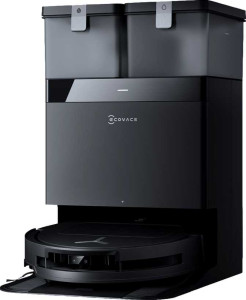
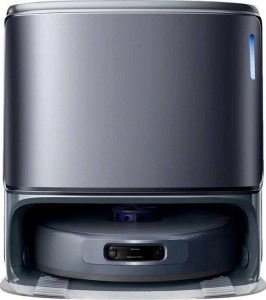
The dustbin capacities are virtually identical — 0.26 L for the T50 Pro Omni versus 0.25 L for the Freo Z10 Ultra — so neither robot holds a practical edge in onboard debris storage. The more consequential design split is in how each handles dust disposal: the T50 Pro Omni uses bags inside its dock, while the Freo Z10 Ultra is bagless. Bags add an ongoing consumable cost but create a sealed, hygienic barrier when emptying — a real advantage for allergy sufferers who want to avoid any dust cloud during maintenance. Bagless systems eliminate that recurring expense but typically require the user to manually clean the dock bin periodically.

Two other distinctions stand out. The Freo Z10 Ultra includes twin side brushes — the T50 Pro Omni has only a single side brush — which generally improves debris funneling along walls and into corners, a meaningful real-world benefit in rooms with lots of skirting board edges. The Z10 Ultra also indicates when full, giving the user a proactive alert before suction performance degrades; the T50 Pro Omni offers no such notification, meaning the user must rely on a cleaning schedule or manual inspection to know when the dock bag needs replacing.

On balance, the Freo Z10 Ultra has the design edge in this group. Its twin side brushes and full-bin indicator are both practical, everyday advantages. The T50 Pro Omni's bag-based system is a legitimate differentiator for dust-sensitive households, but as a standalone design consideration it is more of a preference than a clear performance lead. Both share washable filters and automatic height adjustment, keeping those factors neutral.

Cleaning power:
suction power 15000 Pa 18000 Pa
cleans all floor types
cleaning modes 4 5
mops
has a dirt sensor
has UV light

Suction power is where these two robots part ways most sharply. The Narwal Freo Z10 Ultra delivers 18,000 Pa versus the Ecovacs T50 Pro Omni's 15,000 Pa — a 20% gap that is genuinely noticeable in practice. Higher Pascal ratings translate directly to better pickup of fine debris, pet hair embedded in carpet pile, and heavier particles like cat litter. While both units clean all floor types, the Z10 Ultra's extra headroom in suction means it is better equipped to handle high-pile carpets and homes with shedding pets without needing multiple passes.

The Freo Z10 Ultra also offers 5 cleaning modes to the T50 Pro Omni's 4, providing marginally more granular control over how the robot tackles different surfaces or soil levels on any given run. Both robots share a dirt sensor — which dynamically intensifies cleaning over detected soiled areas — and both mop, meaning the core wet-and-dry workflow is equally available on either platform. The absence of UV light sanitization is a shared omission that places neither at a disadvantage.

For this group, the Freo Z10 Ultra holds a clear cleaning power advantage. Its lead in suction — the single most performance-critical spec for a vacuum — combined with one additional cleaning mode gives it the upper hand for demanding cleaning scenarios. The T50 Pro Omni remains highly capable, but users with carpeted rooms or high pet-hair loads will find the Z10 Ultra's raw power more reassuring.

Power:
battery power 5200 mAh 6400 mAh
runtime 175 min 150 min
charge time 3.25 hours 3.5 hours
has a removable battery
has auto-off

The power specs here tell an intriguing story. The Narwal Freo Z10 Ultra carries a larger battery at 6,400 mAh versus the T50 Pro Omni's 5,200 mAh, yet it delivers a shorter runtime of 150 minutes compared to the Ecovacs's 175 minutes. This apparent paradox is almost certainly explained by the Z10 Ultra's higher suction motor drawing more current — consistent with its 18,000 Pa output noted in cleaning specs. In practical terms, 150 minutes is still sufficient to cover most medium-to-large homes in a single run, but the T50 Pro Omni's greater endurance gives it a tangible edge for larger floor plans or users who run the robot at peak power settings.

Charge times are close but slightly favor the T50 Pro Omni at 3.25 hours versus 3.5 hours for the Z10 Ultra — a minor difference that is unlikely to influence most buying decisions. The more meaningful distinction is the Z10 Ultra's removable battery, a feature the T50 Pro Omni lacks entirely. A swappable battery extends the long-term serviceability of the robot: as the pack degrades over years of charge cycles, the Z10 Ultra can be restored to near-original runtime without replacing the entire unit — a significant advantage for total cost of ownership.

This group produces a nuanced split rather than a clean winner. The T50 Pro Omni has the runtime edge, making it better suited for larger homes or marathon cleaning sessions. The Freo Z10 Ultra counters with its removable battery, which is the more forward-looking advantage for buyers prioritizing longevity. Users cleaning expansive spaces should lean toward the Ecovacs; those thinking in multi-year ownership terms will find the Narwal's serviceability more compelling.

Comparison Summary & Verdict

Both robots are highly capable and share a strong common feature set, but they cater to subtly different priorities. The Narwal Freo Z10 Ultra leads on raw cleaning performance, delivering 18000 Pa of suction, five cleaning modes, twin side brushes, and a removable 6400 mAh battery — all while running noticeably quieter at 55 dB. Its full-bin indicator and bagless design also add practical convenience. The Ecovacs Deebot T50 Pro Omni, meanwhile, wins on endurance and form factor, offering a longer 175-minute runtime, faster charging, a slimmer 81 mm profile, and a lighter 3700 g body that navigates tight spaces with ease. If maximum cleaning power and flexibility matter most, the Narwal is the stronger pick. If extended battery life, a compact build, and quicker charge times are your priorities, the Ecovacs delivers.

Ecovacs Deebot T50 Pro Omni
Buy Ecovacs Deebot T50 Pro Omni if...

Buy the Ecovacs Deebot T50 Pro Omni if you want a longer runtime per charge, a lighter and slimmer robot that fits under low furniture, and a faster charging time.

Narwal Freo Z10 Ultra
Buy Narwal Freo Z10 Ultra if...

Buy the Narwal Freo Z10 Ultra if you prioritize stronger suction power, quieter operation, more cleaning modes, twin side brushes, and the added flexibility of a removable battery.