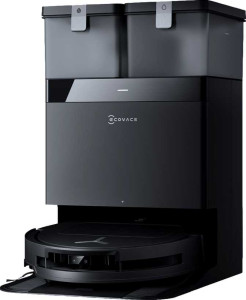
Ecovacs Deebot T50 Pro Omni
Roborock Qrevo L

Ecovacs Deebot T50 Pro Omni Roborock Qrevo L

Overview

When choosing between the Ecovacs Deebot T50 Pro Omni and the Roborock Qrevo L, you are looking at two highly capable robot vacuums that share a strong foundation of smart features yet diverge in meaningful ways. Both offer self-emptying docks, mopping, mapping, and full floor-type coverage, but key battlegrounds emerge around suction power, noise levels, battery performance, and onboard design conveniences. Read on to see how every specification stacks up between these two premium contenders.

Common Features

  • Both products have a HEPA filter.
  • Both products have an allergy filter.
  • Both products are compatible with Google Assistant.
  • Both products work with Alexa.
  • Both products have mapping functionality.
  • Both products support no-go zones.
  • Both products support remote smartphone control.
  • Both products have an obstacle sensor.
  • Both products support problem area cleaning.
  • Both products are self-emptying.
  • Both products have carpet detection.
  • Neither product gets stuck during operation.
  • Neither product has twin side brushes.
  • Both products include washable filters.
  • Both products automatically adjust their height.
  • Both products use bags.
  • Both products clean all floor types.
  • Both products can mop.
  • Both products have a dirt sensor.
  • Neither product has UV light.
  • Neither product has a removable battery.

Main Differences

  • Audible noise is 63 dB on Ecovacs Deebot T50 Pro Omni and 45 dB on Roborock Qrevo L.
  • Weight is 3700 g on Ecovacs Deebot T50 Pro Omni and 3900 g on Roborock Qrevo L.
  • Width is 351.6 mm on Ecovacs Deebot T50 Pro Omni and 353 mm on Roborock Qrevo L.
  • Height is 81 mm on Ecovacs Deebot T50 Pro Omni and 96.5 mm on Roborock Qrevo L.
  • Thickness is 352.7 mm on Ecovacs Deebot T50 Pro Omni and 350 mm on Roborock Qrevo L.
  • Volume is 10044.75 cm³ on Ecovacs Deebot T50 Pro Omni and 11922.58 cm³ on Roborock Qrevo L.
  • Docking station size is 88984.35 cm³ on Ecovacs Deebot T50 Pro Omni and 85936.02 cm³ on Roborock Qrevo L.
  • Dustbin capacity is 0.26 l on Ecovacs Deebot T50 Pro Omni and 0.27 l on Roborock Qrevo L.
  • A display is present on Roborock Qrevo L but not available on Ecovacs Deebot T50 Pro Omni.
  • A full indicator is present on Roborock Qrevo L but not available on Ecovacs Deebot T50 Pro Omni.
  • Suction power is 15000 Pa on Ecovacs Deebot T50 Pro Omni and 10000 Pa on Roborock Qrevo L.
  • Battery power is 5200 mAh on Ecovacs Deebot T50 Pro Omni and 6400 mAh on Roborock Qrevo L.
  • Runtime is 175 min on Ecovacs Deebot T50 Pro Omni and 180 min on Roborock Qrevo L.
  • Charge time is 3.25 hours on Ecovacs Deebot T50 Pro Omni and 2.5 hours on Roborock Qrevo L.
  • Operating power consumption is 75W on Ecovacs Deebot T50 Pro Omni and 60W on Roborock Qrevo L.
Specs Comparison
Ecovacs Deebot T50 Pro Omni

Ecovacs Deebot T50 Pro Omni

Roborock Qrevo L

Roborock Qrevo L

General info:
has HEPA filter
audible noise 63 dB 45 dB
has an allergy filter
compatible with Google Assistant
works with Alexa
release date March 2025 April 2025
weight 3700 g 3900 g
width 351.6 mm 353 mm
height 81 mm 96.5 mm
thickness 352.7 mm 350 mm
volume 10044.75492 cm³ 11922.575 cm³
docking station size 88984.35 cm³ 85936.02 cm³

Both the Ecovacs Deebot T50 Pro Omni and the Roborock Qrevo L share a strong foundation of smart-home compatibility, supporting both Google Assistant and Alexa, and both include a HEPA allergy filter — meaning neither product has an edge on air-quality or ecosystem integration. These are table-stakes features at this price tier.

The most meaningful differentiator in this group is audible noise: the Qrevo L operates at 45 dB versus the T50 Pro Omni's 63 dB. That 18 dB gap is not subtle — on a logarithmic scale, it translates to the Qrevo L sounding roughly four times quieter to the human ear, a genuinely noticeable difference if you run your robot during calls, while sleeping, or in open-plan living spaces. In terms of physical footprint, the two robots are nearly identical in diameter (≈351–353 mm), but the Qrevo L is 15.5 mm taller (96.5 mm vs 81 mm) and slightly heavier (3900 g vs 3700 g), which means the T50 Pro Omni has a better chance of clearing low-clearance furniture like sofas and bed frames.

On balance, the Qrevo L holds a clear edge in noise output — the single most impactful real-world spec in this group — while the T50 Pro Omni's lower profile gives it a practical advantage in homes with furniture close to the floor. If quiet operation is a priority, the Qrevo L wins this category decisively; if under-furniture reach matters more, the T50 Pro Omni's slimmer chassis is the better choice.

Features:
has mapping
supports no-go zones
supports a remote smartphone
has an obstacle sensor
has problem area cleaning
is self-emptying
has carpet detection
doesn't get stuck
supports virtual barriers
has route mapping
Has voice prompts
auto docking
has anti-fall sensor
can be scheduled
has a remote control
has water level adjustment
supports Wi-Fi
has mop cleaning
has mop raising
has mop drying

Across the entire features category, the Ecovacs Deebot T50 Pro Omni and the Roborock Qrevo L are in complete parity — every single capability listed is present on both robots. This includes the full suite of intelligent navigation tools such as mapping, no-go zones, virtual barriers, and route mapping, as well as the automation conveniences users expect at this tier: auto docking, scheduling, and smartphone control.

Notably, both robots also offer the complete mop management trifecta — mop cleaning, mop raising, and mop drying — which is significant in practice. Mop raising ensures the pads lift automatically when carpet is detected, preventing wet streaks on rugs, while self-cleaning and drying of the mop heads reduces bacteria buildup and the need for manual maintenance. The inclusion of self-emptying on both units further reinforces that these are hands-off, premium-tier machines designed to minimize user intervention.

Since no differentiators exist within this spec group, it results in a complete tie. A buyer prioritizing feature breadth alone cannot use this category to distinguish between the two — the decision will need to rest on other specification groups such as cleaning performance, noise, or hardware design.

Design:
dustbin capacity 0.26 l 0.27 l
Has a display
has twin side brushes
has included washable filters
automatically adjusts its height
Indicates when full
uses bags

The design specs between these two robots are largely aligned, but the Roborock Qrevo L pulls ahead on two practical quality-of-life details. It includes a display on the unit itself — something the T50 Pro Omni lacks entirely — which lets users check status, mode, or error information at a glance without reaching for a phone. More meaningfully, the Qrevo L also indicates when the dustbin is full, a convenience the T50 Pro Omni does not offer. On a self-emptying robot this matters less during normal operation, but it becomes relevant when the dock bag itself reaches capacity and the robot's onboard bin starts accumulating debris unnoticed.

Dustbin capacity is functionally identical at 0.26 l vs 0.27 l — a negligible 10 ml difference with no real-world impact. Both robots share washable filters, bag-based dust collection in the dock, and automatic height adjustment, so the core maintenance and adaptability experience is equivalent across both units.

The Roborock Qrevo L holds a modest but clear edge in this category, owing entirely to its onboard display and full-bin indicator. Neither feature is transformative, but together they reduce the friction of day-to-day ownership — particularly in households where the robot runs autonomously and users want passive status awareness without opening an app.

Cleaning power:
suction power 15000 Pa 10000 Pa
cleans all floor types
mops
has a dirt sensor
has UV light

Suction power is where these two robots diverge most sharply. The Ecovacs Deebot T50 Pro Omni delivers 15000 Pa of suction versus the Roborock Qrevo L's 10000 Pa — a 50% increase in rated suction force. In practice, higher Pascal ratings translate to more effective pickup of embedded debris, pet hair tangled in carpet fibers, and fine particulate on hard floors. For households with heavy-shedding pets, thick-pile rugs, or high foot traffic, this gap is genuinely meaningful rather than a spec-sheet abstraction.

Outside of suction, the two robots are evenly matched across every other cleaning power metric: both handle all floor types, both mop, and both use dirt sensors to detect and concentrate cleaning effort on heavily soiled areas. Neither includes UV light sanitization, so there is no hygiene-related differentiator to consider here.

The T50 Pro Omni holds a clear and significant edge in this category. With all other cleaning capabilities being identical, the 5000 Pa suction advantage is the dominant factor — making the T50 Pro Omni the stronger choice for users who prioritize raw vacuuming performance, particularly in carpeted or high-debris environments.

Power:
battery power 5200 mAh 6400 mAh
runtime 175 min 180 min
charge time 3.25 hours 2.5 hours
operating power consumption 75W 60W
has a removable battery

The power specs here tell an interesting story. The Roborock Qrevo L carries a noticeably larger battery — 6400 mAh vs 5200 mAh — yet both robots deliver nearly identical runtimes of 180 min vs 175 min. The explanation lies in operating power consumption: the T50 Pro Omni draws 75W during use compared to the Qrevo L's 60W. In other words, the T50 Pro Omni burns through energy at a faster rate, which offsets its smaller battery and brings the two robots to near-parity in actual cleaning duration. For most homes, five minutes of runtime difference is inconsequential.

Where the gap becomes more tangible is charge time. The Qrevo L returns to full charge in 2.5 hours, while the T50 Pro Omni requires 3.25 hours — a 45-minute difference. For users who run cleaning cycles multiple times per day, or who need the robot ready again quickly after a long clean, faster recharge time has genuine practical value. Neither robot has a removable battery, so in-dock charging is the only option for both.

On balance, the Roborock Qrevo L holds the edge in this category. Its larger battery paired with lower power draw results in a more efficient system overall — matching the T50 Pro Omni's runtime while recharging significantly faster. The T50 Pro Omni's higher power consumption is likely a byproduct of its stronger suction motor, suggesting a deliberate engineering trade-off between cleaning force and energy efficiency.

Comparison Summary & Verdict

After reviewing all the specifications, each robot stands out in different areas. The Ecovacs Deebot T50 Pro Omni delivers a commanding 15000 Pa of suction power and runs more quietly in the home environment with only 63 dB of noise — making it a strong choice for those who prioritize deep cleaning performance and a slimmer, lower-profile build at just 81 mm tall. The Roborock Qrevo L, on the other hand, excels with a larger 6400 mAh battery, a faster 2.5-hour charge time, lower power consumption, and added usability perks like an onboard display and a full-bin indicator. If raw suction and a compact height are your top priorities, the Ecovacs Deebot T50 Pro Omni is the better fit. If you value longer-lasting battery convenience, smarter status feedback, and quieter operation, the Roborock Qrevo L is the more practical everyday companion.

Ecovacs Deebot T50 Pro Omni
Buy Ecovacs Deebot T50 Pro Omni if...

Buy the Ecovacs Deebot T50 Pro Omni if you want maximum suction power at 15000 Pa and a slimmer robot that fits under lower furniture at just 81 mm tall.

Roborock Qrevo L
Buy Roborock Qrevo L if...

Buy the Roborock Qrevo L if you prefer a larger battery with faster 2.5-hour charging, quieter 45 dB operation, and the added convenience of an onboard display with a full-bin indicator.