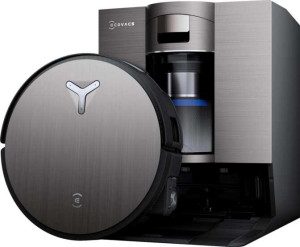
Ecovacs Deebot X11 OmniCyclone
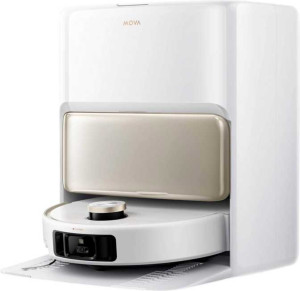
Mova V50 Ultra

Ecovacs Deebot X11 OmniCyclone Mova V50 Ultra

Overview

When choosing between the Ecovacs Deebot X11 OmniCyclone and the Mova V50 Ultra, two capable robot vacuums go head-to-head on some genuinely competitive ground. Both share an impressive foundation of smart navigation, allergy-friendly filtration, and self-emptying convenience, yet they diverge meaningfully on key performance metrics like suction power, noise levels, runtime, and energy efficiency. This side-by-side comparison breaks down exactly where each model leads and where it falls short, helping you make the most informed choice for your home.

Common Features

  • Both products include a HEPA filter.
  • Both products have an allergy filter.
  • Both products are compatible with Google Assistant.
  • Both products work with Alexa.
  • Both products come with a 1-year warranty.
  • Both products support no-go zones.
  • Both products support remote smartphone control.
  • Both products have an obstacle sensor.
  • Both products are self-emptying.
  • Neither product gets stuck during operation.
  • Both products support virtual barriers.
  • Both products have route mapping.
  • Both products have voice prompts.
  • Both products have a dustbin capacity of 0.3 l.
  • Neither product has a display.
  • Neither product has twin side brushes.
  • Both products include washable filters.
  • Both products automatically adjust their height.
  • Neither product indicates when the dustbin is full.
  • Both products clean all floor types.
  • Both products offer 4 cleaning modes.
  • Both products support mopping.
  • Neither product has UV light.
  • Both products have a battery power of 6400 mAh.
  • Both products have an auto-off feature.

Main Differences

  • Audible noise is 65.7 dB on Ecovacs Deebot X11 OmniCyclone and 70 dB on Mova V50 Ultra.
  • Weight is 5000 g on Ecovacs Deebot X11 OmniCyclone and 4600 g on Mova V50 Ultra.
  • Width is 353 mm on Ecovacs Deebot X11 OmniCyclone and 350 mm on Mova V50 Ultra.
  • Height is 98 mm on Ecovacs Deebot X11 OmniCyclone and 89.5 mm on Mova V50 Ultra.
  • Thickness is 351 mm on Ecovacs Deebot X11 OmniCyclone and 350 mm on Mova V50 Ultra.
  • Volume is 12142.494 cm³ on Ecovacs Deebot X11 OmniCyclone and 10963.75 cm³ on Mova V50 Ultra.
  • Estimated empty time is 150 days on Ecovacs Deebot X11 OmniCyclone and 75 days on Mova V50 Ultra.
  • Docking station size is 87113.1 cm³ on Ecovacs Deebot X11 OmniCyclone and 90409.2 cm³ on Mova V50 Ultra.
  • Suction power is 19500 Pa on Ecovacs Deebot X11 OmniCyclone and 24000 Pa on Mova V50 Ultra.
  • A dirt sensor is present on Ecovacs Deebot X11 OmniCyclone but not available on Mova V50 Ultra.
  • Runtime is 200 min on Ecovacs Deebot X11 OmniCyclone and 220 min on Mova V50 Ultra.
  • Charge time is 3 hours on Ecovacs Deebot X11 OmniCyclone and 4 hours on Mova V50 Ultra.
  • Operating power consumption is 110W on Ecovacs Deebot X11 OmniCyclone and 38W on Mova V50 Ultra.
Specs Comparison
Ecovacs Deebot X11 OmniCyclone

Ecovacs Deebot X11 OmniCyclone

Mova V50 Ultra

Mova V50 Ultra

General info:
has HEPA filter
audible noise 65.7 dB 70 dB
has an allergy filter
compatible with Google Assistant
works with Alexa
release date September 2025 June 2025
weight 5000 g 4600 g
width 353 mm 350 mm
height 98 mm 89.5 mm
thickness 351 mm 350 mm
volume 12142.494 cm³ 10963.75 cm³
warranty period 1 years 1 years
estimated empty time 150 days 75 days
docking station size 87113.1 cm³ 90409.2 cm³

At a high level, the Ecovacs Deebot X11 OmniCyclone and the Mova V50 Ultra share a strong foundation: both carry HEPA and allergy filters, support Google Assistant and Alexa, and come with a 1-year warranty. For most users, these shared features mean neither robot has an edge in smart-home compatibility or air filtration capability.

Where the two diverge meaningfully is in noise, size, and autonomy. The X11 OmniCyclone registers at 65.7 dB versus the V50 Ultra's 70 dB — a difference of roughly 4.3 dB that, in practice, translates to the X11 sounding noticeably quieter during a cleaning cycle, which matters for homes with light sleepers, pets, or open-plan work-from-home setups. The X11 is also slightly larger and heavier (5000 g vs. 4600 g; 98 mm tall vs. 89.5 mm), meaning the V50 Ultra has a marginally lower profile that may allow it to slip under more furniture. The X11's docking station, however, is smaller (87,113 cm³ vs. 90,409 cm³), so it takes up less floor footprint at its base.

The most impactful differentiator for day-to-day convenience is the dust-bin emptying cycle: the X11 OmniCyclone is estimated to go 150 days between empties, compared to just 75 days for the V50 Ultra — exactly double the hands-off period. For users who prioritize true ″set and forget″ maintenance, this gives the X11 OmniCyclone a clear practical edge, outweighing the V50 Ultra's minor advantages in weight and low-profile height.
Features:
supports no-go zones
supports a remote smartphone
has an obstacle sensor
is self-emptying
doesn't get stuck
supports virtual barriers
has route mapping
Has voice prompts
auto docking
has anti-fall sensor
can be scheduled
has a remote control
supports Wi-Fi
has mop cleaning
has mop raising
has mop drying

Across the entire features category, the Ecovacs Deebot X11 OmniCyclone and the Mova V50 Ultra are in complete lockstep — every single capability listed is present on both robots. From the essentials like Wi-Fi connectivity, scheduling, and auto docking, to the more sophisticated additions like route mapping, obstacle sensing, and anti-fall protection, neither machine is missing anything the other has.

Particularly notable is that both robots cover the full mopping workflow: mop cleaning, mop raising, and mop drying are all confirmed on each unit. Mop raising is critical for automatically lifting the mop pad when transitioning to carpeted areas, while mop drying reduces bacterial buildup between sessions — having all three stages means neither robot cuts corners on wet-floor hygiene. Equally, both support no-go zones and virtual barriers, giving users precise control over which areas each robot can or cannot enter.

The verdict here is a complete tie. There is no feature-based reason to choose one over the other — buyers should look to other specification groups, such as suction power, battery life, or the general info differences highlighted earlier, to make their final decision.

Design:
dustbin capacity 0.3 l 0.3 l
Has a display
has twin side brushes
has included washable filters
automatically adjusts its height
Indicates when full

The design specifications for the Ecovacs Deebot X11 OmniCyclone and the Mova V50 Ultra are identical across every measured dimension. Both robots carry a 0.3-liter dustbin, include washable filters, and automatically adjust their height to handle different floor surfaces — and neither features a display or twin side brushes.

The shared automatic height adjustment is worth calling out: it allows each robot to seamlessly transition between hard floors and low-pile carpets without manual intervention, which is a meaningful convenience in mixed-flooring homes. The washable filter inclusion is a long-term cost saver on both units, eliminating the need for frequent filter replacements. The absence of a full-bin indicator on either model is a minor limitation, though in practice it is largely offset by the self-emptying docking stations both robots use.

This group results in another complete tie — there is no design-based differentiator between the two. As with the features category, buyers will need to weigh specs from other groups, particularly the autonomy and noise differences identified in the general info section, to find meaningful separation between these two robots.

Cleaning power:
suction power 19500 Pa 24000 Pa
cleans all floor types
cleaning modes 4 4
mops
has a dirt sensor
has UV light

Cleaning power is where the two robots finally show a meaningful hardware gap. The Mova V50 Ultra delivers 24,000 Pa of suction against the Ecovacs Deebot X11 OmniCyclone's 19,500 Pa — a difference of roughly 23%. In practical terms, higher Pascal ratings translate to stronger pickup of fine dust, pet hair embedded in carpet, and debris lodged in floor crevices. For households with thick rugs, heavy shedding pets, or high-traffic areas, that gap is tangible rather than merely theoretical.

The trade-off comes in smart dirt detection. The X11 OmniCyclone includes a dirt sensor that the V50 Ultra lacks entirely. A dirt sensor allows the robot to automatically slow down and increase suction intensity over visibly soiled patches, effectively allocating cleaning effort where it is most needed rather than treating every surface uniformly. This partially offsets the raw suction deficit — a smarter clean can compensate for fewer Pascals in many everyday scenarios. Both robots share 4 cleaning modes, clean all floor types, and include mopping, so neither has a structural advantage in versatility or coverage.

On balance, the Mova V50 Ultra holds the edge in raw cleaning power, making it the stronger choice for homes with demanding debris loads. The X11 OmniCyclone's dirt sensor is a genuine differentiator for adaptive cleaning efficiency, but for users who prioritize maximum suction above all else, the V50 Ultra's 24,000 Pa rating is the decisive figure in this category.

Power:
battery power 6400 mAh 6400 mAh
runtime 200 min 220 min
charge time 3 hours 4 hours
operating power consumption 110W 38W
has auto-off

Both robots draw from an identical 6,400 mAh battery, yet they tell very different stories with it. The Mova V50 Ultra squeezes out 220 minutes of runtime versus the Ecovacs Deebot X11 OmniCyclone's 200 minutes — a 10% advantage that, for larger homes, could be the difference between completing a full clean in one pass or requiring an interim recharge. The explanation for this gap lies directly in operating power consumption: the X11 draws 110W during operation compared to the V50 Ultra's remarkably lean 38W, meaning the X11 burns through the shared battery capacity nearly three times faster.

The recharge picture, however, flips the advantage. The X11 OmniCyclone recovers in 3 hours, while the V50 Ultra needs 4 hours to top up — likely a consequence of its more conservative power draw requiring a gentler charging profile. For users running multiple cleaning cycles per day, the X11's faster turnaround reduces total downtime between sessions. Both units include auto-off, ensuring neither wastes energy sitting idle after a cycle completes.

The standout figure in this group is the V50 Ultra's 38W operating consumption — a significant efficiency advantage that directly funds its longer runtime and will also result in lower electricity costs over time. Overall, the Mova V50 Ultra has the edge in power efficiency and runtime, making it the stronger choice for larger spaces or users prioritizing energy-conscious operation, while the X11 OmniCyclone's faster charge time suits those who need quick turnarounds.

Comparison Summary & Verdict

Having examined all available specifications, both the Ecovacs Deebot X11 OmniCyclone and the Mova V50 Ultra share the same 6400 mAh battery, 0.3 l dustbin, and an equally capable smart-feature set. The Ecovacs Deebot X11 OmniCyclone distinguishes itself with quieter 65.7 dB operation, a dedicated dirt sensor, a faster 3-hour recharge, and a standout 150-day estimated empty interval that dramatically reduces maintenance effort. The Mova V50 Ultra hits back with a higher 24000 Pa suction power, a longer 220-minute runtime, a slimmer and lighter body, and a remarkably low 38W operating power draw. If a quieter, lower-maintenance robot with smarter floor-sensing is your priority, the Ecovacs Deebot X11 OmniCyclone is the stronger match. If raw cleaning muscle, extended runtime, and energy efficiency matter most, the Mova V50 Ultra is the clear choice.

Ecovacs Deebot X11 OmniCyclone
Buy Ecovacs Deebot X11 OmniCyclone if...

Buy the Ecovacs Deebot X11 OmniCyclone if you prioritize quieter operation, a built-in dirt sensor, faster charging, and a much longer self-empty interval for truly hands-off maintenance.

Mova V50 Ultra
Buy Mova V50 Ultra if...

Buy the Mova V50 Ultra if you need maximum suction power and a longer runtime, and prefer a lighter, slimmer robot that consumes significantly less energy during operation.