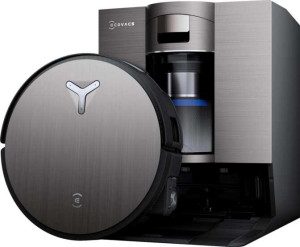
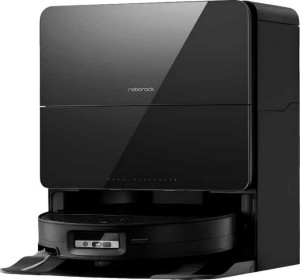
At a high level, the Ecovacs Deebot X11 OmniCyclone and the Roborock Saros 10 share a nearly identical physical footprint — both measure 353 mm wide and weigh exactly 5000 g — and both offer the same smart home ecosystem support (Google Assistant and Alexa) as well as HEPA and allergy filtration. For most users, these shared traits mean the choice won't hinge on fit, weight, or air-quality performance.
The most meaningful physical difference is robot height: the Saros 10 stands just 79.8 mm tall versus the X11's 98 mm, making it roughly 18% slimmer. In practice, that gap can determine whether the robot can slide under low-profile sofas, bed frames, or cabinets — a real-world advantage that a spec table alone undersells. The Saros 10's lower profile also results in a noticeably smaller overall volume (9,859 cm³ vs. 12,142 cm³), giving it a more compact presence. On noise, the X11 edges out the Saros 10 at 65.7 dB versus 68 dB — a small but perceptible difference for those sensitive to robot noise during cleaning cycles.
The starkest differentiator in this group is the estimated dustbin empty interval: the X11 goes an impressive 150 days between empties compared to just 49 days for the Saros 10. For low-maintenance users or larger homes, this is a significant practical advantage — the X11 requires roughly three times less frequent bin attention. Both docking stations are similar in size, so that's a wash. Overall, the Saros 10 has a clear edge for under-furniture reach, while the X11 wins decisively on maintenance convenience and also holds a slight noise advantage.