Ecovacs Deebot X8 Pro Omni
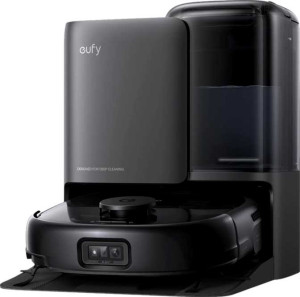
Eufy Omni E25

Ecovacs Deebot X8 Pro Omni Eufy Omni E25

Overview

Choosing between the Ecovacs Deebot X8 Pro Omni and the Eufy Omni E25 is no simple task, as both robot vacuums bring a compelling mix of smart navigation, mopping ability, and allergen filtration to the table. Yet beneath their shared features lie meaningful differences in autonomy, battery performance, suction power, and physical footprint that could make one a far better fit for your home than the other. Read on as we compare every specification side by side.

Common Features

  • Both products include a HEPA filter.
  • Both products include an allergy filter.
  • Both products work with Alexa.
  • The warranty period is 1 year on both products.
  • The estimated empty time is 75 days on both products.
  • Both products support no-go zones.
  • Both products support remote smartphone control.
  • Both products have an obstacle sensor.
  • Neither product gets stuck during operation.
  • Both products support virtual barriers.
  • Both products have route mapping.
  • Both products have voice prompts.
  • Both products feature auto docking.
  • The dustbin capacity is 0.3 l on both products.
  • Neither product has a display.
  • Neither product has twin side brushes.
  • Both products clean all floor types.
  • Both products offer 4 cleaning modes.
  • Both products are capable of mopping.
  • Both products have a dirt sensor.
  • Neither product has UV light.

Main Differences

  • Audible noise is 65 dB on Ecovacs Deebot X8 Pro Omni and 60 dB on Eufy Omni E25.
  • Google Assistant compatibility is present on Eufy Omni E25 but not available on Ecovacs Deebot X8 Pro Omni.
  • Weight is 4100 g on Ecovacs Deebot X8 Pro Omni and 1500 g on Eufy Omni E25.
  • Width is 353 mm on Ecovacs Deebot X8 Pro Omni and 327 mm on Eufy Omni E25.
  • Height is 98 mm on Ecovacs Deebot X8 Pro Omni and 111 mm on Eufy Omni E25.
  • Thickness is 351 mm on Ecovacs Deebot X8 Pro Omni and 346 mm on Eufy Omni E25.
  • Volume is 12142.494 cm³ on Ecovacs Deebot X8 Pro Omni and 12558.762 cm³ on Eufy Omni E25.
  • Docking station size is 88984.35 cm³ on Ecovacs Deebot X8 Pro Omni and 74167.524 cm³ on Eufy Omni E25.
  • Self-emptying functionality is present on Ecovacs Deebot X8 Pro Omni but not available on Eufy Omni E25.
  • Washable filters are included with Ecovacs Deebot X8 Pro Omni but not with Eufy Omni E25.
  • Automatic height adjustment is present on Ecovacs Deebot X8 Pro Omni but not available on Eufy Omni E25.
  • A full dustbin indicator is present on Ecovacs Deebot X8 Pro Omni but not available on Eufy Omni E25.
  • Suction power is 18000 Pa on Ecovacs Deebot X8 Pro Omni and 20000 Pa on Eufy Omni E25.
  • Battery power is 6400 mAh on Ecovacs Deebot X8 Pro Omni and 5000 mAh on Eufy Omni E25.
  • Runtime is 145 min on Ecovacs Deebot X8 Pro Omni and 180 min on Eufy Omni E25.
  • Charge time is 4.5 hours on Ecovacs Deebot X8 Pro Omni and 4 hours on Eufy Omni E25.
  • Operating power consumption is 45W on Ecovacs Deebot X8 Pro Omni and 33W on Eufy Omni E25.
Specs Comparison
Ecovacs Deebot X8 Pro Omni

Ecovacs Deebot X8 Pro Omni

Eufy Omni E25

Eufy Omni E25

General info:
has HEPA filter
audible noise 65 dB 60 dB
has an allergy filter
compatible with Google Assistant
works with Alexa
release date February 2025 April 2025
weight 4100 g 1500 g
width 353 mm 327 mm
height 98 mm 111 mm
thickness 351 mm 346 mm
volume 12142.494 cm³ 12558.762 cm³
warranty period 1 years 1 years
estimated empty time 75 days 75 days
docking station size 88984.35 cm³ 74167.524 cm³

Both the Ecovacs Deebot X8 Pro Omni and the Eufy Omni E25 share a strong filtration foundation, each equipped with a HEPA allergy filter, making either a solid choice for allergy-sensitive households. They also match on 1-year warranty and an identical 75-day estimated dustbin empty cycle, so neither holds an advantage in those areas. Smart home integration is where the first real split appears: the E25 supports both Google Assistant and Alexa, while the X8 Pro Omni is limited to Alexa only — a meaningful disadvantage if your home runs on Google's ecosystem.

On acoustics, the E25 operates at 60 dB versus the X8 Pro Omni's 65 dB — a 5 dB gap that, due to the logarithmic nature of sound, translates to the E25 being perceived as noticeably quieter in practice, which matters for households that run cleaning cycles during work calls or while children sleep. The robot units themselves are comparable in footprint, but the X8 Pro Omni's docking station is substantially larger at 88,984 cm³ compared to the E25's 74,167 cm³, meaning the Ecovacs base demands considerably more floor space — a real consideration in tighter living areas.

Perhaps the most striking general difference is weight: the X8 Pro Omni tips the scale at 4,100 g, nearly three times the E25's 1,500 g. For a robot vacuum this affects how easily it self-recovers from obstacles and how much strain is placed on internal drive components over time. Overall in this category, the Eufy Omni E25 holds a clear edge — it is quieter, lighter, compatible with a broader range of smart home platforms, and its docking station occupies less space, without giving up anything in filtration quality or warranty coverage.

Features:
supports no-go zones
supports a remote smartphone
has an obstacle sensor
is self-emptying
doesn't get stuck
supports virtual barriers
has route mapping
Has voice prompts
auto docking
has anti-fall sensor
can be scheduled
has a remote control
supports Wi-Fi
has mop cleaning
has mop raising
has mop drying

Across the broad feature set, these two robots are remarkably well-matched. Both handle the full suite of intelligent navigation tools — no-go zones, virtual barriers, route mapping, obstacle detection, and anti-fall sensors — and both support scheduling, auto docking, voice prompts, and smartphone control over Wi-Fi. On the mopping side, the parity continues: each robot offers mop cleaning, mop raising, and mop drying, meaning neither cuts corners on wet-floor maintenance.

With so much overlap, the single feature that separates them carries outsized weight: the Ecovacs Deebot X8 Pro Omni is self-emptying, while the Eufy Omni E25 is not. In practical terms, self-emptying means the robot autonomously transfers debris from its onboard bin into the docking station's larger reservoir — reducing how often a user needs to manually intervene to potentially just once every few weeks rather than after every few cleaning runs. For busy households or users who value a genuinely hands-off experience, this is a significant quality-of-life differentiator, not a minor convenience.

The verdict for this group is straightforward: the Ecovacs Deebot X8 Pro Omni has a clear advantage. With every other feature in this category being identical, self-emptying is the decisive factor — it is one of the most impactful autonomy features a robot vacuum can offer, and its absence on the E25 is a meaningful gap for users who want minimal daily maintenance.

Design:
dustbin capacity 0.3 l 0.3 l
Has a display
has twin side brushes
has included washable filters
automatically adjusts its height
Indicates when full

Dustbin capacity is identical at 0.3 l for both robots, and neither features a display or twin side brushes, so the design conversation quickly narrows to three specs where the Ecovacs Deebot X8 Pro Omni pulls meaningfully ahead. It includes washable filters, automatically adjusts its height to handle different floor surfaces and carpet thicknesses, and actively indicates when its bin is full — none of which the Eufy Omni E25 offers.

These differences have tangible day-to-day consequences. Washable filters extend the life of the filtration system and eliminate the recurring cost of replacements. Automatic height adjustment means the X8 Pro Omni can transition between hard floors and rugs without losing suction efficiency or getting caught on thicker pile. The full-bin indicator, meanwhile, ensures the robot never silently degrades its cleaning performance by running with an overloaded dustbin — a particularly useful safeguard given the E25 lacks self-emptying (as noted in the Features group).

The Ecovacs Deebot X8 Pro Omni wins this category decisively. Despite sharing the same raw bin volume, it is the more capable and lower-maintenance design in every dimension that differs — smarter about its own state, more adaptable to varied flooring, and more economical to maintain over time.

Cleaning power:
suction power 18000 Pa 20000 Pa
cleans all floor types
cleaning modes 4 4
mops
has a dirt sensor
has UV light

Strip away the one numerical difference and these two robots are essentially identical in cleaning capability: both handle all floor types, offer 4 cleaning modes, include mopping, and are equipped with dirt sensors to concentrate effort where it's needed most. Neither features UV light, so that's a non-factor for either side.

The sole differentiator is suction power — the Eufy Omni E25 delivers 20,000 Pa versus the Ecovacs Deebot X8 Pro Omni's 18,000 Pa. That 10% gap is worth contextualizing: at these high performance levels, the real-world difference in everyday debris pickup on hard floors is negligible. Where higher Pascal ratings do begin to matter is in deep-pile carpet cleaning, where extra suction helps pull embedded particles from fibers more effectively.

For this group, the Eufy Omni E25 holds a narrow edge strictly on the basis of its higher rated suction. However, given how closely matched every other cleaning specification is, this advantage is modest rather than decisive — users with predominantly hard floors are unlikely to notice the difference in practice.

Power:
battery power 6400 mAh 5000 mAh
runtime 145 min 180 min
charge time 4.5 hours 4 hours
operating power consumption 45W 33W

The power specs here tell a counterintuitive story. The Ecovacs Deebot X8 Pro Omni carries a larger battery at 6,400 mAh versus the Eufy Omni E25's 5,000 mAh, yet delivers a shorter runtime of 145 minutes compared to the E25's 180 minutes. The explanation lies in power consumption: the X8 Pro Omni draws 45W during operation while the E25 runs at a considerably more frugal 33W. The E25 is simply more efficient — it extracts more cleaning time per unit of stored energy despite having a smaller cell.

Charge time follows a similar pattern: the X8 Pro Omni takes 4.5 hours to fully recharge versus 4 hours for the E25. While a 30-minute difference is not dramatic, combined with the shorter runtime it means the X8 Pro Omni spends proportionally more time docked and less time cleaning per cycle. For larger homes where a single charge may not suffice, the E25's 35-minute runtime advantage meaningfully reduces the likelihood of mid-clean interruptions.

The Eufy Omni E25 wins this category, and it does so on the strength of efficiency rather than raw capacity. Longer runtime, faster recharge, and lower operating wattage make it the more practical performer for extended cleaning sessions — a result that runs counter to what the battery size figures alone would suggest.

Comparison Summary & Verdict

Both the Ecovacs Deebot X8 Pro Omni and the Eufy Omni E25 are well-rounded robot vacuums that share strong navigation, mopping, and filtration credentials. The defining distinction is one of autonomy versus raw performance. The Ecovacs Deebot X8 Pro Omni earns its place for users who want a truly hands-off experience, with its self-emptying base, included washable filters, and automatic height adjustment reducing the need for frequent intervention. By contrast, the Eufy Omni E25 appeals to those who prioritize cleaning power and runtime, delivering 20000 Pa of suction, 180 minutes of continuous use, a notably lighter 1500 g body, quieter 60 dB operation, and a smaller docking station, all while adding Google Assistant compatibility to the mix.

Ecovacs Deebot X8 Pro Omni
Buy Ecovacs Deebot X8 Pro Omni if...

Buy the Ecovacs Deebot X8 Pro Omni if you want a fully autonomous cleaning routine, thanks to its self-emptying base, washable filters, and automatic height adjustment that minimize manual upkeep.

Eufy Omni E25
Buy Eufy Omni E25 if...

Choose the Eufy Omni E25 if you prioritize higher suction power, a longer 180-minute runtime, quieter operation, a lighter robot body, and Google Assistant support over built-in self-emptying.