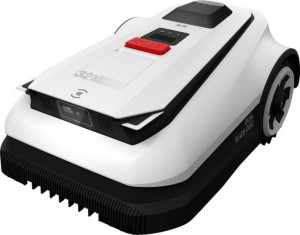
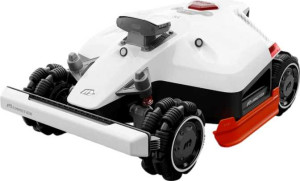
At the heart of this comparison lies a striking divergence in scale. The Mammotion Luba 2 AWD 10000HX is built for expansive properties, covering a recommended area of 10,117 m² and a maximum lawn coverage of 12,141 m², while the Ecovacs GOAT A1600 RTK targets far more modest gardens with a recommended area of just 1,280 m² and a ceiling of 1,600 m². This is not a minor gap — the Luba 2 handles roughly 7.5 times more lawn. A homeowner with a large estate or a commercial-adjacent property has no real choice here: the GOAT A1600 RTK simply isn't designed for that task. Conversely, for a typical suburban garden, the Luba 2's capacity is overkill.
The Luba 2's larger operational scope is physically reflected in its build. It is noticeably heavier at 19,051 g versus 15,800 g for the GOAT, and wider at 513 mm compared to 460 mm. Its cutting width of 40 cm also exceeds the GOAT's 33 cm, which directly translates to fewer passes needed per mowing session — an important efficiency factor on large plots. The GOAT, being more compact and lighter, would be easier to lift, transport, and store, which matters more in a smaller garden context.
On connectivity and noise, the two robots are essentially identical: both are fully electric, offer a dedicated app, Wi-Fi, Bluetooth, and remote smartphone control, and share the same acoustic profile of 60 dB standard and 50 dB in eco mode. There is no differentiator here. The clear overall edge in this group belongs to the Luba 2 AWD 10000HX for any user with a large property, thanks to its dramatically superior coverage capacity and wider cutting path. The GOAT A1600 RTK earns its place only where compactness and smaller-garden suitability are the priority.