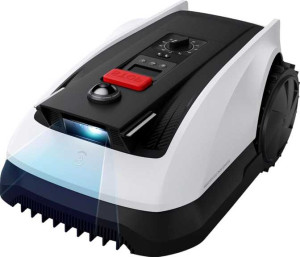
Ecovacs Goat O500 Panorama
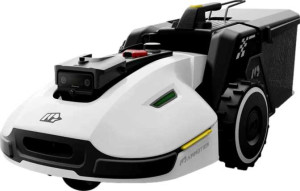
Mammotion Yuka 1000

Ecovacs Goat O500 Panorama Mammotion Yuka 1000

Overview

Welcome to our in-depth comparison of the Ecovacs Goat O500 Panorama and the Mammotion Yuka 1000, two capable robotic lawn mowers designed for modern gardens. While both machines share a strong feature set — including app control, obstacle sensing, and auto docking — they take notably different approaches when it comes to coverage capacity, battery technology, and physical size. Read on to discover which model best suits your lawn and lifestyle.

Common Features

  • Both products have a dedicated smartphone app.
  • Both products support Wi-Fi connectivity.
  • Both products support Bluetooth.
  • Both products are electric.
  • Both products support remote control via smartphone.
  • Both products produce 50 dB of audible noise in eco mode.
  • Both products have an obstacle sensor.
  • Both products have a rain sensor.
  • Both products can be scheduled.
  • Both products have anti-theft features.
  • Both products support auto docking.
  • Both products work with Alexa.
  • Both products are compatible with Google Assistant.
  • Both products have a display.
  • Both products offer a slope performance of 50%.

Main Differences

  • Audible noise is 58 dB on Ecovacs Goat O500 Panorama and 60 dB on Mammotion Yuka 1000.
  • Cutting width is 22 cm on Ecovacs Goat O500 Panorama and 32 cm on Mammotion Yuka 1000.
  • Height is 276 mm on Ecovacs Goat O500 Panorama and 330 mm on Mammotion Yuka 1000.
  • Recommended area is 500 m² on Ecovacs Goat O500 Panorama and 1012 m² on Mammotion Yuka 1000.
  • Lawn area coverage is 600 m² on Ecovacs Goat O500 Panorama and 1214 m² on Mammotion Yuka 1000.
  • Thickness is 600 mm on Ecovacs Goat O500 Panorama and 648 mm on Mammotion Yuka 1000.
  • Volume is 66240 cm³ on Ecovacs Goat O500 Panorama and 110769.12 cm³ on Mammotion Yuka 1000.
  • Weight is 11000 g on Ecovacs Goat O500 Panorama and 10433 g on Mammotion Yuka 1000.
  • Width is 400 mm on Ecovacs Goat O500 Panorama and 518 mm on Mammotion Yuka 1000.
  • Mowing time is 45 minutes on Ecovacs Goat O500 Panorama and 100 minutes on Mammotion Yuka 1000.
  • Number of cutting height settings is 6 on Ecovacs Goat O500 Panorama and 5 on Mammotion Yuka 1000.
  • Maximum cutting height is 80 mm on Ecovacs Goat O500 Panorama and 102 mm on Mammotion Yuka 1000.
  • Minimum cutting height is 30 mm on Ecovacs Goat O500 Panorama and 31 mm on Mammotion Yuka 1000.
  • Working area capacity is 120 m²/h on Ecovacs Goat O500 Panorama and 364 m²/h on Mammotion Yuka 1000.
  • Charge time is 3 hours on Ecovacs Goat O500 Panorama and 1 hour on Mammotion Yuka 1000.
  • A removable battery is available on Mammotion Yuka 1000 but not on Ecovacs Goat O500 Panorama.
  • Voltage is 18V on Ecovacs Goat O500 Panorama and 36.7V on Mammotion Yuka 1000.
  • Wattage is 180W on Ecovacs Goat O500 Panorama and 88W on Mammotion Yuka 1000.
Specs Comparison
Ecovacs Goat O500 Panorama

Ecovacs Goat O500 Panorama

Mammotion Yuka 1000

Mammotion Yuka 1000

General info:
audible noise 58 dB 60 dB
Has a dedicated smartphone app
supports Wi-Fi
audible noise (eco) 50 dB 50 dB
Has Bluetooth
cutting width 22 cm 32 cm
Is electric
height 276 mm 330 mm
recommended area 500 m² 1012 m²
release date February 2025 April 2025
supports a remote smartphone
lawn area coverage 600 m² 1214 m²
thickness 600 mm 648 mm
volume 66240 cm³ 110769.12 cm³
weight 11000 g 10433 g
width 400 mm 518 mm

The most decisive differentiator in this group is lawn coverage capacity. The Mammotion Yuka 1000 is rated for a recommended area of 1012 m² and can handle up to 1214 m² of actual lawn, while the Ecovacs Goat O500 Panorama tops out at 500 m² recommended and 600 m² maximum. In practical terms, the Yuka is suited for medium-to-large suburban gardens, whereas the Goat O500 is firmly a compact-garden solution. Reinforcing this, the Yuka's cutting width of 32 cm versus the Goat's 22 cm means fewer passes per session, translating directly into faster mowing cycles on larger plots.

Physical footprint reflects these different ambitions. The Yuka is a noticeably larger machine — 518 mm wide and 648 mm thick against the Goat's 400 mm width and 600 mm thickness — with a total volume nearly 67% greater (110,769 cm³ vs 66,240 cm³). Interestingly, despite its larger frame, the Yuka is marginally lighter at 10,433 g compared to the Goat's 11,000 g, suggesting a less dense build — useful when lifting or repositioning the unit manually. On noise, both robots are effectively equal: 60 dB vs 58 dB in standard mode (an imperceptible difference in practice) and an identical 50 dB in eco mode, so neither has a meaningful acoustic advantage.

Both units share the same connectivity baseline — Wi-Fi, Bluetooth, a dedicated smartphone app, and remote smartphone control — so there is no edge to assign on software accessibility. Overall, the Yuka 1000 holds a clear advantage for anyone with a garden above 500 m², thanks to its superior coverage capacity and wider cutting path. The Goat O500 Panorama is the more appropriate pick for smaller, constrained spaces where its compact dimensions are actually an asset.
Features:
has an obstacle sensor
Has a rain sensor
can be scheduled
has anti-theft features
auto docking
works with Alexa
compatible with Google Assistant
Has a display
has a frost sensor
Has mulching feature
adapts to weather conditions
works in rain

Across every feature in this group, the Ecovacs Goat O500 Panorama and the Mammotion Yuka 1000 are in complete lockstep. Both carry the full suite of smart autonomy features: obstacle sensing, auto docking, scheduling, and anti-theft protection are all present on each unit, forming a solid baseline of hands-off, set-and-forget operation that most users will rely on daily.

Weather intelligence is equally matched. Both robots include a rain sensor, a frost sensor, and active weather adaptation — and crucially, both are rated to work in rain. This combination means neither machine will stubbornly mow in damaging conditions, nor will either require manual intervention when the weather turns. For owners in variable climates, this full weather-awareness stack is a meaningful quality-of-life feature, and neither product has an edge here.

On the smart home and usability front, both support Alexa and Google Assistant, include an on-unit display, and offer a mulching feature — covering voice control, physical usability, and lawn health in equal measure. The verdict for this group is an unambiguous tie: the feature sets are identical in every tracked dimension, so the decision between these two machines must rest entirely on the specs from other groups.

Performance:
slope performance 50% 50%
mowing time 45 m 100 m
number of cutting height settings 6 5
maximum cutting height 80 mm 102 mm
minimum cutting height 30 mm 31 mm
working area capacity 120 m²/h 364 m²/h

Working area capacity is where the performance gap between these two robots becomes impossible to ignore. The Mammotion Yuka 1000 covers 364 m²/h, while the Ecovacs Goat O500 Panorama manages just 120 m²/h — meaning the Yuka completes the same area roughly three times faster. This aligns directly with the Yuka's wider cutting path noted in the general specs, and has real scheduling consequences: on a 500 m² lawn, the Goat would need over four hours to complete a full pass versus under two for the Yuka. For owners prioritizing efficiency or managing larger plots, this difference is substantial.

Mowing time per session tells a similar story. The Yuka runs for 100 minutes before needing to dock, compared to the Goat's 45 minutes. Combined with its higher throughput, the Yuka can cover significantly more ground in a single outing — reducing the number of charge-and-resume cycles needed to finish a job and making it far better suited to uninterrupted, continuous mowing sessions.

On cutting height, the Yuka again extends its lead with a maximum cutting height of 102 mm versus the Goat's 80 mm, offering more flexibility for owners who prefer longer grass or need to tackle overgrown areas. The minimum heights are virtually identical (31 mm vs 30 mm), and slope performance is a dead heat at 50% for both. Overall, the Yuka 1000 holds a clear performance advantage in this group — its superior throughput, longer runtime, and higher maximum cut height make it the stronger performer across almost every meaningful metric here.

Power:
charge time 3 hours 1 hours
has a removable battery
voltage 18V 36.7V
wattage 180W 88W

Charge time is the standout practical differentiator here. The Mammotion Yuka 1000 fully recharges in just 1 hour, while the Ecovacs Goat O500 Panorama requires 3 hours to do the same. Given that the Goat's mowing sessions already last only 45 minutes (as established in performance specs), a 3-hour recharge creates a significant idle-to-work imbalance — the robot spends far more time on the dock than on the lawn. The Yuka's 1-hour turnaround, by contrast, keeps downtime minimal and supports a much more responsive mowing schedule.

The wattage figures reveal an interesting contrast in design philosophy. The Goat draws 180W versus the Yuka's 88W — yet the Yuka demonstrates higher throughput and longer runtime. The Yuka's 36.7V system operates at roughly double the Goat's 18V, which typically enables more efficient power delivery and better motor torque at lower current draw. The net result is that the Yuka appears to do more with less energy consumption per session, though battery capacity data is not provided here to complete that picture fully.

A final but meaningful distinction is the Yuka's removable battery, a feature the Goat lacks entirely. This matters for long-term ownership: a user can swap in a spare charged pack to extend a mowing session without waiting for a dock cycle, and battery replacement at end-of-life becomes straightforward rather than requiring a service intervention. On balance, the Yuka 1000 holds a clear advantage in this group — faster charging, a more efficient high-voltage architecture, and a removable battery all point decisively in its favor.

Comparison Summary & Verdict

After examining all available specifications, these two robotic mowers serve clearly different audiences. The Ecovacs Goat O500 Panorama is the more compact and lighter-feeling choice in terms of dimensions, and with 6 cutting height settings and a lower minimum cutting height of 30 mm, it offers finer lawn grooming control — making it well suited for smaller, neatly maintained gardens up to 500 m². The Mammotion Yuka 1000, on the other hand, dominates in raw performance: its working area capacity of 364 m²/h, 100-minute mowing time, wider 32 cm cutting width, and support for lawns up to 1012 m² make it the clear pick for larger properties. Add in its removable battery and significantly faster 1-hour charge time, and the Yuka 1000 pulls ahead for users who value efficiency and scalability. Choose the Ecovacs for precision on smaller plots; choose the Mammotion for power and coverage on expansive lawns.

Ecovacs Goat O500 Panorama
Buy Ecovacs Goat O500 Panorama if...

Buy the Ecovacs Goat O500 Panorama if you have a smaller lawn up to 500 m² and want more precise cutting height control with 6 adjustable settings and a compact footprint.

Mammotion Yuka 1000
Buy Mammotion Yuka 1000 if...

Buy the Mammotion Yuka 1000 if you have a larger lawn and need faster coverage, a removable battery, and a much quicker 1-hour charge time for maximum efficiency.