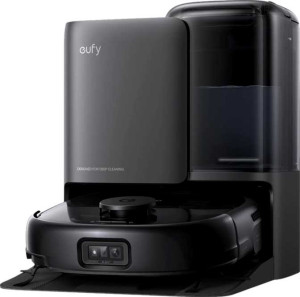
Eufy Omni E25
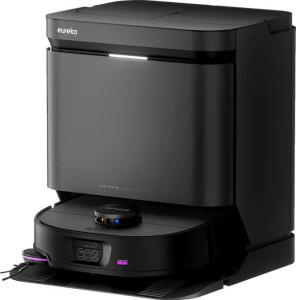
Eureka J15 Max Ultra

Eufy Omni E25 Eureka J15 Max Ultra

Overview

Welcome to this in-depth specification comparison between the Eufy Omni E25 and the Eureka J15 Max Ultra, two capable robot vacuums that share a strong foundation but take noticeably different approaches in key areas. Both models offer HEPA filtration, mopping, smart home integration, and route mapping, yet they diverge significantly when it comes to battery life, weight and size, and automation features. Read on to see which one better fits your cleaning needs and lifestyle.

Common Features

  • Both products include a HEPA filter.
  • Both products include an allergy filter.
  • Both products are compatible with Google Assistant.
  • Both products work with Alexa.
  • Both products come with a 1-year warranty.
  • Both products have an estimated empty time of 75 days.
  • Both products support no-go zones.
  • Both products support remote smartphone control.
  • Both products have an obstacle sensor.
  • Neither product gets stuck during cleaning.
  • Both products support virtual barriers.
  • Both products have route mapping.
  • Both products have voice prompts.
  • Both products support auto docking.
  • Both products have a dustbin capacity of 0.3 l.
  • Neither product has a display.
  • Neither product has twin side brushes.
  • Neither product automatically adjusts its height.
  • Both products clean all floor types.
  • Both products offer 4 cleaning modes.
  • Both products are capable of mopping.
  • Both products have a dirt sensor.
  • Neither product has UV light.
  • Both products have an auto-off feature.

Main Differences

  • Audible noise is 60 dB on Eufy Omni E25 and 67 dB on Eureka J15 Max Ultra.
  • Weight is 1500 g on Eufy Omni E25 and 6000 g on Eureka J15 Max Ultra.
  • Width is 327 mm on Eufy Omni E25 and 354 mm on Eureka J15 Max Ultra.
  • Height is 111 mm on Eufy Omni E25 and 110 mm on Eureka J15 Max Ultra.
  • Thickness is 346 mm on Eufy Omni E25 and 355 mm on Eureka J15 Max Ultra.
  • Volume is 12558.762 cm³ on Eufy Omni E25 and 13823.7 cm³ on Eureka J15 Max Ultra.
  • Docking station size is 74167.524 cm³ on Eufy Omni E25 and 88846.152 cm³ on Eureka J15 Max Ultra.
  • Self-emptying capability is present on Eureka J15 Max Ultra but not available on Eufy Omni E25.
  • A remote control is included with Eureka J15 Max Ultra but not with Eufy Omni E25.
  • Washable filters are included with Eureka J15 Max Ultra but not with Eufy Omni E25.
  • A full dustbin indicator is present on Eureka J15 Max Ultra but not on Eufy Omni E25.
  • Suction power is 20000 Pa on Eufy Omni E25 and 22000 Pa on Eureka J15 Max Ultra.
  • Battery power is 5000 mAh on Eufy Omni E25 and 6400 mAh on Eureka J15 Max Ultra.
  • Runtime is 180 min on Eufy Omni E25 and 360 min on Eureka J15 Max Ultra.
  • Charge time is 4 hours on Eufy Omni E25 and 5 hours on Eureka J15 Max Ultra.
Specs Comparison
Eufy Omni E25

Eufy Omni E25

Eureka J15 Max Ultra

Eureka J15 Max Ultra

General info:
has HEPA filter
audible noise 60 dB 67 dB
has an allergy filter
compatible with Google Assistant
works with Alexa
release date April 2025 June 2025
weight 1500 g 6000 g
width 327 mm 354 mm
height 111 mm 110 mm
thickness 346 mm 355 mm
volume 12558.762 cm³ 13823.7 cm³
warranty period 1 years 1 years
estimated empty time 75 days 75 days
docking station size 74167.524 cm³ 88846.152 cm³

Both the Eufy Omni E25 and the Eureka J15 Max Ultra share a strong baseline of smart-home integration — each supports Google Assistant and Amazon Alexa, includes a HEPA allergy filter, carries a 1-year warranty, and offers an identical 75-day estimated bin-empty cycle, meaning neither will demand frequent manual emptying. For everyday use, these shared traits put them on equal footing in terms of air-filtration quality and smart-home compatibility.

The most striking divergence in this group is weight. The Eufy Omni E25 tips the scales at 1,500 g, while the Eureka J15 Max Ultra weighs a substantial 6,000 g — four times heavier. In robotic vacuums, body weight is closely tied to the complexity and bulk of onboard systems; the J15 Max Ultra's mass suggests a significantly larger internal architecture, which is also reflected in its bigger footprint (354 × 355 mm vs. 327 × 346 mm) and considerably larger docking station (88,846 cm³ vs. 74,168 cm³). If floor space and furniture clearance are concerns, the E25's more compact, lighter profile offers a real practical advantage.

On noise, the gap is meaningful: the Eufy E25 operates at 60 dB versus the Eureka's 67 dB — a 7 dB difference that, perceptually, makes the E25 roughly twice as quiet to the human ear. For households that run the robot during work-from-home hours, sleep schedules, or in open-plan living spaces, this is a genuine quality-of-life edge. Overall, the Eufy Omni E25 holds a clear advantage in this general-info group: it is dramatically lighter, meaningfully quieter, and demands less floor space from its dock, while matching the Eureka on every shared smart and filtration feature.
Features:
supports no-go zones
supports a remote smartphone
has an obstacle sensor
is self-emptying
doesn't get stuck
supports virtual barriers
has route mapping
Has voice prompts
auto docking
has anti-fall sensor
can be scheduled
has a remote control
supports Wi-Fi
has mop cleaning
has mop raising
has mop drying

Across the features landscape, these two robots share an impressively broad common ground: both handle no-go zones, virtual barriers, route mapping, obstacle and anti-fall sensing, scheduled runs, auto-docking, voice prompts, and a full mopping suite that includes mop raising and mop drying. For the vast majority of users, this shared feature set means day-to-day operation will feel functionally equivalent — smart navigation, hands-off scheduling, and capable wet cleaning are baked into both.

The two differentiators are where the story gets interesting. The Eureka J15 Max Ultra is self-emptying, while the Eufy Omni E25 is not. In practical terms, self-emptying means the robot deposits collected debris into its dock automatically after each run, so users can go days or weeks without touching the dustbin — a genuinely significant convenience upgrade for low-maintenance households. The J15 Max Ultra also includes a physical remote control, which the E25 lacks; while smartphone app control covers most use cases, a dedicated remote can be a convenient fallback, particularly for users less comfortable with app-based interfaces.

In this features group, the Eureka J15 Max Ultra holds a clear edge. Self-emptying alone is a high-impact differentiator that meaningfully reduces user intervention, and the added remote control, while secondary, further expands its usability. The Eufy Omni E25 keeps pace on every other front, but the absence of autonomous bin-emptying is a notable gap in an otherwise competitive feature set.

Design:
dustbin capacity 0.3 l 0.3 l
Has a display
has twin side brushes
has included washable filters
automatically adjusts its height
Indicates when full

From a design standpoint, these two robots share several baseline characteristics: identical 0.3 L dustbin capacity, no onboard display, and no automatic height adjustment or twin side brushes. With so much common ground, the design differences narrow down to two specific but practical details.

The Eureka J15 Max Ultra includes washable filters and a full bin indicator, neither of which is present on the Eufy Omni E25. Washable filters reduce the ongoing cost and hassle of purchasing replacements — a small but recurring expense that adds up over a robot vacuum's lifespan. The full bin indicator is equally practical: without it, users of the E25 must either check the bin manually or rely on degraded suction performance as a cue that it needs emptying. For a robot meant to operate autonomously, the absence of this alert is a tangible friction point.

Neither product stands out as a design showpiece in this category, but the Eureka J15 Max Ultra takes a modest yet clear edge through its washable filters and bin-full notification — two design-level decisions that reduce maintenance effort and improve day-to-day usability over the Eufy Omni E25.

Cleaning power:
suction power 20000 Pa 22000 Pa
cleans all floor types
cleaning modes 4 4
mops
has a dirt sensor
has UV light

When it comes to cleaning power, these two robots are remarkably well-matched. Both cover all floor types, offer 4 cleaning modes, include mopping, carry a dirt sensor for adaptive cleaning intensity, and omit UV light — making the spec sheet almost a mirror image. The only numerical gap is suction: the Eureka J15 Max Ultra delivers 22,000 Pa versus the Eufy Omni E25's 20,000 Pa.

That 2,000 Pa difference is worth contextualizing. At this performance tier, both figures represent very high suction output, well beyond what is needed for hard floors or low-pile carpet. The practical impact of a 10% suction difference is most likely to surface in demanding scenarios — thick rugs, deep-pile carpet, or heavy debris — where marginally higher suction can improve pickup without requiring multiple passes. For typical mixed-floor homes, however, the gap is unlikely to produce a perceptible difference in day-to-day results.

This group is effectively a near-tie, with the Eureka J15 Max Ultra holding a narrow, technical edge on suction power. Users with predominantly hard floors or low-pile surfaces will find both robots equally capable; those with thick carpeting may find the J15 Max Ultra's extra headroom marginally beneficial, but the advantage remains slim given how closely matched the two are across every other cleaning-power metric.

Power:
battery power 5000 mAh 6400 mAh
runtime 180 min 360 min
charge time 4 hours 5 hours
has auto-off

Power is where the Eureka J15 Max Ultra pulls ahead most decisively. Its 6,400 mAh battery dwarfs the Eufy Omni E25's 5,000 mAh, and the real-world impact of that gap is dramatic: the J15 Max Ultra delivers a runtime of 360 minutes — a full six hours — compared to the E25's 180 minutes. That is exactly double the operational endurance on a single charge.

In practical terms, runtime is one of the most consequential specs for a robot vacuum. A 180-minute ceiling is adequate for many apartments and mid-sized homes, but larger floor plans — or users who run combined vacuum-and-mop cycles, which are more battery-intensive — may find the E25 needing to dock and recharge mid-job. The J15 Max Ultra's six-hour runtime makes it far more capable of completing large-area cleans in a single uninterrupted pass. The trade-off is a longer charge time: 5 hours versus the E25's 4 hours, though this is a minor inconvenience given the substantially larger capacity being replenished. Both models include auto-off, ensuring neither wastes energy once charging is complete.

The Eureka J15 Max Ultra wins this category outright. Double the runtime is not a marginal improvement — it fundamentally expands the range of homes and cleaning scenarios the robot can handle without interruption, making it the stronger choice for larger spaces or users who prioritize unattended, single-session cleaning.

Comparison Summary & Verdict

After reviewing all the specifications, both robots prove to be well-rounded cleaners, but they cater to different priorities. The Eufy Omni E25 stands out with its significantly lighter 1500 g body, quieter 60 dB operation, faster 4-hour charge time, and more compact footprint, making it an excellent choice for users who value a discreet, low-noise vacuum. The Eureka J15 Max Ultra, on the other hand, dominates in autonomy and convenience: it offers a remarkable 360-minute runtime, higher 22000 Pa suction power, a self-emptying base, washable filters, a full-bin indicator, and a bundled remote control. If hands-free, long-session cleaning is your priority, the Eureka is the clear pick; if you prefer a lighter, quieter, and more compact unit, the Eufy is the smarter choice.

Eufy Omni E25
Buy Eufy Omni E25 if...

Buy the Eufy Omni E25 if you want a significantly lighter, quieter robot vacuum with a smaller footprint and faster charging time.

Eureka J15 Max Ultra
Buy Eureka J15 Max Ultra if...

Buy the Eureka J15 Max Ultra if you need a self-emptying robot vacuum with a much longer runtime, stronger suction, and greater overall cleaning autonomy.