FiiO M21
HiBy R6 III

FiiO M21 HiBy R6 III

Overview

Welcome to our in-depth specification comparison between the FiiO M21 and the HiBy R6 III, two feature-rich Android-based digital audio players sharing the same quad-DAC configuration. While both devices pack identical DAC hardware and a broad suite of Bluetooth codecs, they diverge in meaningful ways across performance, design, and connectivity. From battery endurance and charging speed to screen sharpness and physical dimensions, this head-to-head breakdown covers every key battleground to help you make the most informed decision.

Common Features

  • Both devices offer 64GB of internal storage.
  • Both devices feature audio outputs including 3.5 mm, 4.4 mm, and USB-C.
  • Both devices use the Cirrus Logic CS43198 x4 DAC.
  • Both devices support external memory expansion.
  • Wireless charging is not available on either device.
  • Neither device is weather-sealed or splashproof.
  • Both devices come with 4GB of RAM.
  • Both devices have a touchscreen display.
  • Both devices use an LCD display type.
  • Both devices support Bluetooth 5.
  • aptX support is available on both devices.
  • LDAC support is available on both devices.
  • aptX HD support is available on both devices.
  • aptX Adaptive support is not available on either device.
  • aptX Lossless support is not available on either device.
  • AAC Bluetooth codec support is available on both devices.
  • aptX Low Latency support is not available on either device.

Main Differences

  • Audio file type support includes OGG on FiiO M21 but OGG is not listed for HiBy R6 III.
  • Battery life is 15 hours on FiiO M21 and 13 hours on HiBy R6 III.
  • Charge time is 1.5 hours on FiiO M21 and 2 hours on HiBy R6 III.
  • Signal-to-noise ratio is 124 dB on FiiO M21 and 126 dB on HiBy R6 III.
  • The chipset is Qualcomm Snapdragon 680 on FiiO M21 and Qualcomm Snapdragon 665 on HiBy R6 III.
  • Android version is 13 on FiiO M21 and 12 on HiBy R6 III.
  • Screen size is 4.7″ on FiiO M21 and 5″ on HiBy R6 III.
  • Resolution is 750 x 1334 px on FiiO M21 and 720 x 1280 px on HiBy R6 III.
  • Pixel density is 326 ppi on FiiO M21 and 294 ppi on HiBy R6 III.
  • Weight is 193 g on FiiO M21 and 250 g on HiBy R6 III.
  • The display on HiBy R6 III is specified as LCD IPS, while FiiO M21 uses a standard LCD panel.
  • Device volume is 139.876 cm³ on FiiO M21 and 147.562584 cm³ on HiBy R6 III.
  • Width is 68 mm on FiiO M21 and 73.1 mm on HiBy R6 III.
  • Thickness is 17 mm on FiiO M21 and 15.6 mm on HiBy R6 III.
  • Height is 121 mm on FiiO M21 and 129.4 mm on HiBy R6 III.
  • LDHC Bluetooth codec support is present on FiiO M21 but not available on HiBy R6 III.
  • AirPlay support is present on FiiO M21 but not available on HiBy R6 III.
Specs Comparison
FiiO M21

FiiO M21

HiBy R6 III

HiBy R6 III

General info:
internal storage 64GB 64GB
Audio outputs 3.5 mm, 4.4 mm, USB-C 3.5 mm, 4.4 mm, USB-C
DAC name Cirrus Logic CS43198 x4 Cirrus Logic CS43198 x4
Audio file types MP3, FLAC, WAV, APE, AIFF, WMA, ALAC, OGG, AAC, DSD, DFF, MQA MQA, DSD, MP3, WAV, FLAC, APE, ALAC, AAC, AIFF, WMA
Battery life 15 hours 13 hours
release date May 2025 February 2025
charge time 1.5 hours 2 hours
has an external memory slot
Signal-to-noise ratio (SNR) 124 dB 126 dB
has wireless charging
is weather-sealed (splashproof)
RAM 4GB 4GB
Chipset (SoC) name Qualcomm Snapdragon 680 Qualcomm Snapdragon 665
Android version Android 13 Android 12

At their core, the FiiO M21 and HiBy R6 III are built on a remarkably similar foundation: both pack the same Cirrus Logic CS43198 x4 DAC configuration, identical 64GB internal storage, 4GB of RAM, and offer the same trio of audio outputs (3.5 mm, 4.4 mm, and USB-C). Their format support is functionally equivalent as well, covering all major lossless and lossy codecs including DSD and MQA. For a buyer focused purely on audio hardware parity, these two devices start from nearly the same place.

The differences emerge in the platform and endurance specs. The M21 runs on a Snapdragon 680 paired with Android 13, while the R6 III uses the older Snapdragon 665 on Android 12. In practice, the 680 is a more modern, efficient chip, which likely contributes to the M21's superior real-world stamina: 15 hours of battery life versus 13 hours on the R6 III — a meaningful gap for long listening sessions or travel days. The M21 also recharges faster, needing just 1.5 hours compared to the R6 III's 2 hours. The R6 III does edge ahead on SNR at 126 dB versus the M21's 124 dB, a 2 dB difference that is technically measurable but unlikely to be audible in real-world use.

Overall, the FiiO M21 holds a clear practical advantage in this group: a newer chipset, a more current Android version, longer battery life, and faster charging all tip the scales in its favor. The R6 III's marginal SNR lead does not meaningfully offset these platform-level advantages for most users.
Design:
screen size 4.7" 5"
resolution 750 x 1334 px 720 x 1280 px
pixel density 326 ppi 294 ppi
weight 193 g 250 g
Display type LCD LCD, IPS
has a touch screen
volume 139.876 cm³ 147.562584 cm³
width 68 mm 73.1 mm
thickness 17 mm 15.6 mm
height 121 mm 129.4 mm

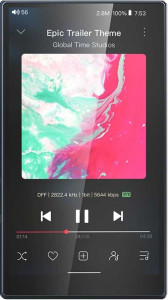
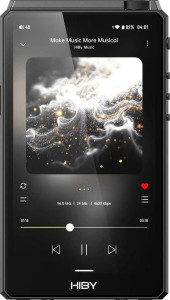
The two devices take noticeably different approaches to physical design. The FiiO M21 is the more compact and significantly lighter option at 193 g, compared to the HiBy R6 III's heftier 250 g — a 57 g difference that is immediately perceptible when holding either device for extended periods. For commuters or gym users who pocket their player, the M21's smaller footprint and lower mass translate directly into greater day-to-day comfort.

On the display front, the trade-offs are more nuanced. The R6 III offers a larger 5″ screen, which benefits navigation and album art browsing, but its 294 ppi pixel density trails the M21's 326 ppi on a 4.7″ panel — meaning the M21's smaller screen is actually sharper. The R6 III specifies an IPS LCD panel, which typically delivers better viewing angles and color accuracy than a standard LCD, partially compensating for the pixel density gap. The M21's display type is listed simply as LCD without the IPS designation, leaving that advantage with the R6 III for screen quality.

Taken together, the FiiO M21 holds the stronger design edge for portability-focused users: it is lighter, more pocketable, and sharper. The R6 III counters with a bigger screen and likely better panel quality, making it the preferable choice for those who prioritize a more immersive visual interface over compactness — but the weight penalty is substantial and hard to ignore.

Connectivity:
Bluetooth version 5 5
has aptX
has LDAC
has LDHC
has aptX HD
has aptX Adaptive
has aptX Lossless
has AAC
has aptX Low Latency
has AirPlay
supports Wi-Fi

Wireless connectivity is largely a shared story between these two players. Both run Bluetooth 5 with Wi-Fi support, and both cover the most important high-quality audio codecs: LDAC, aptX HD, aptX, and AAC. For the vast majority of users pairing either device with a quality wireless headphone or IEM, this common codec foundation means real-world wireless audio performance will be comparable.

The differentiators are specific but meaningful depending on your ecosystem. The FiiO M21 adds LDHC (also known as HWA), a high-res wireless codec that supports up to 900 kbps and is particularly relevant for users with compatible Huawei or HiBy-ecosystem earphones. More broadly useful is the M21's support for AirPlay, which opens seamless streaming integration with Apple devices and AirPlay-compatible speakers — a genuine convenience advantage for users in the Apple ecosystem. The HiBy R6 III supports neither LDHC nor AirPlay.

The FiiO M21 takes a clear edge in connectivity. Its additional LDHC codec broadens wireless headphone compatibility, and AirPlay support adds a layer of ecosystem versatility that the R6 III simply cannot match. Neither device supports aptX Adaptive or aptX Lossless, so that is not a differentiator, but the M21's extras make it the more flexible wireless performer of the two.

Comparison Summary & Verdict

After examining the full specification set, both players offer a strong foundation with quad Cirrus Logic CS43198 DACs, 64GB of storage, and wide Bluetooth codec support including LDAC and aptX HD. However, the differences reveal two distinct personalities. The FiiO M21 stands out with its longer 15-hour battery life, faster 1.5-hour charge time, sharper 326 ppi display, lighter 193g body, and extras like AirPlay and LDHC support, making it the more practical everyday carry. The HiBy R6 III counters with a larger 5-inch IPS screen, a marginally better 126 dB SNR, and a slightly more spacious form factor that some users may prefer for home or desktop use. Audiophiles who value portability and quicker charging will lean toward the FiiO M21, while those who prioritize screen real estate and display quality may find the HiBy R6 III more appealing.

FiiO M21
Buy FiiO M21 if...

Buy the FiiO M21 if you want longer battery life, faster charging, a lighter and more portable build, and bonus features like AirPlay and LDHC support.

HiBy R6 III
Buy HiBy R6 III if...

Buy the HiBy R6 III if you prefer a larger IPS display, a slightly higher signal-to-noise ratio, and a roomier screen experience for home listening sessions.