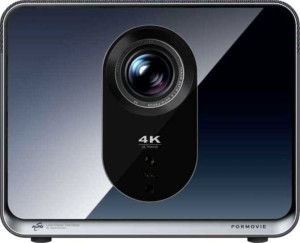
Formovie X5 Pro
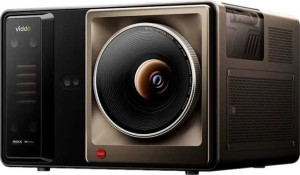
Hisense Vidda C5

Formovie X5 Pro Hisense Vidda C5

Overview

Welcome to our detailed specification comparison between the Formovie X5 Pro and the Hisense Vidda C5, two laser 4K projectors that share a strong foundation yet diverge in some meaningful ways. In this head-to-head, we examine key battlegrounds including projection size capability, smart features, audio performance, and connectivity options to help you determine which projector best fits your home cinema needs.

Common Features

  • Both projectors use a laser light source.
  • Both projectors output at 4K resolution.
  • Neither projector has a motorized zoom.
  • Both projectors support HDR10+.
  • Both projectors support HDR10.
  • Neither projector has a manual focus.
  • Both projectors have 2 HDMI ports.
  • Both projectors include Bluetooth connectivity.
  • Both projectors support Wi-Fi.
  • Both projectors have 1 USB port.
  • Neither projector has a VGA connector.
  • Neither projector has a DVI connector.
  • Neither projector has an S/PDIF Out port.
  • Both projectors feature stereo speakers.
  • Both projectors include a remote control.
  • Both projectors have a built-in smart TV platform.
  • Both projectors have a built-in speaker.

Main Differences

  • Width is 217 mm on Formovie X5 Pro and 283 mm on Hisense Vidda C5.
  • Height is 167 mm on Formovie X5 Pro and 213 mm on Hisense Vidda C5.
  • Thickness is 210 mm on Formovie X5 Pro and 273 mm on Hisense Vidda C5.
  • Volume is 7610.19 cm³ on Formovie X5 Pro and 16456.167 cm³ on Hisense Vidda C5.
  • Motorized focus is available on Formovie X5 Pro but not on Hisense Vidda C5.
  • Maximum projection size is 500″ on Formovie X5 Pro and 300″ on Hisense Vidda C5.
  • Dolby Vision support is present on Hisense Vidda C5 but not available on Formovie X5 Pro.
  • Wi-Fi version support includes Wi-Fi 6, Wi-Fi 5, and Wi-Fi 4 on Formovie X5 Pro, while Hisense Vidda C5 also adds Wi-Fi 6E and Wi-Fi 7.
  • Audio output power is 2 x 18W on Formovie X5 Pro and 2 x 10W on Hisense Vidda C5.
  • Dolby Atmos support is present on Hisense Vidda C5 but not available on Formovie X5 Pro.
Specs Comparison
Formovie X5 Pro

Formovie X5 Pro

Hisense Vidda C5

Hisense Vidda C5

General info:
has laser light source
release date July 2025 October 2025
width 217 mm 283 mm
height 167 mm 213 mm
thickness 210 mm 273 mm
volume 7610.19 cm³ 16456.167 cm³

Both the Formovie X5 Pro and the Hisense Vidda C5 share a laser light source, which is a significant common ground — laser projection delivers superior brightness consistency, longer lifespan, and a wider color gamut compared to traditional lamp-based systems. On this fundamental technology, neither product has an advantage over the other.

Where they diverge sharply is physical footprint. The Formovie X5 Pro is considerably more compact, with dimensions of 217 × 167 × 210 mm and a volume of roughly 7,610 cm³, while the Vidda C5 is substantially larger at 283 × 213 × 273 mm and a volume of approximately 16,456 cm³ — more than twice the physical bulk. In real-world terms, this means the X5 Pro demands significantly less shelf or cabinet space and is far easier to reposition or carry between rooms.

For users where placement flexibility and a minimal physical presence matter — such as smaller living spaces or setups where the projector needs to be stored away — the Formovie X5 Pro holds a clear size advantage. The Vidda C5's larger chassis may be justified by other internal hardware differences, but based strictly on general info, the X5 Pro is the more space-efficient choice by a wide margin.

Projection quality:
output resolution 4K 4K
has motorized focus
maximum projection size 500" 300"
has motorized zoom
supports HDR10+
has manual focus
supports Dolby Vision
supports HDR10

At the foundation, both projectors output at 4K resolution and support HDR10+ and HDR10, so neither has an edge on core image sharpness or baseline HDR compatibility. The meaningful split comes in the HDR ecosystem beyond that: the Vidda C5 adds Dolby Vision support, which is the more tightly mastered and dynamically superior HDR format — particularly valuable for users streaming from platforms that deliver Dolby Vision content. The X5 Pro lacks this, which is a tangible gap for cinema-grade HDR accuracy.

On the usability side, the Formovie X5 Pro counters with motorized focus, a convenience feature the Vidda C5 omits entirely — and since neither unit offers manual focus either, Vidda C5 owners have no focus adjustment path at all per these specs, which raises a practical concern for fine-tuning image sharpness after placement. Meanwhile, the X5 Pro's maximum projection size of 500″ dwarfs the Vidda C5's ceiling of 300″, making the X5 Pro far more capable in large rooms or dedicated home theater setups where screen size is a priority.

The two products target subtly different priorities: the Vidda C5 edges ahead on color science with Dolby Vision, while the Formovie X5 Pro wins on installation flexibility and sheer screen scale. For a large-room, big-screen setup, the X5 Pro has a clear practical advantage. For users in a controlled environment who prioritize the best possible HDR pipeline for streaming, the Vidda C5's Dolby Vision support tips the balance its way.

Connectivity:
HDMI ports 2 2
Has Bluetooth
supports Wi-Fi
Wi-Fi version Wi-Fi 6 (802.11ax), Wi-Fi 5 (802.11ac), Wi-Fi 4 (802.11n) Wi-Fi 6E (802.11ax), Wi-Fi 6 (802.11ax), Wi-Fi 5 (802.11ac), Wi-Fi 4 (802.11n), Wi-Fi 7 (802.11be)
USB ports 1 1
has a VGA connector
has a DVI connector
Has S/PDIF Out port

Wired connectivity is identical across both units — 2 HDMI ports, 1 USB port, Bluetooth, and no legacy connectors like VGA or DVI. For most home theater users, this parity is perfectly adequate, and neither projector has a wired edge over the other.

The real differentiator here is wireless. The Formovie X5 Pro tops out at Wi-Fi 6, which is already a capable standard offering low latency and strong throughput in congested environments. The Hisense Vidda C5, however, goes further with support for both Wi-Fi 6E and Wi-Fi 7 — the latter being the current cutting edge of consumer Wi-Fi, delivering significantly higher theoretical bandwidth, reduced interference via the 6 GHz band, and better multi-device performance. For 4K streaming, large local file transfers, or future-proofing the setup, this is a meaningful gap rather than a marketing footnote.

If wireless performance matters to your setup — particularly in a home with many connected devices or a router that already supports Wi-Fi 6E or Wi-Fi 7 — the Vidda C5 holds a clear connectivity advantage. Users with older networking hardware or simpler streaming needs will find both projectors equally capable day-to-day, but the Vidda C5 is the more future-ready choice on this front.

Features:
has stereo speakers
has a remote control
has built-in smart TV
has a built-in speaker
audio output power 2 x 18W 2 x 10W
has Dolby Atmos

The feature baseline is identical: both projectors come with stereo speakers, a built-in smart TV platform, and a remote control — so neither has an edge on general usability or smart functionality out of the box. The divergence lies in audio output and audio format support, which turn out to pull in opposite directions.

Raw power favors the Formovie X5 Pro, whose built-in amplifier delivers 2 × 18W compared to the Vidda C5's 2 × 10W — a difference of nearly double the wattage. In practical terms, higher output power translates to louder maximum volume and typically more dynamic headroom, which matters in larger rooms where the projector may be placed far from the viewer. The Vidda C5's 10W per channel is respectable for casual use but will reach its limits faster in open or noisy environments. On the other hand, the Vidda C5 supports Dolby Atmos, the object-based surround sound format that — when content is encoded for it — delivers a more spatially immersive audio experience. The X5 Pro lacks this certification entirely.

This is a genuine trade-off rather than a clean win for either side. Users who prioritize sheer volume and room-filling sound for everyday content will find the X5 Pro's higher wattage more immediately impactful. Those who regularly watch Dolby Atmos-encoded films and value audio fidelity over raw loudness will lean toward the Vidda C5 — though the real benefit of Atmos through a compact stereo speaker array is inherently limited compared to a dedicated surround system.

Comparison Summary & Verdict

Both the Formovie X5 Pro and the Hisense Vidda C5 are capable laser 4K projectors that cover the essentials well, but they cater to different priorities. The Formovie X5 Pro stands out with its larger maximum projection size of 500″, motorized focus for effortless setup, and significantly higher audio output of 2 x 18W, making it the stronger choice for dedicated home theater enthusiasts who want a truly cinematic, room-filling experience. The Hisense Vidda C5, on the other hand, appeals to users who value cutting-edge connectivity via Wi-Fi 7 and Wi-Fi 6E, richer color and audio formats through Dolby Vision and Dolby Atmos support, and a more compact-friendly installation scenario with its 300″ projection ceiling. Choose the Formovie X5 Pro for raw projection scale and audio power; opt for the Hisense Vidda C5 if premium audiovisual format support and next-generation wireless connectivity are your top priorities.

Formovie X5 Pro
Buy Formovie X5 Pro if...

Buy the Formovie X5 Pro if you want the largest possible screen size up to 500″, benefit from motorized focus for easy setup, and need more powerful built-in audio at 2 x 18W.

Hisense Vidda C5
Buy Hisense Vidda C5 if...

Buy the Hisense Vidda C5 if Dolby Vision and Dolby Atmos support are essential to you, or if you want the latest Wi-Fi 7 and Wi-Fi 6E connectivity for a future-proof setup.