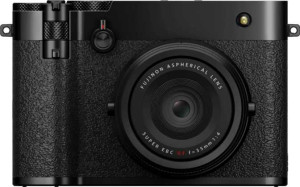
The most fundamental design difference here is form factor philosophy. The Fujifilm GFX100RF is classified as a Compact camera, while the Hasselblad X2D II 100C is a Mirrorless system camera — meaning the Hasselblad is designed around an interchangeable lens ecosystem, whereas the GFX100RF comes with a fixed lens. This single distinction shapes everything: the GFX100RF is lighter at 735 g versus 840 g, and considerably smaller in total volume (923 cm³ vs 1,180 cm³). In practice, the GFX100RF can be carried and used far more discreetly, approaching street and travel photography in a way the bulkier Hasselblad simply cannot replicate.
Both cameras share an identical 5760k-dot EVF with 100% coverage — a genuinely high-end viewfinder experience on both sides. Where they differ is the rear screen: the X2D II offers a larger 3.6″ panel at 2360k dots, compared to the GFX100RF's 3.15″ screen at 2100k dots. Both are flip-out and touch-enabled, which is a meaningful usability advantage shared equally. The Hasselblad's larger, slightly sharper screen gives a modest edge for image review and menu navigation, but the gap is not dramatic in real-world use.
On environmental resilience, the X2D II edges ahead with a 45°C maximum operating temperature versus 40°C for the GFX100RF, while both share a -10°C lower limit. Overall, the GFX100RF holds a clear design advantage for portability and discretion, while the X2D II has the edge for users who need a larger screen, system-camera versatility with lens swapping, and marginally broader thermal tolerance.