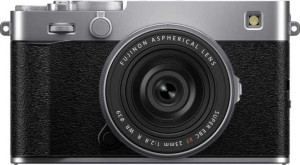
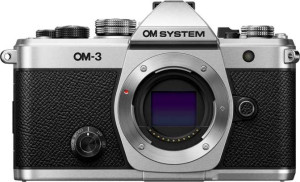
The sensor story here is fundamental. The X-E5 uses an APS-C sensor at 40.2 MP, while the OM-3 packs a Micro Four Thirds sensor at 20.4 MP. The larger APS-C format captures roughly twice the light-gathering area, which generally benefits dynamic range and low-light per-pixel performance. The X-E5's resolution advantage is substantial — nearly double — making it the clear choice for large prints, aggressive cropping, or high-detail commercial work. That said, the OM-3's stacked CMOS sensor (absent on the X-E5) enables faster data readout, reducing rolling shutter artifacts in video and fast-moving subjects, which is a meaningful engineering trade-off.
Autofocus coverage is another area where the two diverge sharply. The OM-3 offers 1053 focus points versus the X-E5's 425, giving it far denser subject tracking across the frame — useful for erratic or fast-moving subjects. However, both cameras support phase-detection AF and touch autofocus, so the gap is one of density and precision rather than fundamental capability. On image stabilization, the X-E5 edges ahead with a 7-stop CIPA rating compared to the OM-3's 6.5 stops, and both support combined stabilization with compatible lenses — a notable perk for handheld shooters in low light. The OM-3 counters with a longer maximum exposure time of 60 s versus 30 s, useful for astrophotography without an external remote.
Neither camera dominates outright, but the winner depends heavily on use case. The X-E5 holds the edge for resolution, sensor size, and stabilization, making it more versatile for stills-focused, detail-demanding work. The OM-3 counters with its stacked sensor, denser AF grid, and higher ISO ceiling — advantages that pay off in action, low-light tracking, and scenarios where readout speed matters. Photographers prioritizing image quality and resolution will favor the X-E5; those shooting fast action or needing extended ISO headroom will lean toward the OM-3.