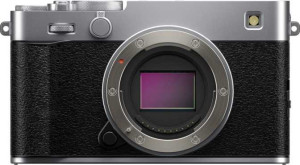
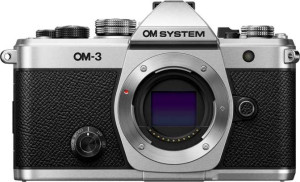
The sensor story is where these two cameras diverge most fundamentally. The Fujifilm X-E5 uses an APS-C sensor with 40.2 MP, giving it a substantial resolution advantage — nearly double that of the OM-3's 20.4 MP Micro Four Thirds sensor. In practice, this means the X-E5 can resolve considerably more fine detail, enabling larger prints and more aggressive cropping in post. The larger APS-C sensor also has an inherent light-gathering advantage over MFT, which generally translates to better image quality at higher native ISOs, despite the X-E5's lower maximum native ISO of 12800 ISO versus the OM-3's 25600 ISO. Expanded ISO reaches 51200 on the X-E5 and 102400 on the OM-3, but expanded values involve significant noise and are rarely used for critical work.
The OM-3 punches back hard in autofocus and subject tracking. Its 1053 focus points versus the X-E5's 425 provide denser scene coverage, giving the OM-3 more granular control over where and how focus is acquired — a genuine advantage when tracking erratically moving subjects. The OM-3 also features a stacked CMOS sensor, which the X-E5 lacks; stacked architecture enables faster readout speeds, reducing rolling shutter distortion during fast motion or when panning. This is reflected in the OM-3's maximum electronic shutter speed of approximately 1/32000 s compared to the X-E5's 1/180000 s — the X-E5 actually achieves a much faster peak electronic shutter, suggesting its sensor readout is exceptionally quick despite not being stacked. For burst shooting, the X-E5 edges ahead with 8 fps mechanical versus the OM-3's 6 fps.
On stabilization, both cameras support in-body sensor-shift IS and can combine it with optically stabilized lenses, but the X-E5 holds a slight advantage at a 7-stop CIPA rating versus 6.5 stops for the OM-3. The OM-3 partially compensates with a longer maximum exposure time of 60 s compared to 30 s on the X-E5, useful for long-exposure and astrophotography scenarios. Overall, the X-E5 has a clear edge in resolution and peak shutter speed, while the OM-3 counters with denser autofocus coverage and a stacked sensor — making the X-E5 the stronger choice for detail-oriented and landscape shooters, and the OM-3 more compelling for action and wildlife photographers.