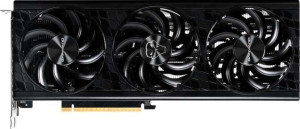
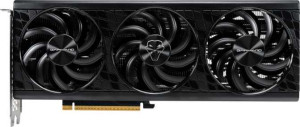
At first glance, the RTX 5060 Ti PythoN III appears to hold a clock speed edge — its base and turbo clocks of 2407 / 2572 MHz outpace the RTX 5070 Python III's 2325 / 2512 MHz. However, raw clock speed tells only a fraction of the story. GPU throughput is the product of clock speed multiplied by the number of functional units, and the 5070 enjoys a substantial lead in every hardware count that matters: 6144 shading units versus 4608 (a ~33% increase), 192 TMUs versus 144, and — most strikingly — 80 ROPs versus 48, a 67% advantage in render output units.
Those unit counts translate directly into the throughput figures. The 5070 delivers 30.87 TFLOPS of floating-point performance against the 5060 Ti's 23.7 TFLOPS, a ~30% gap that reflects its real-world advantage in shader-heavy workloads like ray tracing, complex shaders, and compute tasks. The ROP disparity is especially consequential: ROPs govern how quickly a GPU can write pixels to the framebuffer, so the 5070's 201 GPixel/s pixel rate versus the 5060 Ti's 123.5 GPixel/s means it can sustain higher framerates at higher resolutions — a critical edge at 4K or with antialiasing enabled. The texture fill rate gap (482.3 vs 370.4 GTexels/s) similarly benefits texture-rich scenes. Memory speed is identical at 1750 MHz for both, and both support Double Precision Floating Point, so neither card has an advantage on those fronts.
The verdict for this group is clear: the RTX 5070 Python III holds a decisive performance advantage across every meaningful throughput metric. The 5060 Ti's marginally higher clock speeds cannot compensate for the 5070's broader hardware architecture. For users prioritizing raw rendering power, high-resolution gaming, or GPU compute workloads, the 5070 is the stronger card by a significant margin.