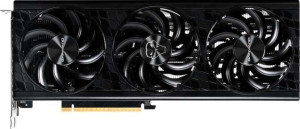
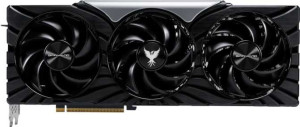
The most revealing performance gap between the RTX 5060 Ti PythoN III and the RTX 5080 Phoenix lies in their raw compute muscle. The 5080 Phoenix delivers 56.28 TFLOPS of floating-point performance against the 5060 Ti's 23.7 TFLOPS — a roughly 2.4× advantage that translates directly into faster shader workloads, more responsive ray tracing, and headroom for demanding AI-accelerated tasks. This gap is rooted in the shading unit count: 10,752 on the 5080 Phoenix versus 4,608 on the 5060 Ti, meaning the 5080 can process far more parallel operations per clock cycle.
Clock speeds tell a more nuanced story. The 5060 Ti actually leads at base with 2,407 MHz versus the 5080's 2,295 MHz, but the 5080 edges ahead at boost (2,617 MHz vs. 2,572 MHz). In practice, this means neither card has a meaningful frequency advantage — the 5080's performance lead is almost entirely structural, driven by its wider execution pipeline. The 5080's memory also runs slightly faster at 1,875 MHz versus 1,750 MHz, which supports its much higher texture rate (879.3 GTexels/s vs. 370.4 GTexels/s) and pixel fill rate (293.1 GPixel/s vs. 123.5 GPixel/s), both of which matter for high-resolution rendering throughput.
Both cards support Double Precision Floating Point (DPFP), making them each viable for compute workloads beyond gaming. That said, the RTX 5080 Phoenix holds a clear and commanding performance advantage in every meaningful throughput metric — compute, texturing, and pixel output — by a factor of roughly 2× to 2.4×. The 5060 Ti PythoN III is no slouch, but users prioritizing raw GPU horsepower will find the 5080 Phoenix in a substantially higher performance tier.