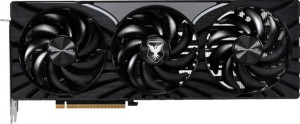
At first glance, the Gainward RTX 5070 Phoenix-S GS appears to have a clock speed advantage, running at 2572 MHz boost versus the RTX 5070 Ti Phoenix-S's 2452 MHz — a meaningful 120 MHz gap. However, raw clock speed tells only part of the story. The Ti variant compensates with a dramatically wider GPU die: 8,960 shading units against the standard model's 6,144, along with 280 TMUs versus 192 and 96 ROPs versus 80. More execution units mean more work completed per clock cycle, which effectively neutralizes and then reverses the RTX 5070's clock speed lead.
This architectural width advantage translates directly into compute throughput numbers that are impossible to overlook. The RTX 5070 Ti Phoenix-S delivers 43.94 TFLOPS of floating-point performance compared to 31.6 TFLOPS on the standard Phoenix-S GS — roughly a 39% uplift. Similarly, its texture rate of 686.6 GTexels/s dwarfs the 493.8 GTexels/s on the non-Ti, which matters in texture-heavy scenes and modern rendering workloads. The higher ROP count also means the Ti can write more pixels to the framebuffer per clock, giving it a pixel rate advantage of 235.4 GPixel/s versus 205.8 GPixel/s. Both cards share identical 1750 MHz memory speeds and both support Double Precision Floating Point, so those are non-factors in differentiating them.
The RTX 5070 Ti Phoenix-S holds a clear and substantial performance edge in this group. The RTX 5070 Phoenix-S GS's higher boost clock is a real but ultimately insufficient counterweight to the Ti's wider shader array. For users prioritizing raw GPU compute throughput — whether for high-resolution gaming, content creation, or AI-accelerated workloads — the Ti is the stronger choice by a significant margin based strictly on these specs.