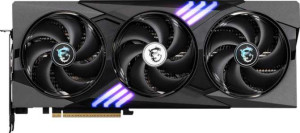
The most telling performance differentiator here is raw compute silicon. The MSI RTX 5070 Ti Gaming Trio OC Plus fields 8960 shading units and 280 TMUs against the Gainward Phoenix-S's 6144 shading units and 192 TMUs — a roughly 46% advantage in shader and texturing throughput. This directly translates into the floating-point gap: 46.09 TFLOPS versus 31.6 TFLOPS, meaning the 5070 Ti can push through significantly more geometry, lighting calculations, and shader workloads per second, which matters most in complex, GPU-bound scenes at high resolutions.
Clock speeds tell a nuanced story. The Gainward Phoenix-S actually carries a marginally higher base clock at 2325 MHz versus the 5070 Ti's 2295 MHz, but both cards reach an identical turbo ceiling of 2572 MHz. This means the per-core efficiency of the Phoenix-S is competitive — it simply has fewer cores to work with. The texture rate and pixel rate deltas (720.2 vs 493.8 GTexels/s and 246.9 vs 205.8 GPixel/s respectively) reinforce that the 5070 Ti's advantage is architectural breadth, not clock speed. Both share the same 1750 MHz memory speed and support Double Precision Floating Point, so for GPGPU or professional compute workloads they are equally capable in kind, just not in scale.
The MSI RTX 5070 Ti Gaming Trio OC Plus holds a clear and substantial performance edge in this group. Its higher shader count, TMU count, ROPs, and resulting compute throughput make it the stronger card for demanding gaming at 4K, heavy ray tracing loads, or any workload that saturates the GPU. The Gainward Phoenix-S is not a slow card — its clock speeds are healthy — but it is a tier below in raw horsepower, which these numbers make unambiguous.