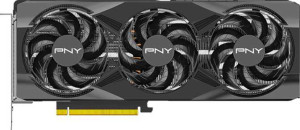
At first glance, the base and boost clock speeds tell a misleadingly close story: the Gainward RTX 5070 Phoenix-S GS actually edges out the PNY RTX 5070 Ti OC Triple Fan on base clock (2325 MHz vs 2295 MHz), and both cards hit an identical turbo of 2572 MHz. However, clock speed is only half the equation — the number of execution units doing the work at that speed is where the real gap emerges.
The PNY 5070 Ti carries significantly more silicon: 8960 shading units, 280 TMUs, and 96 ROPs versus the Gainward's 6144 shaders, 192 TMUs, and 80 ROPs — roughly a 46% advantage in raw shader and texturing throughput. This directly translates into the floating-point performance figures: 46.09 TFLOPS for the PNY versus 31.6 TFLOPS for the Gainward, a ~46% compute lead. The texture rate gap mirrors this (720.2 GTexels/s vs 493.8 GTexels/s), meaning the 5070 Ti can handle significantly more texture work per frame — relevant for high-resolution rendering, demanding rasterization, and compute-heavy workloads. The pixel fillrate advantage (246.9 GPixel/s vs 205.8 GPixel/s), driven by the extra ROPs, also favors the PNY, particularly at higher resolutions where bandwidth to the framebuffer becomes a bottleneck.
Both cards share the same 1750 MHz memory speed and both support double-precision floating point, so they are evenly matched on those fronts. Overall, the PNY RTX 5070 Ti OC Triple Fan holds a clear and substantial performance advantage in this group — not because it runs faster, but because it has far more parallel compute resources working at the same speed. The Gainward 5070 is a capable card, but it is a tier below in raw throughput by design.