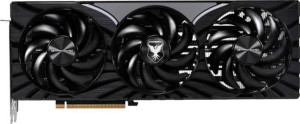
In the Performance category, the Gainward RTX 5070 Phoenix-S and the MSI RTX 5070 Shadow 3X are in a complete dead heat. Every single core compute metric is shared: a base GPU clock of 2325 MHz, a turbo boost of 2512 MHz, 6144 shading units, 192 TMUs, and 80 ROPs. This is expected, as both are custom board partner designs built on the same RTX 5070 silicon running at reference clocks.
The practical consequence of identical clocks and shader counts is that raw throughput figures are also indistinguishable: 30.87 TFLOPS of floating-point performance, a texture rate of 482.3 GTexels/s, and a pixel fill rate of 201 GPixel/s. In real-world rendering workloads — rasterization, ray tracing setup, and compute-heavy tasks — these two cards will produce frame times that are statistically interchangeable before thermal and power-limit behavior comes into play. Memory speed is also matched at 1750 MHz, meaning memory bandwidth, which directly affects high-resolution texture streaming and large dataset compute, is equivalent as well.
Both cards support Double Precision Floating Point (DPFP), which matters for scientific compute and certain professional simulation workflows, though on consumer GeForce parts DPFP throughput is typically throttled relative to the full-precision path. On pure spec-sheet performance, this group is an unambiguous tie: neither the Phoenix-S nor the Shadow 3X holds any advantage whatsoever. Differentiators between these two cards will need to be found elsewhere — in cooling design, power delivery, or software features.