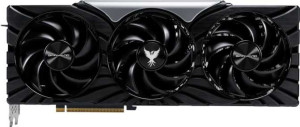
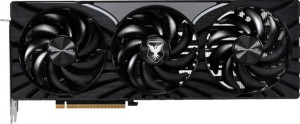
When comparing the Performance specs of the Gainward GeForce RTX 5070 Ti Phoenix GS and the Phoenix-S, the picture is unusually clear: every single metric is identical. Both cards share a base GPU clock of 2295 MHz and a turbo boost of 2452 MHz, meaning neither will outpace the other in sustained or peak frequency scenarios. The 43.94 TFLOPS of floating-point performance and matching texture and pixel rates — 686.6 GTexels/s and 235.4 GPixel/s respectively — confirm that both cards deliver the exact same theoretical compute throughput.
Under the hood, the hardware configuration is also a mirror image: 8960 shading units, 280 TMUs, and 96 ROPs are shared across both variants. The ROPs in particular are worth noting, as they directly govern how fast the GPU can write pixels to the framebuffer — 96 ROPs is a high-end count that supports smooth high-resolution rendering. Memory bandwidth potential is equally matched, with both running at 1750 MHz GPU memory speed. Both also support Double Precision Floating Point, which matters for scientific compute and certain professional workloads, though it is less relevant for gaming.
In terms of raw performance, this group is a complete tie. There is no measurable advantage for either the Phoenix GS or the Phoenix-S based on these specs alone. Any difference between the two cards — such as cooling design, power limits, or factory overclocking headroom — would need to be found in other spec groups, as performance figures here offer no basis for choosing one over the other.