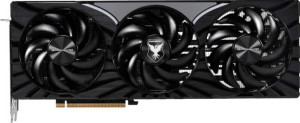
At the foundation, both cards share an identical hardware configuration: 8960 shading units, 280 TMUs, 96 ROPs, and a base GPU clock of 2295 MHz — meaning neither holds an architectural edge over the other. The real divergence emerges in boosted performance. The Gigabyte Gaming OC reaches a higher GPU turbo of 2588 MHz versus the Phoenix-S GS's 2482 MHz — a gap of roughly 106 MHz, or about 4.3%. In sustained workloads that push the GPU into its boost states, this translates directly into higher throughput across the board.
That clock advantage compounds into every compute metric. The Gaming OC delivers 46.38 TFLOPS of floating-point performance compared to 44.48 TFLOPS, and a texture rate of 724.6 GTexels/s versus 695 GTexels/s. In practice, higher TFLOPS benefit compute-heavy tasks like ray tracing, AI-based upscaling, and shader workloads, while the texture rate advantage means the Gaming OC can process more surface detail per second — relevant in complex, texture-dense scenes. The pixel rate gap (248.4 vs 238.3 GPixel/s) also slightly favors the Gigabyte, which can matter at very high resolutions or in fill-rate-bound scenarios.
Both cards share the same 1750 MHz memory speed and support Double Precision Floating Point, so there is no differentiation on memory bandwidth or professional compute capability. Overall, the Gigabyte GeForce RTX 5070 Ti Gaming OC holds a clear, consistent performance edge in this group, driven entirely by its higher factory boost clock. The advantage is modest but real — roughly 4–5% across all throughput metrics — making it the stronger choice for users who want maximum out-of-the-box GPU performance without manual overclocking.