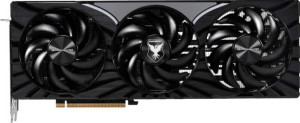
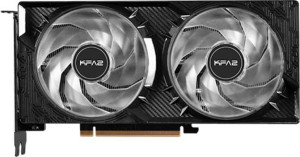
Both cards share the same GDDR7 memory standard and an identical effective memory speed of 28000 MHz, so the technology generation is level. The divergence comes entirely from the bus architecture: the Gainward RTX 5070 Ti Phoenix-S GS uses a 256-bit memory bus, while the KFA2 RTX 5060 1-Click OC is fitted with a 128-bit bus — exactly half the width. Since bandwidth is a direct product of speed × bus width, this halves the 5060's throughput ceiling, resulting in 448 GB/s versus the 5070 Ti's 896 GB/s. No amount of fast memory can compensate for a narrow pipe.
The capacity difference reinforces this gap: 16 GB of VRAM on the 5070 Ti versus 8 GB on the 5060. VRAM capacity determines how large a scene, texture set, or dataset the GPU can hold locally without spilling to system memory — an increasingly critical factor as modern games push high-resolution texture packs and ray-traced assets. At 4K or with demanding mods, 8 GB can become a hard ceiling that causes stuttering and frame drops regardless of raw compute power. Both cards support ECC memory, but that feature is primarily relevant for professional and compute workloads rather than gaming.
The memory advantage belongs clearly to the Gainward RTX 5070 Ti Phoenix-S GS on every meaningful axis — twice the bandwidth, twice the capacity — while the underlying technology quality (GDDR7) is identical. For users targeting high resolutions, future-proofing, or memory-intensive workloads, this is a substantial and practical difference, not a marginal one.