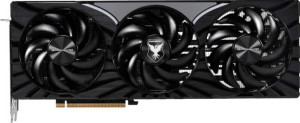
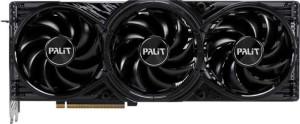
Both cards share an identical base clock of 2295 MHz, meaning neither has a manufacturing or binning advantage at stock frequencies. The gap opens under sustained load: the Palit RTX 5080 GamingPro OC boosts to 2700 MHz versus 2482 MHz on the Gainward RTX 5070 Ti Phoenix-S GS — a roughly 9% turbo advantage that compounds across every throughput metric that follows.
That clock delta, combined with a significantly larger shader array (10752 vs 8960 shading units, ~20% more), drives the real performance story. The RTX 5080 delivers 58.06 TFLOPS of floating-point throughput against 44.48 TFLOPS on the 5070 Ti — a ~30% lead that directly translates to faster frame generation, heavier ray-tracing workloads, and greater headroom at 4K. The texture rate gap mirrors this: 907.2 GTexels/s vs 695 GTexels/s, meaning the 5080 can feed textures to the pipeline considerably faster, which matters in highly detailed open-world scenes. The 5080 also holds an edge in memory speed (1875 MHz vs 1750 MHz) and pixel fillrate (302.4 vs 238.3 GPixel/s), the latter affecting how quickly the GPU can resolve high-resolution frames — relevant at 4K or with anti-aliasing enabled.
The verdict here is unambiguous: the Palit RTX 5080 GamingPro OC holds a clear and consistent advantage across every performance dimension in this group. Both cards support Double Precision Floating Point, so for compute or professional tasks requiring DPFP, neither has an edge there. But for gaming and graphics throughput, the 5080 outperforms the 5070 Ti by roughly 20–30% depending on the workload — a meaningful generational step up, not a marginal one.