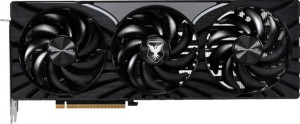
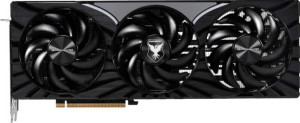
Both the Phoenix-S and the Phoenix-S GS share an identical architectural foundation: the same 8960 shading units, 280 TMUs, 96 ROPs, and a base GPU clock of 2295 MHz. They also match on memory speed at 1750 MHz and both support Double Precision Floating Point, confirming that the underlying silicon and compute structure are the same chip running the same memory subsystem.
The sole but consistent differentiator is the boost clock. The Phoenix-S GS reaches a turbo of 2482 MHz versus 2452 MHz on the standard Phoenix-S — a gap of 30 MHz, or roughly 1.2%. Because pixel rate, texture rate, and floating-point throughput are all directly derived from clock speed, this advantage propagates uniformly: the GS edges ahead with 44.48 TFLOPS versus 43.94, and 695 GTexels/s versus 686.6. In practice, a ~1.2% clock uplift sits well within frame-to-frame variance in games, so users are unlikely to perceive a tangible difference in real-world frame rates or rendering tasks.
On pure performance specs, the Phoenix-S GS holds a narrow edge thanks to its higher factory boost clock, which delivers marginally better theoretical throughput across every compute metric. However, given that the gap is under 1.5% on all figures and the core configuration is otherwise identical, this advantage is minimal. The GS essentially represents a factory-overclocked bin of the same GPU, and the performance delta would realistically be imperceptible without a benchmark tool. If the two products are similarly priced, the GS is the marginally stronger choice on paper; at a meaningful price premium, the standard Phoenix-S offers effectively the same real-world experience.