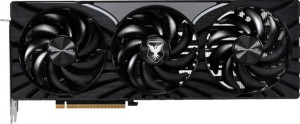
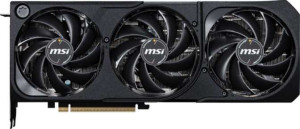
At the foundation, both the Gainward Phoenix-S and the MSI Shadow 3X OC are built on identical silicon configurations: 8960 shading units, 280 TMUs, and 96 ROPs — meaning neither card has a hardware advantage in terms of raw compute resources. Memory is also clocked identically at 1750 MHz on both. The real differentiator lives entirely in the boost clock: the MSI Shadow 3X OC is factory-tuned to a 2482 MHz turbo, versus 2452 MHz on the Gainward Phoenix-S — a 30 MHz edge that, while modest in percentage terms (~1.2%), directly lifts every performance metric derived from it.
That clock advantage cascades into a small but consistent lead for the MSI across throughput figures: 44.48 TFLOPS of floating-point performance versus 43.94 TFLOPS, and a texture fill rate of 695 GTexels/s compared to 686.6 GTexels/s. In practice, these differences are unlikely to be perceptible in standard gaming workloads, but they can matter at the margins in heavily shader-bound or compute-intensive scenarios. Both cards support Double Precision Floating Point, which is relevant for mixed-precision compute tasks beyond gaming.
The MSI Shadow 3X OC holds a narrow but clear performance edge in this group, courtesy of its higher factory boost clock translating into slightly better throughput across all derived metrics. The Gainward Phoenix-S is not meaningfully behind — the gap is small enough that real-world gaming frame rates would rarely diverge — but on paper, the MSI is the faster card of the two.