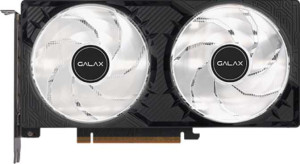
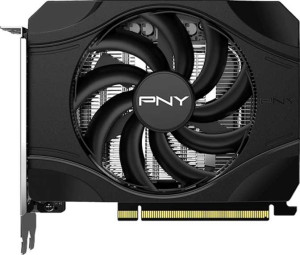
At the core, both the Galax GeForce RTX 5050 1-Click OC and the PNY GeForce RTX 5050 Single Fan share an identical architectural foundation: the same 2317 MHz base clock, 2560 shading units, 80 TMUs, 32 ROPs, and 2500 MHz memory speed. This means their theoretical parallelism and memory bandwidth are on completely equal footing — the raw GPU silicon is essentially the same, and neither card has a structural pipeline advantage over the other.
The only meaningful differentiator in this group is the GPU turbo (boost) clock: the Galax reaches 2587 MHz versus the PNY's 2572 MHz — a gap of just 15 MHz. This small boost advantage ripples through the derived metrics: the Galax edges ahead with 13.25 TFLOPS of floating-point performance versus 13.17 TFLOPS, and a texture rate of 207 GTexels/s against 205.8 GTexels/s. In practice, a ~0.6% clock difference of this magnitude will be entirely invisible in real-world gaming or compute workloads — it falls well within run-to-run variance and would not produce a measurable framerate difference in any benchmark.
Both cards support Double Precision Floating Point (DPFP), which matters for certain scientific or professional compute tasks, and here they are perfectly matched. The Galax holds a narrow technical edge on paper due to its slightly higher boost clock, but for all practical purposes, these two cards are performance equals in this group. The decision between them should rest on other factors such as cooling, price, or form factor rather than any real-world performance gap.