Galax GeForce RTX 5060 1-Click OC
Gigabyte GeForce RTX 5060 WindForce OC

Galax GeForce RTX 5060 1-Click OC Gigabyte GeForce RTX 5060 WindForce OC

Overview

Welcome to our in-depth spec comparison between the Galax GeForce RTX 5060 1-Click OC and the Gigabyte GeForce RTX 5060 WindForce OC. Both cards are built on the same cutting-edge Blackwell architecture, share identical GPU clocks, memory configurations, and feature sets, making this a uniquely close head-to-head. The key battleground in this comparison comes down to physical dimensions and how each card fits into your build.

Common Features

  • GPU clock speed is 2280 MHz on both products.
  • GPU turbo speed is 2512 MHz on both products.
  • Pixel rate is 120.6 GPixel/s on both products.
  • Floating-point performance is 19.29 TFLOPS on both products.
  • Texture rate is 301.4 GTexels/s on both products.
  • GPU memory speed is 1750 MHz on both products.
  • Both products have 3840 shading units.
  • Both products have 120 texture mapping units (TMUs).
  • Effective memory speed is 28000 MHz on both products.
  • Maximum memory bandwidth is 448 GB/s on both products.
  • Both products feature 8GB of GDDR7 VRAM.
  • Memory bus width is 128-bit on both products.
  • ECC memory is supported on both products.
  • Both products support DirectX 12 Ultimate.
  • OpenGL version is 4.6 on both products.
  • OpenCL version is 3 on both products.
  • Multi-display technology is supported on both products.
  • Ray tracing is supported on both products.
  • DLSS is supported on both products.
  • XeSS (XMX) is not available on either product.
  • Both products have one HDMI 2.1b output.
  • Both products offer three DisplayPort outputs.
  • Neither product includes USB-C, DVI, or mini DisplayPort outputs.
  • Both products are based on the Blackwell GPU architecture.
  • Thermal Design Power (TDP) is 145W on both products.
  • Both products use PCIe version 5.
  • Semiconductor size is 5 nm on both products.
  • Both products feature 21900 million transistors.
  • Air-water cooling is not available on either product.

Main Differences

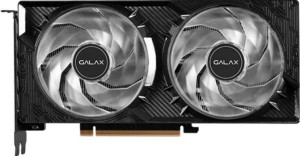
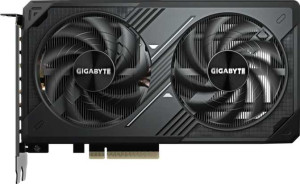
  • Width is 247 mm on the Galax GeForce RTX 5060 1-Click OC and 199 mm on the Gigabyte GeForce RTX 5060 WindForce OC.
  • Height is 131 mm on the Galax GeForce RTX 5060 1-Click OC and 116 mm on the Gigabyte GeForce RTX 5060 WindForce OC.
Specs Comparison
Galax GeForce RTX 5060 1-Click OC

Galax GeForce RTX 5060 1-Click OC

Gigabyte GeForce RTX 5060 WindForce OC

Gigabyte GeForce RTX 5060 WindForce OC

Performance:
GPU clock speed 2280 MHz 2280 MHz
GPU turbo 2512 MHz 2512 MHz
pixel rate 120.6 GPixel/s 120.6 GPixel/s
floating-point performance 19.29 TFLOPS 19.29 TFLOPS
texture rate 301.4 GTexels/s 301.4 GTexels/s
GPU memory speed 1750 MHz 1750 MHz
shading units 3840 3840
texture mapping units (TMUs) 120 120
render output units (ROPs) 48 48
Has Double Precision Floating Point (DPFP)

In the Performance category, the Galax GeForce RTX 5060 1-Click OC and the Gigabyte GeForce RTX 5060 WindForce OC are in complete lockstep across every measurable metric. Both cards share an identical base clock of 2280 MHz and a turbo clock of 2512 MHz, meaning neither card has a factory overclocking advantage out of the box. The same applies to memory speed at 1750 MHz, pixel rate at 120.6 GPixel/s, and floating-point performance at 19.29 TFLOPS — figures that place both squarely in the mid-range segment with capable real-time rendering throughput.

Digging deeper into the shader architecture reveals no surprises either: both GPUs field 3840 shading units, 120 TMUs, and 48 ROPs. The TMU count directly governs how quickly textures are applied to geometry, while the ROP count determines blending and output throughput — areas where both cards perform identically. The shared support for Double Precision Floating Point (DPFP) is a minor note of interest for users with compute or simulation workloads alongside gaming, though neither card differentiates here.

The conclusion for this group is straightforward: these two cards are a perfect tie on performance. Every clock speed, throughput figure, and architectural unit count is numerically identical. Buyers should therefore shift their decision criteria entirely to other factors — such as cooling design, build quality, dimensions, acoustics, and price — since raw performance alone offers no reason to prefer one over the other.
Memory:
effective memory speed 28000 MHz 28000 MHz
maximum memory bandwidth 448 GB/s 448 GB/s
VRAM 8GB 8GB
GDDR version GDDR7 GDDR7
memory bus width 128-bit 128-bit
Supports ECC memory

Both the Galax RTX 5060 1-Click OC and the Gigabyte RTX 5060 WindForce OC share an identical memory configuration built around GDDR7, the latest generation of graphics memory. Running at an effective speed of 28000 MHz across a 128-bit bus, this translates to a peak bandwidth of 448 GB/s — a figure that punches well above what previous-generation GDDR6X solutions could deliver on similar bus widths, thanks to GDDR7's architectural efficiency gains.

The practical implication is meaningful: higher memory bandwidth reduces the GPU's likelihood of stalling while feeding its shader array with texture and geometry data, particularly at higher resolutions or when using demanding texture packs. The 8GB VRAM allocation is the one area worth flagging for context — while sufficient for 1080p and most 1440p workloads today, it is a tighter ceiling than some competing mid-range cards offer, which prospective buyers should weigh against future-proofing concerns. Both cards also support ECC memory, a feature that enables error correction useful in compute and professional scenarios, though it has negligible impact in typical gaming use.

As with the Performance group, this category yields a dead tie. Every memory specification — speed, bandwidth, capacity, type, bus width, and ECC support — is identical across both cards. Memory configuration offers no basis for choosing one over the other.

Features:
DirectX version DirectX 12 Ultimate DirectX 12 Ultimate
OpenGL version 4.6 4.6
OpenCL version 3 3
Supports multi-display technology
supports ray tracing
Supports 3D
supports DLSS
has XeSS (XMX)
AMD SAM / Intel Resizable BAR Intel Resizable BAR Intel Resizable BAR
has LHR
has RGB lighting
supported displays 4 4

Feature parity continues to define this comparison. Both the Galax RTX 5060 1-Click OC and the Gigabyte RTX 5060 WindForce OC support DirectX 12 Ultimate, which is the current gold standard for modern gaming APIs and unlocks the full suite of advanced rendering features including hardware-accelerated ray tracing. Ray tracing support on both cards means realistic lighting, shadows, and reflections are accessible in titles that implement it, though real-world performance will depend on resolution and scene complexity.

DLSS support is another shared highlight — NVIDIA's AI-driven upscaling technology can substantially boost frame rates with minimal perceptible quality loss, making it one of the most practically valuable features on both cards for everyday gaming. Neither card supports XeSS, which is Intel's competing upscaling solution, though this is expected for NVIDIA hardware and not a meaningful omission. Both also support Intel Resizable BAR, which allows the CPU to access the full GPU framebuffer simultaneously rather than in small chunks, offering modest but real performance gains in supported games. Multi-display capability extends to up to 4 displays on both cards, catering to productivity and multi-monitor gaming setups alike.

Once again, the feature set is a complete tie. From API support and upscaling technologies to display connectivity and RGB lighting, no specification in this group distinguishes one card from the other. Buyers comparing these two on features alone will find no differentiator here.

Ports:
has an HDMI output
HDMI ports 1 1
HDMI version HDMI 2.1b HDMI 2.1b
DisplayPort outputs 3 3
USB-C ports 0 0
DVI outputs 0 0
mini DisplayPort outputs 0 0

The port layout on both the Galax RTX 5060 1-Click OC and the Gigabyte RTX 5060 WindForce OC follows the same modern configuration: one HDMI 2.1b port and three DisplayPort outputs, totaling four display connections. This aligns with the four-display limit noted in the Features group, meaning every output can be used simultaneously at maximum capacity.

HDMI 2.1b is a meaningful inclusion — it supports high refresh rates at 4K and even 8K resolutions, and is the connector of choice for users hooking up to a modern television or an AV receiver. The three DisplayPort outputs, meanwhile, serve monitor-centric setups well, accommodating multi-monitor productivity arrays or a mix of high-refresh gaming displays. The absence of USB-C, DVI, and mini DisplayPort outputs is unsurprising for current-generation mid-range cards and represents no practical loss for the vast majority of users.

There is nothing to separate these two cards on connectivity — the port selection is identical in every respect. Users with specific display requirements, such as a need for USB-C video output, will find neither card accommodating, but for standard monitor and TV setups the shared layout is entirely capable.

General info:
GPU architecture Blackwell Blackwell
release date May 2025 May 2025
Thermal Design Power (TDP) 145W 145W
PCI Express (PCIe) version 5 5
semiconductor size 5 nm 5 nm
number of transistors 21900 million 21900 million
Has air-water cooling
width 247 mm 199 mm
height 131 mm 116 mm

At the architectural level, these two cards are cut from exactly the same cloth. Both are built on NVIDIA's Blackwell architecture using a 5nm process node and pack 21,900 million transistors onto the die. They also share a 145W TDP and connect via PCIe 5.0, meaning power delivery requirements and motherboard compatibility are identical across both options.

The one area where this group finally surfaces a meaningful difference is physical size. The Galax RTX 5060 1-Click OC measures 247 × 131 mm, while the Gigabyte RTX 5060 WindForce OC is notably more compact at 199 × 116 mm — a difference of nearly 50mm in length and 15mm in height. That gap is significant in practice: the Gigabyte card will fit comfortably in smaller mid-tower and even some mini-ITX cases where the Galax card might not clear, making it the more versatile choice for space-constrained builds.

For general info, the Gigabyte WindForce OC holds a clear advantage purely on the basis of its smaller footprint. Both cards are thermally and architecturally equivalent, so the Gigabyte's more compact dimensions make it the better fit for a wider range of PC cases without any trade-off in underlying silicon capability.

Comparison Summary & Verdict

After examining the full specification breakdown, it is clear that the Galax GeForce RTX 5060 1-Click OC and the Gigabyte GeForce RTX 5060 WindForce OC are remarkably matched cards. Both deliver identical 19.29 TFLOPS of floating-point performance, 8GB of GDDR7 VRAM at 448 GB/s bandwidth, and the same robust feature set including ray tracing and DLSS support. The sole distinguishing factor is physical size: the Galax measures 247 mm wide and 131 mm tall, while the Gigabyte is a noticeably more compact 199 mm wide and 116 mm tall. If your case has tight clearances or you are building a smaller system, the Gigabyte WindForce OC is the practical choice. If case space is not a concern and you are comfortable with a larger card, the Galax 1-Click OC will serve you equally well in every performance metric.

Galax GeForce RTX 5060 1-Click OC
Buy Galax GeForce RTX 5060 1-Click OC if...

Buy the Galax GeForce RTX 5060 1-Click OC if you have a full-size case with ample room and are comfortable accommodating a larger card measuring 247 mm wide and 131 mm tall.

Gigabyte GeForce RTX 5060 WindForce OC
Buy Gigabyte GeForce RTX 5060 WindForce OC if...

Buy the Gigabyte GeForce RTX 5060 WindForce OC if you need a more compact GPU, as its smaller 199 mm width and 116 mm height make it the better fit for tighter or smaller PC builds.