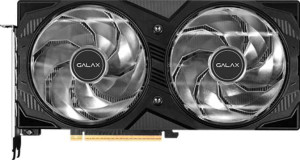
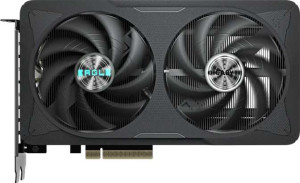
At their core, the Galax GeForce RTX 5060 EX and the Gigabyte GeForce RTX 5060 Eagle OC share an identical silicon foundation: the same 3840 shading units, 120 TMUs, 48 ROPs, and 1750 MHz memory speed. Both also support Double Precision Floating Point, which is relevant for compute workloads but largely inconsequential for gaming. The base GPU clock is likewise locked at 2280 MHz on both cards, meaning out-of-the-box behavior before boost kicks in is perfectly matched.
The only differentiator within this group is the boost clock. The Gigabyte Eagle OC boosts to 2550 MHz versus the Galax EX's 2535 MHz — a gap of just 15 MHz, or roughly 0.6%. This translates into a marginal lead in derived metrics: the Eagle OC edges ahead with 19.58 TFLOPS of floating-point performance versus 19.47 TFLOPS, and a texture rate of 306 GTexels/s versus 304.2 GTexels/s. In practice, these differences fall well within the noise floor of real-world frame time variance and are unlikely to produce any measurable difference in gaming or GPU-compute benchmarks.
From a pure performance standpoint, the two cards are effectively tied. The Gigabyte Eagle OC holds a technical edge on paper thanks to its slightly higher turbo clock, but the margin is so slim that it will not manifest as a perceptible advantage in actual use. Buyers should look to other spec groups — cooling, memory capacity, power draw, or price — to differentiate between these two cards, as raw GPU performance alone offers no meaningful reason to choose one over the other.