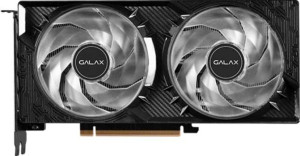
Galax GeForce RTX 5060 Ti 1-Click OC 16GB
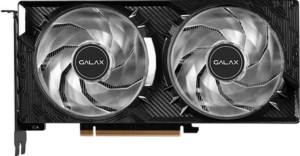
Galax GeForce RTX 5060 Ti 1-Click OC 8GB

Galax GeForce RTX 5060 Ti 1-Click OC 16GB Galax GeForce RTX 5060 Ti 1-Click OC 8GB

Overview

Welcome to our detailed spec comparison between the Galax GeForce RTX 5060 Ti 1-Click OC 16GB and the Galax GeForce RTX 5060 Ti 1-Click OC 8GB. Both cards share the same Blackwell architecture, identical clock speeds, and a unified feature set, yet they diverge in one critical area: VRAM capacity. If you are trying to decide which of these two GPUs best suits your needs, this comparison will help you cut through the noise.

Common Features

  • GPU clock speed is 2407 MHz on both products.
  • GPU turbo speed is 2587 MHz on both products.
  • Pixel rate is 124.2 GPixel/s on both products.
  • Floating-point performance is 23.84 TFLOPS on both products.
  • Texture rate is 372.5 GTexels/s on both products.
  • GPU memory speed is 1750 MHz on both products.
  • Shading units count is 4608 on both products.
  • Texture mapping units (TMUs) count is 144 on both products.
  • Effective memory speed is 28000 MHz on both products.
  • Maximum memory bandwidth is 448 GB/s on both products.
  • Both products use GDDR7 memory.
  • Memory bus width is 128-bit on both products.
  • ECC memory is supported on both products.
  • DirectX 12 Ultimate is supported on both products.
  • OpenGL version is 4.6 on both products.
  • OpenCL version is 3 on both products.
  • Multi-display technology is supported on both products.
  • Ray tracing is supported on both products.
  • DLSS is supported on both products.
  • XeSS (XMX) is not available on either product.
  • Both products have an HDMI output.
  • HDMI port count is 1 on both products.
  • HDMI version is 2.1b on both products.
  • DisplayPort output count is 3 on both products.
  • Neither product has USB-C ports.
  • Neither product has DVI outputs.
  • Neither product has mini DisplayPort outputs.
  • GPU architecture is Blackwell on both products.
  • Thermal Design Power (TDP) is 180W on both products.
  • PCIe version is 5 on both products.
  • Semiconductor size is 5 nm on both products.
  • Number of transistors is 21900 million on both products.
  • Neither product features air-water cooling.
  • Width is 247 mm on both products.
  • Height is 131 mm on both products.
  • 3D support is available on both products.

Main Differences

  • VRAM is 16GB on Galax GeForce RTX 5060 Ti 1-Click OC 16GB and 8GB on Galax GeForce RTX 5060 Ti 1-Click OC 8GB.
Specs Comparison
Galax GeForce RTX 5060 Ti 1-Click OC 16GB

Galax GeForce RTX 5060 Ti 1-Click OC 16GB

Galax GeForce RTX 5060 Ti 1-Click OC 8GB

Galax GeForce RTX 5060 Ti 1-Click OC 8GB

Performance:
GPU clock speed 2407 MHz 2407 MHz
GPU turbo 2587 MHz 2587 MHz
pixel rate 124.2 GPixel/s 124.2 GPixel/s
floating-point performance 23.84 TFLOPS 23.84 TFLOPS
texture rate 372.5 GTexels/s 372.5 GTexels/s
GPU memory speed 1750 MHz 1750 MHz
shading units 4608 4608
texture mapping units (TMUs) 144 144
render output units (ROPs) 48 48
Has Double Precision Floating Point (DPFP)

In the Performance category, the Galax RTX 5060 Ti 1-Click OC 16GB and the Galax RTX 5060 Ti 1-Click OC 8GB are, in every measurable way, identical. Both cards share the same 2407 MHz base clock and 2587 MHz boost clock, the same 4608 shading units, 144 TMUs, and 48 ROPs, and deliver the exact same 23.84 TFLOPS of floating-point performance, 372.5 GTexels/s texture rate, and 124.2 GPixel/s pixel fill rate. Even memory speed is locked at 1750 MHz on both.

What this tells us is that the two variants are built on the same GPU die running at the same frequencies, with no binning difference or clock advantage given to either model. The compute throughput, shader horsepower, and rasterization pipeline are functionally equivalent, meaning in GPU-bound scenarios the two cards will perform within margin-of-error of each other. The presence of Double Precision Floating Point (DPFP) on both is a minor plus for users doing compute or scientific workloads, though it is not a differentiator between the two.

For this specific group, the verdict is a complete tie. Neither variant holds any performance edge over the other based on these specs. The only distinction between the two products lies outside this group — namely VRAM capacity — which will matter in memory-bound workloads but does not change the raw compute profile analyzed here.

Memory:
effective memory speed 28000 MHz 28000 MHz
maximum memory bandwidth 448 GB/s 448 GB/s
VRAM 16GB 8GB
GDDR version GDDR7 GDDR7
memory bus width 128-bit 128-bit
Supports ECC memory

The memory subsystem is where these two otherwise identical cards finally diverge. Both run GDDR7 over a 128-bit bus at an effective speed of 28000 MHz, yielding 448 GB/s of bandwidth — a strong figure for this bus width, made possible by GDDR7's improved efficiency over its predecessor. That shared foundation means neither card has a bandwidth advantage over the other in practice.

The decisive difference is capacity: the 16GB variant carries 16 GB of VRAM versus 8 GB on the 8GB model — exactly double. VRAM capacity does not affect raw throughput speed, but it determines how large a workload the GPU can hold on-die without spilling to slower system memory. At modern gaming resolutions with high-resolution texture packs, or in AI and creative workloads that stage large assets on the GPU, hitting the VRAM ceiling causes sharp, visible performance drops. With 8 GB increasingly tight at higher settings in demanding titles, the 16 GB model provides substantially more headroom for the present and near future.

The clear winner in this group is the 16GB variant. The bandwidth and memory technology are equal, so there is no trade-off to weigh — the only variable is capacity, and more is unambiguously better here. For users targeting high-fidelity gaming, content creation, or any memory-intensive workload, the additional 8 GB of buffer the 16GB model provides is a meaningful and practical advantage.

Features:
DirectX version DirectX 12 Ultimate DirectX 12 Ultimate
OpenGL version 4.6 4.6
OpenCL version 3 3
Supports multi-display technology
supports ray tracing
Supports 3D
supports DLSS
has XeSS (XMX)
AMD SAM / Intel Resizable BAR Intel Resizable BAR Intel Resizable BAR
has LHR
has RGB lighting
supported displays 4 4

Across every feature in this group, the two cards are a perfect match. Both support DirectX 12 Ultimate and ray tracing, which together enable the full suite of modern rendering techniques — hardware-accelerated reflections, shadows, and global illumination in supported titles. Equally important for competitive and quality-focused gamers alike is shared support for DLSS, NVIDIA's AI-driven upscaling technology that boosts frame rates with minimal visual cost, effectively making both cards punch above their native rasterization weight.

On the practical side, each card supports up to 4 displays simultaneously and includes Intel Resizable BAR, which allows the CPU to access the full GPU frame buffer at once rather than in chunks — a low-level optimization that can yield modest but real frame rate gains in supported games and systems. Neither card carries an LHR (Lite Hash Rate) limiter, though this is largely a non-issue in today's market. RGB lighting is present on both, which matters to builders prioritizing aesthetics.

This group is a straightforward tie. Every feature — from API support and upscaling to display output and resizable BAR — is shared identically between the 16GB and 8GB models. A buyer choosing between the two will find no functional or feature-set difference here; the decision remains entirely a question of how much VRAM is needed for their target workloads.

Ports:
has an HDMI output
HDMI ports 1 1
HDMI version HDMI 2.1b HDMI 2.1b
DisplayPort outputs 3 3
USB-C ports 0 0
DVI outputs 0 0
mini DisplayPort outputs 0 0

Port configuration is identical across both cards. Each offers 3 DisplayPort outputs and 1 HDMI 2.1b port for a total of four physical outputs — consistent with the four-display limit noted in the Features group. HDMI 2.1b is the most current HDMI specification, supporting high refresh rates at 4K and beyond, along with features like Variable Refresh Rate (VRR) and Auto Low Latency Mode (ALLM), making it well-suited for modern TVs and high-end monitors alike.

The absence of USB-C, DVI, and mini DisplayPort outputs is worth noting for users with legacy or specialized display setups, though neither card is at a disadvantage relative to the other since both share the same omissions. The three full-size DisplayPort outputs are the workhorses here — ideal for multi-monitor productivity rigs or daisy-chaining compatible displays.

This group is another tie. The port layout, connector types, and display protocol versions are completely identical between the 16GB and 8GB variants. No advantage exists for either card in terms of connectivity.

General info:
GPU architecture Blackwell Blackwell
release date April 2025 April 2025
Thermal Design Power (TDP) 180W 180W
PCI Express (PCIe) version 5 5
semiconductor size 5 nm 5 nm
number of transistors 21900 million 21900 million
Has air-water cooling
width 247 mm 247 mm
height 131 mm 131 mm

Both cards are built on the same physical and architectural foundation. The Blackwell architecture fabricated on a 5 nm process with 21,900 million transistors is shared identically, meaning the silicon inside each card is the same die. The 180W TDP applies equally to both, so power supply requirements, cooling demands, and expected thermals are indistinguishable between the two variants — a builder sizing a PSU or planning airflow needs to make no distinction here.

Physically, the cards are also identical: both measure 247 mm × 131 mm and use air cooling exclusively. This means case compatibility, slot footprint, and cooling solution are the same, removing any installation or clearance considerations that might otherwise differentiate them. PCIe 5.0 support on both ensures full bandwidth headroom on current-generation motherboards, while maintaining backward compatibility with older platforms — a non-issue for comparison purposes but a relevant future-proofing detail shared by both.

Unsurprisingly, this group is a complete tie. From die architecture and process node down to physical dimensions and thermal envelope, the 16GB and 8GB models are engineered from the same blueprint. Buyers can make their choice purely on the memory capacity question without any concern that one variant differs in build quality, power draw, or physical fit.

Comparison Summary & Verdict

After examining every specification, the Galax GeForce RTX 5060 Ti 1-Click OC 16GB and the Galax GeForce RTX 5060 Ti 1-Click OC 8GB are virtually identical cards in terms of raw compute power, delivering the same 23.84 TFLOPS of floating-point performance, the same 2587 MHz turbo clock, and the same 448 GB/s memory bandwidth over a 128-bit GDDR7 bus. The sole differentiator is VRAM: 16 GB versus 8 GB. For users targeting high-resolution gaming, content creation, or AI workloads where large frame buffers matter, the 16 GB model offers meaningful headroom. For budget-conscious buyers running 1080p or light 1440p workloads, the 8 GB variant delivers the same performance ceiling at a lower cost.

Galax GeForce RTX 5060 Ti 1-Click OC 16GB
Buy Galax GeForce RTX 5060 Ti 1-Click OC 16GB if...

Buy the Galax GeForce RTX 5060 Ti 1-Click OC 16GB if you need a larger VRAM buffer for demanding workloads such as high-resolution gaming, 3D rendering, or AI tasks.

Galax GeForce RTX 5060 Ti 1-Click OC 8GB
Buy Galax GeForce RTX 5060 Ti 1-Click OC 8GB if...

Buy the Galax GeForce RTX 5060 Ti 1-Click OC 8GB if your workloads are less memory-intensive and you want the same core GPU performance at a more accessible price point.