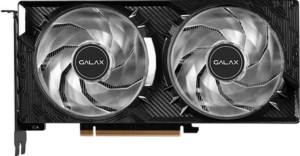
Galax GeForce RTX 5060 Ti 1-Click OC 8GB
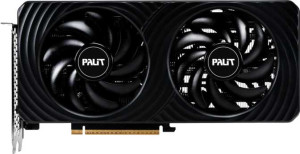
Palit GeForce RTX 5060 Ti Dual 8GB

Galax GeForce RTX 5060 Ti 1-Click OC 8GB Palit GeForce RTX 5060 Ti Dual 8GB

Overview

When choosing between the Galax GeForce RTX 5060 Ti 1-Click OC 8GB and the Palit GeForce RTX 5060 Ti Dual 8GB, you are looking at two cards that share the same Blackwell architecture, 8GB GDDR7 memory, and a 180W TDP, making them remarkably close on paper. Yet subtle but real distinctions exist across boost clock speeds, raw compute figures, and physical form factor dimensions that could tip the balance depending on your priorities. Read on to see exactly where each card pulls ahead.

Common Features

  • Both GPUs have a base GPU clock speed of 2407 MHz.
  • Both GPUs have a GPU memory speed of 1750 MHz.
  • Both GPUs feature 4608 shading units.
  • Both GPUs have 144 texture mapping units (TMUs).
  • Both GPUs have 48 render output units (ROPs).
  • Double Precision Floating Point (DPFP) is supported on both GPUs.
  • Both GPUs have an effective memory speed of 28000 MHz.
  • Both GPUs offer a maximum memory bandwidth of 448 GB/s.
  • Both GPUs come with 8GB of VRAM.
  • Both GPUs use GDDR7 memory.
  • Both GPUs have a 128-bit memory bus width.
  • ECC memory is supported on both GPUs.
  • Both GPUs support DirectX 12 Ultimate.
  • Both GPUs support OpenGL version 4.6.
  • Both GPUs support OpenCL version 3.
  • Multi-display technology is supported on both GPUs.
  • Ray tracing is supported on both GPUs.
  • 3D support is available on both GPUs.
  • DLSS is supported on both GPUs.
  • XeSS (XMX) is not available on either GPU.
  • Both GPUs have one HDMI 2.1b output.
  • Both GPUs have 3 DisplayPort outputs.
  • Neither GPU has USB-C or DVI outputs.
  • Both GPUs are based on the Blackwell architecture.
  • Both GPUs have a Thermal Design Power (TDP) of 180W.
  • Both GPUs use PCIe version 5.
  • Both GPUs are built on a 5 nm semiconductor process.
  • Both GPUs contain 21900 million transistors.
  • Neither GPU features air-water cooling.

Main Differences

  • GPU turbo clock speed is 2587 MHz on Galax GeForce RTX 5060 Ti 1-Click OC 8GB and 2573 MHz on Palit GeForce RTX 5060 Ti Dual 8GB.
  • Pixel rate is 124.2 GPixel/s on Galax GeForce RTX 5060 Ti 1-Click OC 8GB and 123.5 GPixel/s on Palit GeForce RTX 5060 Ti Dual 8GB.
  • Floating-point performance is 23.84 TFLOPS on Galax GeForce RTX 5060 Ti 1-Click OC 8GB and 23.71 TFLOPS on Palit GeForce RTX 5060 Ti Dual 8GB.
  • Texture rate is 372.5 GTexels/s on Galax GeForce RTX 5060 Ti 1-Click OC 8GB and 370.5 GTexels/s on Palit GeForce RTX 5060 Ti Dual 8GB.
  • Width is 247 mm on Galax GeForce RTX 5060 Ti 1-Click OC 8GB and 262.1 mm on Palit GeForce RTX 5060 Ti Dual 8GB.
  • Height is 131 mm on Galax GeForce RTX 5060 Ti 1-Click OC 8GB and 126.3 mm on Palit GeForce RTX 5060 Ti Dual 8GB.
Specs Comparison
Galax GeForce RTX 5060 Ti 1-Click OC 8GB

Galax GeForce RTX 5060 Ti 1-Click OC 8GB

Palit GeForce RTX 5060 Ti Dual 8GB

Palit GeForce RTX 5060 Ti Dual 8GB

Performance:
GPU clock speed 2407 MHz 2407 MHz
GPU turbo 2587 MHz 2573 MHz
pixel rate 124.2 GPixel/s 123.5 GPixel/s
floating-point performance 23.84 TFLOPS 23.71 TFLOPS
texture rate 372.5 GTexels/s 370.5 GTexels/s
GPU memory speed 1750 MHz 1750 MHz
shading units 4608 4608
texture mapping units (TMUs) 144 144
render output units (ROPs) 48 48
Has Double Precision Floating Point (DPFP)

At their core, the Galax RTX 5060 Ti 1-Click OC and the Palit RTX 5060 Ti Dual are built on identical silicon: both share the same 4608 shading units, 144 TMUs, 48 ROPs, and 1750 MHz memory speed, which means their theoretical throughput ceilings and memory bandwidth are exactly the same. The base GPU clock of 2407 MHz is also shared, confirming these are both standard RTX 5060 Ti dies with no fundamental architectural difference between them.

The only meaningful separation comes from the boost clock. The Galax's factory overclock pushes its turbo to 2587 MHz versus the Palit's 2573 MHz — a gap of just 14 MHz. This directly flows into every derived throughput metric: the Galax edges ahead with 23.84 TFLOPS of floating-point performance versus 23.71 TFLOPS, and a texture rate of 372.5 GTexels/s compared to 370.5 GTexels/s. In practice, a ~0.5% clock advantage translates to differences well within run-to-run benchmark variance — no user will perceive it in actual workloads or gameplay.

Both cards support Double Precision Floating Point (DPFP), which is relevant for compute or professional workloads rather than gaming. Overall, the Galax holds a marginal theoretical edge in this group solely due to its factory overclock, but the real-world performance gap is negligible. The choice between them on performance grounds alone is effectively a tie.

Memory:
effective memory speed 28000 MHz 28000 MHz
maximum memory bandwidth 448 GB/s 448 GB/s
VRAM 8GB 8GB
GDDR version GDDR7 GDDR7
memory bus width 128-bit 128-bit
Supports ECC memory

The memory subsystems of the Galax RTX 5060 Ti 1-Click OC and the Palit RTX 5060 Ti Dual are completely identical across every measurable dimension. Both carry 8GB of GDDR7 over a 128-bit bus, running at an effective speed of 28000 MHz for a peak bandwidth of 448 GB/s. There is no differentiator to find here — this is the same memory configuration in every respect.

The generational context is worth noting: GDDR7 brings a substantial bandwidth improvement over the GDDR6X used in prior-generation cards, and 448 GB/s on a 128-bit bus is a direct result of that newer standard's higher per-pin data rates. This helps offset what would otherwise be a bandwidth constraint from the relatively narrow bus — meaning both cards are better equipped to feed their shading units at 1080p and 1440p than raw bus width alone might suggest. ECC memory support is also present on both, a feature that adds error-correction reliability relevant to compute and professional use cases.

This group is an unambiguous complete tie. Neither card holds any memory advantage whatsoever, and buyers should look to other specification groups — such as cooling, power, or physical design — to differentiate between them.

Features:
DirectX version DirectX 12 Ultimate DirectX 12 Ultimate
OpenGL version 4.6 4.6
OpenCL version 3 3
Supports multi-display technology
supports ray tracing
Supports 3D
supports DLSS
has XeSS (XMX)
AMD SAM / Intel Resizable BAR Intel Resizable BAR Intel Resizable BAR
has LHR
has RGB lighting
supported displays 4 4

Feature parity between the Galax RTX 5060 Ti 1-Click OC and the Palit RTX 5060 Ti Dual is total. Both support DirectX 12 Ultimate, ray tracing, and DLSS — the three pillars of modern GeForce feature sets. DirectX 12 Ultimate ensures compatibility with the full range of current and near-future rendering techniques, while DLSS provides AI-driven upscaling that can meaningfully recover frame rates in ray-traced or demanding rasterized scenes.

On the practical side, both cards support up to 4 simultaneous displays and include Intel Resizable BAR, which allows the CPU to access the full GPU frame buffer at once rather than in smaller chunks — a low-cost performance uplift in many modern titles that requires no user configuration beyond a compatible platform. Neither card carries LHR (Lite Hash Rate) restrictions, and both feature RGB lighting, which is a cosmetic consideration but relevant for builds with windowed cases.

With no feature present on one card that is absent on the other, this group is a complete tie. Buyers gain exactly the same software capabilities, display support, and platform features regardless of which card they choose.

Ports:
has an HDMI output
HDMI ports 1 1
HDMI version HDMI 2.1b HDMI 2.1b
DisplayPort outputs 3 3
USB-C ports 0 0
DVI outputs 0 0
mini DisplayPort outputs 0 0

Both the Galax RTX 5060 Ti 1-Click OC and the Palit RTX 5060 Ti Dual offer an identical port layout: 1 HDMI 2.1b and 3 DisplayPort outputs, for a total of four connectors — matching the four-display limit noted in their feature specs. The absence of USB-C, DVI, or mini-DisplayPort outputs is consistent with modern mid-range GPU design, where those legacy and alternate connectors have largely been retired.

The HDMI 2.1b standard is the key detail worth unpacking. It supports up to 10K resolution and high refresh rates at 4K, including 4K/144Hz and beyond without compression — making it a strong choice for connecting to modern gaming monitors or televisions that use HDMI rather than DisplayPort. The three DisplayPort outputs round out a versatile multi-monitor setup capability, and the 4-display ceiling means power users running productivity arrays are well covered.

Port selection is a complete tie between these two cards. Anyone choosing between them based on connectivity will find absolutely no difference — the same resolutions, the same display count, and the same connector types on both.

General info:
GPU architecture Blackwell Blackwell
release date April 2025 April 2025
Thermal Design Power (TDP) 180W 180W
PCI Express (PCIe) version 5 5
semiconductor size 5 nm 5 nm
number of transistors 21900 million 21900 million
Has air-water cooling
width 247 mm 262.1 mm
height 131 mm 126.3 mm

Architecturally, these two cards are cut from the same cloth. Both are built on the Blackwell architecture using a 5nm process with 21.9 billion transistors, share an identical 180W TDP, and use PCIe 5.0 — meaning power requirements, platform compatibility, and the underlying silicon are completely equivalent. Neither uses liquid cooling, relying instead on air solutions from their respective vendors.

The only distinction this group surfaces is physical footprint. The Galax 1-Click OC measures 247 mm in length and 131 mm in height, while the Palit Dual is slightly longer at 262.1 mm but marginally shorter at 126.3 mm. The Palit extends roughly 15 mm further into the case, which could matter in compact mid-tower or mini-ITX builds with tight GPU clearance. The Galax, meanwhile, is about 5 mm taller, which is rarely a constraint but worth verifying against PCIe slot spacing in dense multi-card or heavily populated motherboard configurations.

For most standard cases, neither dimension difference will be a practical obstacle, but the Galax holds a slight edge for length-constrained builds while the Palit fits marginally better where height is the limiting factor. Buyers with compact cases should measure clearance carefully before committing to either.

Comparison Summary & Verdict

After a thorough look at every available data point, both cards are built on the same strong foundation: Blackwell architecture, 8GB GDDR7 at 448 GB/s bandwidth, identical port configurations, and full support for ray tracing and DLSS. The Galax GeForce RTX 5060 Ti 1-Click OC 8GB edges ahead in every performance metric, delivering a higher GPU turbo of 2587 MHz, 23.84 TFLOPS of floating-point performance, and a slightly superior texture and pixel rate. It is also the more compact card in terms of width at 247 mm. The Palit GeForce RTX 5060 Ti Dual 8GB matches it in every architectural and feature respect but runs a modestly lower boost clock of 2573 MHz and measures wider at 262.1 mm, though it is marginally shorter at 126.3 mm. Neither card offers a dramatic leap over the other, so case clearance and cooler design may ultimately be the deciding factor for many buyers.

Galax GeForce RTX 5060 Ti 1-Click OC 8GB
Buy Galax GeForce RTX 5060 Ti 1-Click OC 8GB if...

Buy the Galax GeForce RTX 5060 Ti 1-Click OC 8GB if you want the highest available boost clock and floating-point performance of the two, and prefer a narrower card that is easier to fit in tighter cases.

Palit GeForce RTX 5060 Ti Dual 8GB
Buy Palit GeForce RTX 5060 Ti Dual 8GB if...

Buy the Palit GeForce RTX 5060 Ti Dual 8GB if a slightly shorter card height better suits your case clearance constraints and the marginal performance difference is not a concern for you.