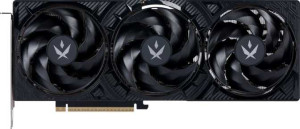
At the heart of the performance gap between these two cards lies the sheer difference in shader hardware. The Inno3D RTX 5080 X3 fields 10,752 shading units, 336 TMUs, and 112 ROPs against the Galax RTX 5070 Fire's 6,144 shaders, 192 TMUs, and 80 ROPs — roughly a 75% advantage across the board. This isn't a marginal uplift; it reflects a fundamentally larger GPU die with far more parallel compute resources, meaning the 5080 X3 can process significantly more geometry, textures, and pixels in every rendered frame.
That hardware advantage translates directly into the throughput numbers. The 5080 X3 delivers 56.28 TFLOPS of floating-point performance versus 30.87 TFLOPS on the 5070 Fire — an 82% lead — while its texture rate of 879.3 GTexels/s nearly doubles the 5070 Fire's 482.3 GTexels/s. In practice, this means the 5080 X3 handles high-resolution rendering, compute-heavy workloads, and texture-intensive scenes with considerably more headroom. The 5080 X3 also has a higher turbo clock (2617 MHz vs 2512 MHz) and faster memory speed (1875 MHz vs 1750 MHz), compounding the advantage. Interestingly, the 5070 Fire has a marginally higher base clock (2325 MHz vs 2295 MHz), but this is inconsequential given the 5080 X3's dominance in every throughput metric.
Both cards support Double Precision Floating Point (DPFP), making them viable for certain professional or scientific compute tasks. Overall, the Inno3D RTX 5080 X3 holds a decisive and unambiguous performance edge in every meaningful metric — from raw compute to texturing to pixel output. The 5070 Fire is not a slow card, but the 5080 X3 is in a clearly higher performance tier, and users prioritizing maximum rendering throughput will find the gap hard to ignore.