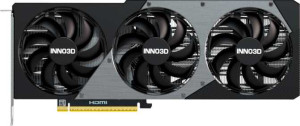
At the foundation, both the Galax EX Gamer 1-Click OC and the Inno3D X3 share the same core silicon architecture: identical 8960 shading units, 280 TMUs, 96 ROPs, and a base GPU clock of 2295 MHz, along with the same 1750 MHz memory speed. This means both cards are drawing from the exact same well of raw hardware resources — the real-world differentiator here comes down entirely to how aggressively each manufacturer has tuned the boost behavior.
That is where the Galax pulls ahead. Its GPU turbo of 2497 MHz outpaces the Inno3D's 2452 MHz — a 45 MHz advantage that cascades directly into every derived throughput metric. The Galax delivers 44.75 TFLOPS of floating-point performance versus 43.94 TFLOPS for the Inno3D, a roughly 1.8% gap. Similarly, its texture rate of 699.2 GTexels/s and pixel rate of 239.7 GPixel/s edge out the Inno3D's 686.6 GTexels/s and 235.4 GPixel/s. In practice, these differences are modest and unlikely to produce perceptible frame rate gaps in most gaming scenarios, but they do confirm that the Galax carries a mild factory overclock advantage out of the box.
The Galax EX Gamer 1-Click OC holds a clear, if narrow, performance edge in this group, driven purely by its higher boost clock. Both cards support double-precision floating point, which matters for compute and professional workloads. If maximum out-of-the-box throughput is the priority, the Galax is the stronger choice; the Inno3D X3 trades a small performance ceiling for what may be other design trade-offs evaluated elsewhere.