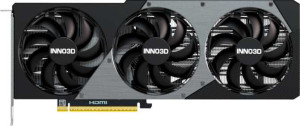
Both cards share the same RTX 5070 Ti silicon foundation, which is reflected in their identical base clocks of 2295 MHz, matching shader counts of 8960 units, and the same TMU and ROP configurations (280 and 96, respectively). Memory bandwidth is also on equal footing, with both running at 1750 MHz. This means that in sustained, thermally-constrained workloads, the two cards are effectively indistinguishable.
The meaningful — if modest — differentiator lies in the boost clock. The Galax EX Gamer 1-Click OC reaches a turbo of 2497 MHz, compared to 2482 MHz on the Inno3D X3 OC. That 15 MHz gap cascades into slightly higher derived metrics: the Galax edges ahead with 44.75 TFLOPS of floating-point performance versus 44.48 TFLOPS, and a texture rate of 699.2 GTexels/s against 695 GTexels/s. In practice, these differences fall well within single-digit percentage territory and are unlikely to produce frame rate deltas a user would notice without benchmarking tools.
Overall, the Galax holds a narrow but clear performance edge in this group, courtesy of its factory overclock pushing the boost clock higher. Both cards support Double Precision Floating Point, which is relevant for compute workloads but inconsequential for gaming. For pure rasterization and AI-accelerated rendering, the Galax is the marginally faster card on paper — though real-world gaming performance will hinge far more on cooling headroom and power delivery than this small clock speed advantage suggests.