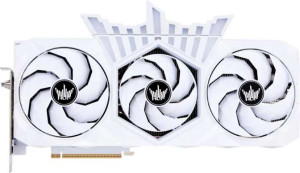
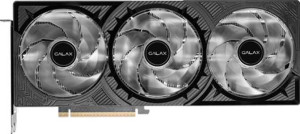
Both cards share an identical base clock of 2295 MHz, but their paths diverge at boost frequencies and, more importantly, in raw silicon scale. The HOF OC Lab Deluxe boosts to 2580 MHz while the 1-Click OC reaches 2625 MHz — a modest 45 MHz gap that on its own would be nearly imperceptible. The real story is in what those clocks are driving: the 5080 fields 10,752 shading units against the 5070 Ti's 8,960, a roughly 20% wider compute array that compounds across every throughput metric.
That scaling is consistent and significant. Floating-point throughput lands at 56.45 TFLOPS on the 5080 versus 46.23 TFLOPS on the 5070 Ti HOF — a ~22% advantage that directly translates to headroom in compute-heavy workloads like ray tracing, AI-accelerated features, and high-resolution rendering. Texture throughput follows the same pattern (882 vs. 722.4 GTexels/s), as does pixel fill rate (294 vs. 247.7 GPixel/s), meaning the 5080 is faster not just in one dimension but uniformly across the rendering pipeline. The 5080's higher memory clock of 1875 MHz versus 1750 MHz further ensures the wider GPU isn't memory-starved under pressure.
The Galax GeForce RTX 5080 1-Click OC holds a clear and consistent performance edge in this group. Its advantage isn't a quirk of one inflated spec — it reflects a larger, faster chip running at a slightly higher boost clock with quicker memory. For users prioritizing raw throughput, the 5080 is the stronger card; the 5070 Ti HOF OC Lab Deluxe remains competitive but is outpaced by roughly 20% across the board.