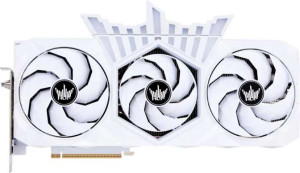
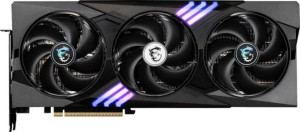
At first glance, the clock speed gap between these two cards is almost negligible — the MSI GeForce RTX 5070 Gaming Trio OC runs a base of 2325 MHz and a turbo of 2610 MHz, edging out the Galax GeForce RTX 5070 Ti HOF OC Lab Deluxe at 2295 / 2580 MHz. However, clock speed alone is a deeply misleading metric when the underlying silicon is this different. The real story is in the compute units: the Galax Ti variant fields 8960 shading units, 280 TMUs, and 96 ROPs, versus the MSI's 6144 shaders, 192 TMUs, and 80 ROPs — roughly a 46% wider execution engine across the board.
That hardware gap translates directly into throughput numbers that are impossible to ignore. The Galax HOF delivers 46.23 TFLOPS of floating-point performance and a texture rate of 722.4 GTexels/s, compared to the MSI's 32.07 TFLOPS and 501.1 GTexels/s — differences of approximately 44% and 44% respectively. In practice, this means the Galax handles heavier geometry, larger shaders, and more complex scenes with considerably more headroom, particularly at 4K or in GPU-compute workloads. The pixel rate advantage (247.7 vs 208.8 GPixel/s) further reinforces the Galax's edge in fill-rate-sensitive scenarios. Both cards share an identical 1750 MHz memory speed and both support Double Precision Floating Point, so those dimensions offer no differentiation.
The Galax GeForce RTX 5070 Ti HOF OC Lab Deluxe holds a clear and substantial performance advantage in this group. The MSI Gaming Trio OC's marginally higher clock speeds are entirely outweighed by the Ti-class architecture's much larger shader array, making the Galax the stronger choice for anyone prioritizing raw throughput, whether in gaming or professional GPU-compute tasks.