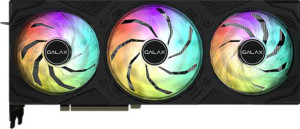
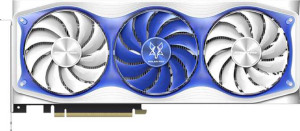
At their core, both the Galax RTX 5080 EX Gamer 1-Click OC and the Manli Polar Fox RTX 5080 OC share identical silicon foundations: the same 10,752 shading units, 336 TMUs, 112 ROPs, and a base GPU clock of 2295 MHz with memory running at 1875 MHz. This means rasterization throughput, memory bandwidth, and compute architecture are effectively equivalent between the two cards before boost clocks enter the picture.
The only meaningful differentiator in this group lies in the boost clock and the performance figures derived from it. The Manli Polar Fox boosts to 2640 MHz versus the Galax's 2617 MHz — a gap of 23 MHz, or roughly 0.9%. This translates directly into slightly higher throughput across every compute metric: 56.77 TFLOPS of floating-point performance versus 56.28 TFLOPS, a texture fill rate of 887 GTexels/s against 879.3 GTexels/s, and a pixel rate of 295.7 GPixel/s compared to 293.1 GPixel/s. In practice, differences of this magnitude — under 1% across the board — are statistically invisible in gaming frame rates or real-world rendering workloads.
The Manli Polar Fox holds a narrow technical edge in this performance group purely on paper, owing to its marginally higher boost clock. However, because the gap is well within normal run-to-run variance and both cards share identical core hardware, this advantage should not be treated as a meaningful real-world differentiator. For all practical purposes, performance in this group is a virtual tie, and buyers should weigh other factors — such as cooling design, price, and warranty — rather than the boost clock delta alone.