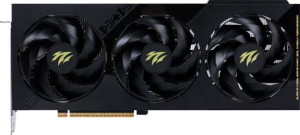
Galax GeForce RTX 5080 Magic Blade
Nvidia GeForce RTX 5080

Galax GeForce RTX 5080 Magic Blade Nvidia GeForce RTX 5080

Overview

Welcome to our detailed spec comparison between the Galax GeForce RTX 5080 Magic Blade and the Nvidia GeForce RTX 5080 — two Blackwell-architecture cards that share a remarkably similar DNA. While both deliver the same 16GB GDDR7 memory and 360W TDP, the differences emerge in areas like clock speeds, physical dimensions, and aesthetic features such as RGB lighting, making the choice between them more nuanced than it might first appear.

Common Features

  • GPU memory speed is 1875 MHz on both products.
  • Both products have 10752 shading units.
  • Both products have 336 texture mapping units (TMUs).
  • Both products have 112 render output units (ROPs).
  • Double Precision Floating Point (DPFP) is supported on both products.
  • Effective memory speed is 30000 MHz on both products.
  • Maximum memory bandwidth is 960 GB/s on both products.
  • Both products have 16GB of VRAM.
  • Both products use GDDR7 memory.
  • Memory bus width is 256-bit on both products.
  • ECC memory is supported on both products.
  • Both products support DirectX 12 Ultimate.
  • OpenGL version is 4.6 on both products.
  • OpenCL version is 3 on both products.
  • Multi-display technology is supported on both products.
  • Ray tracing is supported on both products.
  • 3D support is available on both products.
  • DLSS is supported on both products.
  • XeSS (XMX) is not available on either product.
  • Both products have one HDMI output running HDMI 2.1b.
  • Both products have 3 DisplayPort outputs.
  • Neither product has USB-C ports, DVI outputs, or mini DisplayPort outputs.
  • Both products are built on the Blackwell GPU architecture.
  • Thermal Design Power (TDP) is 360W on both products.
  • Both products use PCIe version 5.
  • Semiconductor size is 5 nm on both products.
  • Both products have 45600 million transistors.
  • Neither product features air-water cooling.

Main Differences

  • GPU clock speed is 2295 MHz on Galax GeForce RTX 5080 Magic Blade and 2300 MHz on Nvidia GeForce RTX 5080.
  • GPU turbo speed is 2617 MHz on Galax GeForce RTX 5080 Magic Blade and 2620 MHz on Nvidia GeForce RTX 5080.
  • Pixel rate is 293.1 GPixel/s on Galax GeForce RTX 5080 Magic Blade and 293.4 GPixel/s on Nvidia GeForce RTX 5080.
  • Floating-point performance is 56.28 TFLOPS on Galax GeForce RTX 5080 Magic Blade and 56.34 TFLOPS on Nvidia GeForce RTX 5080.
  • Texture rate is 879.3 GTexels/s on Galax GeForce RTX 5080 Magic Blade and 880 GTexels/s on Nvidia GeForce RTX 5080.
  • RGB lighting is present on Galax GeForce RTX 5080 Magic Blade but not available on Nvidia GeForce RTX 5080.
  • Width is 316.5 mm on Galax GeForce RTX 5080 Magic Blade and 304 mm on Nvidia GeForce RTX 5080.
  • Height is 140.1 mm on Galax GeForce RTX 5080 Magic Blade and 137 mm on Nvidia GeForce RTX 5080.
Specs Comparison
Galax GeForce RTX 5080 Magic Blade

Galax GeForce RTX 5080 Magic Blade

Nvidia GeForce RTX 5080

Nvidia GeForce RTX 5080

Performance:
GPU clock speed 2295 MHz 2300 MHz
GPU turbo 2617 MHz 2620 MHz
pixel rate 293.1 GPixel/s 293.4 GPixel/s
floating-point performance 56.28 TFLOPS 56.34 TFLOPS
texture rate 879.3 GTexels/s 880 GTexels/s
GPU memory speed 1875 MHz 1875 MHz
shading units 10752 10752
texture mapping units (TMUs) 336 336
render output units (ROPs) 112 112
Has Double Precision Floating Point (DPFP)

When comparing the raw performance specs of the Galax GeForce RTX 5080 Magic Blade and the Nvidia GeForce RTX 5080 reference card, the two GPUs are remarkably close across every metric. The underlying silicon is identical: both share the same 10,752 shading units, 336 TMUs, 112 ROPs, and 1875 MHz memory speed, meaning their theoretical throughput ceilings are built from the exact same foundation.

The only measurable separation lies in clock speeds. The Nvidia RTX 5080 reference card runs a marginally higher base clock of 2300 MHz versus the Magic Blade's 2295 MHz, and a slightly higher turbo of 2620 MHz versus 2617 MHz. This 3–5 MHz gap translates into differences of just 0.06 TFLOPS in floating-point performance (56.34 vs 56.28) and fractions of a GTexel/s in texture rate — differences that fall well below the threshold of real-world perceptibility. No user would observe or benchmark a performance gap from this delta.

In practice, these two cards are effectively tied on performance. The Nvidia reference card holds a negligible technical edge on paper due to its slightly higher factory clocks, but the margin is so small it carries no meaningful weight in any real-world workload, gaming scenario, or compute task. A buyer's decision between the two should rest entirely on factors outside this spec group — such as cooling design, pricing, or physical dimensions — rather than performance.

Memory:
effective memory speed 30000 MHz 30000 MHz
maximum memory bandwidth 960 GB/s 960 GB/s
VRAM 16GB 16GB
GDDR version GDDR7 GDDR7
memory bus width 256-bit 256-bit
Supports ECC memory

The memory configurations of the Galax RTX 5080 Magic Blade and the Nvidia RTX 5080 reference card are a perfect mirror of one another. Both carry 16GB of GDDR7 VRAM across a 256-bit bus, delivering an effective memory speed of 30,000 MHz and a peak bandwidth of 960 GB/s. There is not a single differentiating data point across this entire spec group.

Those shared numbers are worth contextualizing. GDDR7 represents a substantial generational leap over the GDDR6X used on previous-generation high-end cards, and 960 GB/s of bandwidth gives this GPU significant headroom for memory-intensive workloads — think high-resolution texture streaming, 4K rendering, or large AI inference tasks where data throughput is often the true bottleneck. The 256-bit bus width is a deliberate engineering balance: wide enough to sustain that bandwidth target without the die area cost of a 320-bit or 384-bit design. ECC memory support is also present on both, which matters to users running professional or compute workloads where data integrity is a priority.

This group is a straightforward tie. Every memory specification — capacity, speed, bandwidth, bus width, and ECC support — is identical between the two cards. Memory performance will be indistinguishable in any real-world scenario, so this category offers no basis for choosing one over the other.

Features:
DirectX version DirectX 12 Ultimate DirectX 12 Ultimate
OpenGL version 4.6 4.6
OpenCL version 3 3
Supports multi-display technology
supports ray tracing
Supports 3D
supports DLSS
has XeSS (XMX)
AMD SAM / Intel Resizable BAR Intel Resizable BAR Intel Resizable BAR
has LHR
has RGB lighting
supported displays 4 4

Across the software and API feature set, these two cards are completely aligned. Both support DirectX 12 Ultimate, ray tracing, and DLSS — the trio that defines the modern Nvidia gaming experience. DirectX 12 Ultimate ensures compatibility with the full range of current-generation rendering features, while DLSS provides AI-accelerated upscaling that can meaningfully boost frame rates without a proportional hit to image quality. Neither card supports XeSS, which is expected given that is an Intel-native technology.

Practical connectivity is also identical: both drive up to 4 displays simultaneously and support multi-display setups, and both work with Intel Resizable BAR — a feature that allows the CPU to access the full GPU framebuffer at once, offering incremental performance gains in supported titles. The absence of LHR (Lite Hash Rate) on both cards is a non-issue for gaming-focused buyers and simply reflects that this restriction is no longer applied to current-generation Nvidia hardware.

The sole differentiator in this group is RGB lighting: the Galax Magic Blade includes it, the Nvidia reference card does not. This has zero impact on performance or compatibility, but it does give the Magic Blade a tangible aesthetic edge for users building visually themed systems. Overall, the Galax Magic Blade earns a narrow edge here purely on the strength of that RGB inclusion — buyers who value system aesthetics will find it the more complete package, while those indifferent to lighting will see both cards as functionally identical.

Ports:
has an HDMI output
HDMI ports 1 1
HDMI version HDMI 2.1b HDMI 2.1b
DisplayPort outputs 3 3
USB-C ports 0 0
DVI outputs 0 0
mini DisplayPort outputs 0 0

Port selection is identical on both cards: one HDMI 2.1b output and three DisplayPort outputs, totaling four display connections — consistent with what both cards advertise under their multi-display support. There are no USB-C, DVI, or mini DisplayPort outputs on either, which is typical for modern high-end discrete GPUs where legacy connectors have been phased out entirely.

The version of HDMI matters here. HDMI 2.1b supports up to 10K resolution and very high refresh rates at 4K, making it fully capable of feeding the latest high-end TVs and monitors without any bandwidth limitations. Combined with three full-size DisplayPort outputs, both cards can comfortably drive a mixed ecosystem of gaming monitors, professional displays, or multi-monitor productivity setups up to the four-screen maximum.

This group is a complete tie. Every port — type, count, and version — is identical between the Galax Magic Blade and the Nvidia RTX 5080 reference card. Connectivity will not be a differentiating factor for any buyer choosing between these two.

General info:
GPU architecture Blackwell Blackwell
release date January 2025 January 2025
Thermal Design Power (TDP) 360W 360W
PCI Express (PCIe) version 5 5
semiconductor size 5 nm 5 nm
number of transistors 45600 million 45600 million
Has air-water cooling
width 316.5 mm 304 mm
height 140.1 mm 137 mm

At their core, these two cards are built from the same foundation: the Blackwell architecture, manufactured on a 5nm process with 45.6 billion transistors, drawing a 360W TDP over a PCIe 5.0 interface. The 5nm node and transistor count reflect the same physical die, which explains why performance metrics across every other spec group have been essentially identical. The 360W TDP is a significant power requirement that demands a well-ventilated case and a robust PSU, but that demand is equal for both cards.

Where this group surfaces a tangible difference is physical size. The Galax Magic Blade measures 316.5 mm × 140.1 mm, while the Nvidia RTX 5080 reference card is a more compact 304 mm × 137 mm. That 12.5mm difference in length is meaningful in practice — tighter mid-tower cases that clear the reference card may not accommodate the Magic Blade, making case compatibility a genuine consideration for buyers in smaller builds.

The Nvidia reference card holds a narrow edge here on physical footprint alone: its more compact dimensions give it broader case compatibility without sacrificing any of the underlying architecture, power, or interface specifications shared between the two. For buyers with spacious full-tower cases this distinction is irrelevant, but in constrained builds the reference card's smaller profile is a concrete practical advantage.

Comparison Summary & Verdict

In this head-to-head, the Galax GeForce RTX 5080 Magic Blade and the Nvidia GeForce RTX 5080 are near-identical in raw compute power, both featuring the same 16GB GDDR7 memory at 960 GB/s bandwidth, identical port configurations, and the Blackwell architecture. The reference RTX 5080 holds a slim advantage in boost clock speed (2620 MHz vs 2617 MHz) and is marginally more compact at 304 mm wide and 137 mm tall. Meanwhile, the Magic Blade distinguishes itself with RGB lighting — a feature entirely absent on the reference card — at the cost of a slightly larger 316.5 mm footprint. For users who value every last megahertz and a smaller chassis fit, the reference card wins on paper. For builders who want visual customization without sacrificing meaningful performance, the Magic Blade is the more compelling choice.

Galax GeForce RTX 5080 Magic Blade
Buy Galax GeForce RTX 5080 Magic Blade if...

Buy the Galax GeForce RTX 5080 Magic Blade if RGB lighting is important to your build aesthetic and you are comfortable with its slightly larger physical dimensions.

Nvidia GeForce RTX 5080
Buy Nvidia GeForce RTX 5080 if...

Buy the Nvidia GeForce RTX 5080 if you want a marginally higher boost clock and a more compact card with a clean, no-RGB design.