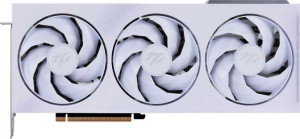
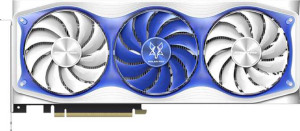
At their core, both the Galax Saber and the Manli Polar Fox are built on identical silicon foundations: the same 10,752 shading units, 336 TMUs, 112 ROPs, and a matching base clock of 2295 MHz with 1875 MHz memory speed. This means any performance delta between them comes down entirely to how aggressively each board partner has tuned the GPU boost behavior — not architectural differences.
That tuning gap, while modest, consistently favors the Manli Polar Fox OC. Its boost clock reaches 2640 MHz versus the Galax Saber's 2617 MHz — a 23 MHz advantage that flows directly into every derived throughput metric. The Polar Fox edges ahead with 295.7 GPixel/s pixel fill rate versus 293.1 GPixel/s, 887 GTexels/s texture throughput versus 879.3 GTexels/s, and a floating-point compute ceiling of 56.77 TFLOPS against 56.28 TFLOPS. In absolute terms these are differences of roughly 0.9%, which will not be perceptible in standard gaming workloads where frame pacing, memory bandwidth, and driver overhead dominate.
In practical terms, both cards will perform virtually identically in games and most creative applications. The Manli Polar Fox OC holds a narrow but real performance edge on paper, and in sustained GPU-compute or rendering workloads where every TFLOP is accounted for, that higher boost ceiling could compound into a marginally shorter render time. For gaming, consider them a tie and let cooling, acoustics, and price be the deciding factors.