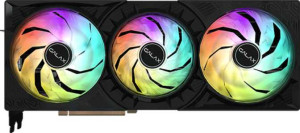
Galax GeForce RTX 5090 D 1-Click OC
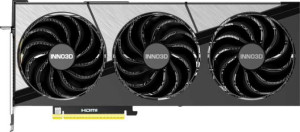
Inno3D GeForce RTX 5090 X3

Galax GeForce RTX 5090 D 1-Click OC Inno3D GeForce RTX 5090 X3

Overview

When choosing between the Galax GeForce RTX 5090 D 1-Click OC and the Inno3D GeForce RTX 5090 X3, you are evaluating two flagship graphics cards built on the same Blackwell architecture with nearly identical performance credentials. Both share the same GPU, memory setup, and feature set, so this comparison zeroes in on the physical dimensions and the finer details that could make one a better fit for your specific build than the other.

Common Features

  • Both cards have a base GPU clock speed of 2017 MHz.
  • Both cards have a GPU turbo clock speed of 2407 MHz.
  • Both cards deliver a pixel rate of 423.6 GPixel/s.
  • Both cards offer 104.8 TFLOPS of floating-point performance.
  • Both cards have a GPU memory speed of 1750 MHz.
  • Both cards feature 21760 shading units.
  • Both cards include 680 texture mapping units (TMUs).
  • Both cards have 176 render output units (ROPs).
  • Both cards have an effective memory speed of 28000 MHz.
  • Both cards provide a maximum memory bandwidth of 1792 GB/s.
  • Both cards come with 32GB of VRAM.
  • Both cards use GDDR7 memory.
  • Both cards feature a 512-bit memory bus width.
  • ECC memory support is available on both cards.
  • Both cards support DirectX 12 Ultimate.
  • Both cards support OpenGL version 4.6.
  • Both cards support OpenCL version 3.
  • Multi-display technology is supported on both cards.
  • Ray tracing is supported on both cards.
  • DLSS is supported on both cards.
  • 3D support is available on both cards.
  • XeSS (XMX) support is not available on either card.
  • Both cards have one HDMI 2.1b output.
  • Both cards feature three DisplayPort outputs.
  • Neither card has USB-C ports, DVI outputs, or mini DisplayPort outputs.
  • Both cards are based on the Blackwell GPU architecture.
  • Both cards have a Thermal Design Power (TDP) of 575W.
  • Both cards use PCIe version 5.
  • Both cards are manufactured on a 5 nm semiconductor process.
  • Both cards contain 92200 million transistors.
  • Neither card uses air-water cooling.

Main Differences

  • Texture rate is 1637 GTexels/s on Galax GeForce RTX 5090 D 1-Click OC and 1636.8 GTexels/s on Inno3D GeForce RTX 5090 X3.
  • Width is 337 mm on Galax GeForce RTX 5090 D 1-Click OC and 333 mm on Inno3D GeForce RTX 5090 X3.
  • Height is 151 mm on Galax GeForce RTX 5090 D 1-Click OC and 137 mm on Inno3D GeForce RTX 5090 X3.
Specs Comparison
Galax GeForce RTX 5090 D 1-Click OC

Galax GeForce RTX 5090 D 1-Click OC

Inno3D GeForce RTX 5090 X3

Inno3D GeForce RTX 5090 X3

Performance:
GPU clock speed 2017 MHz 2017 MHz
GPU turbo 2407 MHz 2407 MHz
pixel rate 423.6 GPixel/s 423.6 GPixel/s
floating-point performance 104.8 TFLOPS 104.8 TFLOPS
texture rate 1637 GTexels/s 1636.8 GTexels/s
GPU memory speed 1750 MHz 1750 MHz
shading units 21760 21760
texture mapping units (TMUs) 680 680
render output units (ROPs) 176 176
Has Double Precision Floating Point (DPFP)

In terms of raw performance, the Galax GeForce RTX 5090 D 1-Click OC and the Inno3D GeForce RTX 5090 X3 are nearly identical across the board. Both cards share the same 2017 MHz base clock and 2407 MHz boost clock, the same 21,760 shading units, 680 TMUs, 176 ROPs, and identical 1750 MHz memory speed. This is expected given they are built on the same GPU die, but it also means neither card has been factory-tuned to pull ahead in clock speed or memory bandwidth.

The only measurable difference between the two lies in the texture rate: the Galax reports 1637 GTexels/s versus the Inno3D's 1636.8 GTexels/s — a delta of just 0.2 GTexels/s. This is a rounding-level discrepancy with absolutely no perceptible real-world impact on texture throughput or rendering performance. Similarly, both deliver identical 423.6 GPixel/s pixel fill rate and 104.8 TFLOPS of floating-point performance, and both support Double Precision Floating Point (DPFP), which benefits scientific computing and certain professional workloads.

In conclusion, these two cards are effectively performance-tied in this category. The texture rate difference is purely a matter of decimal rounding and should not factor into any purchasing decision. Buyers should look to other specification groups — such as cooling, design, or connectivity — to differentiate between these two otherwise compute-equivalent GPUs.

Memory:
effective memory speed 28000 MHz 28000 MHz
maximum memory bandwidth 1792 GB/s 1792 GB/s
VRAM 32GB 32GB
GDDR version GDDR7 GDDR7
memory bus width 512-bit 512-bit
Supports ECC memory

The memory specifications for the Galax GeForce RTX 5090 D 1-Click OC and the Inno3D GeForce RTX 5090 X3 are identical across all key metrics. Both products feature an effective memory speed of 28000 MHz and a maximum memory bandwidth of 1792 GB/s. Each card comes with 32GB of VRAM and utilizes the GDDR7 memory type. The memory bus width is also the same for both at 512-bit. Additionally, both cards support ECC memory.

Given that all memory-related specifications are the same, there is no difference in memory performance or capabilities between the two cards. Users can expect equivalent performance in terms of memory speed, bandwidth, and capacity from both the Galax and Inno3D models.

In conclusion, the memory configurations are fully matched between the two products, ensuring similar memory performance in real-world applications.

Features:
DirectX version DirectX 12 Ultimate DirectX 12 Ultimate
OpenGL version 4.6 4.6
OpenCL version 3 3
Supports multi-display technology
supports ray tracing
Supports 3D
supports DLSS
has XeSS (XMX)
AMD SAM / Intel Resizable BAR Intel Resizable BAR Intel Resizable BAR
has LHR
has RGB lighting
supported displays 4 4

The Galax GeForce RTX 5090 D 1-Click OC and the Inno3D GeForce RTX 5090 X3 share identical features across all major categories. Both cards support DirectX 12 Ultimate, OpenGL 4.6, and OpenCL 3.0. They are also equipped with multi-display technology, ray tracing support, and 3D capabilities. Both models support DLSS and lack XeSS (XMX) support. Additionally, both cards feature Intel Resizable BAR (but no support for AMD SAM), and neither product has LHR (Lite Hash Rate) limitations.

In terms of aesthetics, both the Galax and Inno3D models come with RGB lighting. The supported display count is also the same for both cards, with each supporting up to 4 displays.

Overall, the feature sets of the two products are completely aligned, with no differences in the capabilities or technologies supported by either card.

Ports:
has an HDMI output
HDMI ports 1 1
HDMI version HDMI 2.1b HDMI 2.1b
DisplayPort outputs 3 3
USB-C ports 0 0
DVI outputs 0 0
mini DisplayPort outputs 0 0

The ports available on the Galax GeForce RTX 5090 D 1-Click OC and the Inno3D GeForce RTX 5090 X3 are identical. Both cards feature one HDMI output with HDMI 2.1b support, three DisplayPort outputs, and no USB-C, DVI, or mini DisplayPort outputs. There is no difference in the port configuration between the two products.

Both models provide the same connectivity options for display outputs, ensuring equivalent versatility for connecting multiple monitors or external displays.

In summary, the port specifications are fully matched, offering the same output options across both the Galax and Inno3D cards.

General info:
GPU architecture Blackwell Blackwell
release date January 2025 January 2025
Thermal Design Power (TDP) 575W 575W
PCI Express (PCIe) version 5 5
semiconductor size 5 nm 5 nm
number of transistors 92200 million 92200 million
Has air-water cooling
width 337 mm 333 mm
height 151 mm 137 mm

The general specifications for the Galax GeForce RTX 5090 D 1-Click OC and the Inno3D GeForce RTX 5090 X3 are identical across most key metrics. Both cards feature the Blackwell GPU architecture, a thermal design power (TDP) of 575W, PCI Express 5.0 compatibility, a semiconductor size of 5 nm, and 92,200 million transistors. Additionally, neither card includes air-water cooling support.

There are slight physical differences in the dimensions of the two products. The Galax model has a width of 337 mm and a height of 151 mm, while the Inno3D model is slightly more compact with a width of 333 mm and a height of 137 mm. However, these differences are relatively minor and may not significantly affect their compatibility in most systems.

In summary, the core technical features are the same between the two cards, with only slight differences in size that could influence installation space in certain cases.

Comparison Summary & Verdict

The Galax GeForce RTX 5090 D 1-Click OC and the Inno3D GeForce RTX 5090 X3 are, for all practical purposes, performance equals. Both deliver 104.8 TFLOPS of floating-point power, feature 32GB of GDDR7 memory on a 512-bit bus with 1792 GB/s of bandwidth, and support the full modern feature stack including ray tracing and DLSS. The real differentiator comes down to physical size: the Galax measures 337 x 151 mm, while the Inno3D is more compact at 333 x 137 mm. Builders working with tighter cases or limited vertical clearance will find the Inno3D GeForce RTX 5090 X3 the easier card to accommodate, whereas those with no space constraints will find the Galax GeForce RTX 5090 D 1-Click OC equally capable. Let your case dimensions and cooler aesthetic guide the final decision.

Galax GeForce RTX 5090 D 1-Click OC
Buy Galax GeForce RTX 5090 D 1-Click OC if...

Buy the Galax GeForce RTX 5090 D 1-Click OC if your case offers ample clearance and physical dimensions are not a constraint, as it delivers the same top-tier performance in a slightly larger form factor.

Inno3D GeForce RTX 5090 X3
Buy Inno3D GeForce RTX 5090 X3 if...

Buy the Inno3D GeForce RTX 5090 X3 if you are working with a space-constrained build, as its more compact 333 x 137 mm footprint makes it the easier of the two RTX 5090 cards to fit.