Garmin Forerunner 970
Garmin Instinct 3 AMOLED 50mm

Garmin Forerunner 970 Garmin Instinct 3 AMOLED 50mm

Overview

Welcome to our in-depth specification comparison between the Garmin Forerunner 970 and the Garmin Instinct 3 AMOLED 50mm. Both watches share a strong common foundation — AMOLED displays, comprehensive health sensors, and robust activity tracking — yet they diverge sharply when it comes to battery endurance, smart features, and rugged design priorities. Read on to see how these two Garmin offerings stack up across every key specification.

Common Features

  • Both watches feature an OLED/AMOLED display type.
  • Both watches are waterproof.
  • Neither watch has branded damage-resistant glass.
  • The watch band is replaceable on both products.
  • Both watches support an Always-On Display.
  • Both watches have a maximum operating temperature of 60 °C and a lowest operating temperature of -20 °C.
  • Both watches have GPS support.
  • Both watches include a heart rate monitor.
  • Both watches monitor blood oxygenation levels.
  • Both watches include a barometer, accelerometer, compass, temperature sensor, and gyroscope.
  • Both watches offer route tracking, distance tracking, pace measurement, trackback mode, sleep tracking, multi-sport mode, automatic activity detection, and elevation tracking.
  • Both watches are compatible with iOS and Android.
  • Neither watch has a cellular module.
  • Both watches support ANT+ and NFC.
  • Neither watch supports wireless charging or solar power battery charging.
  • Both watches have a rechargeable, non-removable battery.
  • Both watches support HRV tracking, VO2 max measurement, resting heart rate measurement, fast/slow heart rate notifications, and readiness level display.
  • Both watches include a stopwatch, phone locator, and silent alarm.
  • Both watches provide activity reports, inactivity alerts, calorie tracking, goal setting, achievements, exercise diary, weight tracking, and BMI tracking.
  • Both watches have a battery level indicator, are compatible with Windows and Mac OS X, have no external memory slot, and have no 3.5 mm audio jack socket.

Main Differences

  • Screen size is 1.4″ on Garmin Forerunner 970 and 1.3″ on Garmin Instinct 3 AMOLED 50mm.
  • ATM rating is 5 ATM on Garmin Forerunner 970 and 10 ATM on Garmin Instinct 3 AMOLED 50mm.
  • Resolution is 454 x 454 px on Garmin Forerunner 970 and 416 x 416 px on Garmin Instinct 3 AMOLED 50mm.
  • Touchscreen support is present on Garmin Forerunner 970 but not available on Garmin Instinct 3 AMOLED 50mm.
  • Weight is 56 g on Garmin Forerunner 970 and 59 g on Garmin Instinct 3 AMOLED 50mm.
  • Sapphire glass display is present on Garmin Forerunner 970 but not available on Garmin Instinct 3 AMOLED 50mm.
  • Thickness is 12.9 mm on Garmin Forerunner 970 and 14.4 mm on Garmin Instinct 3 AMOLED 50mm.
  • Height is 47 mm on Garmin Forerunner 970 and 50 mm on Garmin Instinct 3 AMOLED 50mm.
  • Pixel density is 458.6 ppi on Garmin Forerunner 970 and 452 ppi on Garmin Instinct 3 AMOLED 50mm.
  • Width is 47 mm on Garmin Forerunner 970 and 50 mm on Garmin Instinct 3 AMOLED 50mm.
  • Band width is 22 mm on Garmin Forerunner 970 and 26 mm on Garmin Instinct 3 AMOLED 50mm.
  • Volume is 28.4961 cm³ on Garmin Forerunner 970 and 36 cm³ on Garmin Instinct 3 AMOLED 50mm.
  • A cadence sensor is present on Garmin Instinct 3 AMOLED 50mm but not available on Garmin Forerunner 970.
  • Wi-Fi support is present on Garmin Forerunner 970 but not available on Garmin Instinct 3 AMOLED 50mm.
  • Battery life is 15 days on Garmin Forerunner 970 and 24 days on Garmin Instinct 3 AMOLED 50mm.
  • Battery life with GPS on is 26 hours on Garmin Forerunner 970 and 40 hours on Garmin Instinct 3 AMOLED 50mm.
  • Battery life in training mode is 14 hours on Garmin Forerunner 970 and 30 hours on Garmin Instinct 3 AMOLED 50mm.
  • Map uploading is supported on Garmin Forerunner 970 but not available on Garmin Instinct 3 AMOLED 50mm.
  • Internal storage is 32GB on Garmin Forerunner 970 and 4GB on Garmin Instinct 3 AMOLED 50mm.
  • Call answering, call control, vibrating alerts, and voice commands are all present on Garmin Forerunner 970 but none of these features are available on Garmin Instinct 3 AMOLED 50mm.
Specs Comparison
Garmin Forerunner 970

Garmin Forerunner 970

Garmin Instinct 3 AMOLED 50mm

Garmin Instinct 3 AMOLED 50mm

Design:
screen size 1.4" 1.3"
Display type OLED/AMOLED OLED/AMOLED
water resistance Waterproof Waterproof
has branded damage-resistant glass
ATM rating 5 ATM 10 ATM
resolution 454 x 454 px 416 x 416 px
Watch band is replaceable
has a touch screen
weight 56 g 59 g
Has sapphire glass display
thickness 12.9 mm 14.4 mm
Always-On Display
height 47 mm 50 mm
pixel density 458.6 ppi 452 ppi
maximum operating temperature 60 °C 60 °C
lowest potential operating temperature -20 °C -20 °C
Has a display
width 47 mm 50 mm
width of band 22 mm 26 mm
volume 28.4961 cm³ 36 cm³

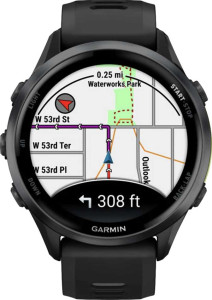
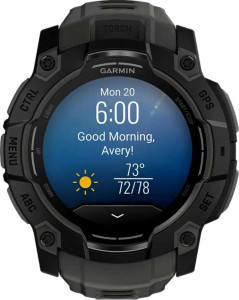
Both watches share a solid design foundation — AMOLED displays, always-on capability, waterproofing, and replaceable bands — but they diverge meaningfully in form factor and key protective features. The Forerunner 970 is the more compact and refined of the two: at 47 mm wide, 12.9 mm thick, and 56 g, it wears noticeably slimmer and lighter than the Instinct 3 AMOLED 50mm, which measures 50 mm across, 14.4 mm thick, and 59 g. The volume difference — 28.5 cm³ vs 36 cm³ — underscores just how much bulkier the Instinct 3 is, a trade-off that matters for all-day wearability and sleep tracking comfort.

Display quality slightly favors the Forerunner 970 as well: its 1.4″ screen at 454 × 454 px and 458.6 ppi offers a marginally larger and sharper canvas than the Instinct 3's 1.3″ panel at 416 × 416 px and 452 ppi. More critically, the Forerunner 970 adds a sapphire glass display and a touchscreen — two features the Instinct 3 lacks entirely. Sapphire glass is significantly harder than standard mineral glass, making it far more resistant to everyday scratches, which is a real long-term durability advantage. The absence of touch input on the Instinct 3 means all navigation is button-based, which some users prefer in rugged or wet conditions but limits interface fluidity.

The Instinct 3 does hit back on one spec: its 10 ATM water resistance rating doubles the Forerunner 970's 5 ATM, meaning it is rated for deeper water exposure. For the vast majority of swimmers and triathletes, 5 ATM is sufficient, but the Instinct 3 has a clear edge for diving or high-pressure water activities. Overall, the Forerunner 970 holds the design advantage for most users — it is smaller, lighter, sharper, touchscreen-enabled, and protected by sapphire glass — while the Instinct 3 trades those refinements for a larger, more rugged build and superior water resistance.
Sensors:
has GPS
Has a heart rate monitor
Monitors blood oxygenation levels
Has a barometer
has an accelerometer
has a compass
Has a temperature sensor
Has a cadence sensor
has a gyroscope
Has a wind speed sensor
Monitors perspiration

For two watches positioned at different ends of the Garmin lineup, their sensor suites are remarkably aligned. Both pack GPS, a heart rate monitor, blood oxygen monitoring, a barometer, an accelerometer, a gyroscope, a compass, and a temperature sensor — a comprehensive array that covers the needs of most endurance athletes, hikers, and outdoor adventurers. Neither watch monitors perspiration or wind speed, so those omissions are a wash.

The single differentiator in this category is the cadence sensor, which the Instinct 3 AMOLED 50mm includes and the Forerunner 970 does not. A built-in cadence sensor tracks steps or pedal strokes per minute directly from the wrist, without requiring an external footpod or cycling sensor. For runners, cadence is a key biomechanical metric tied to efficiency and injury prevention, making its native inclusion on the Instinct 3 a meaningful — if narrow — functional advantage.

On balance, the Instinct 3 AMOLED 50mm edges ahead in this category purely on the strength of that cadence sensor. It is the only distinction in an otherwise identical sensor package, but for runners or cyclists who want cadence data without pairing additional accessories, it is a genuinely useful differentiator.

Activity tracking:
Has a route tracker
Tracks distance
Measures pace
Has trackback mode
Tracks your sleep
Has multi-sport mode
Detects activities automatically
Tracks elevation
Tracks steps taken
Provides sleep reports
Has exercise tagging
Has a stroke counter for swimming
Tracks calorie intake
Designed for diving
Designed for golf

Rare in a head-to-head comparison, the activity tracking category is a perfect tie — every single spec is identical across the Forerunner 970 and the Instinct 3 AMOLED 50mm. Both cover the full spectrum of endurance and daily tracking needs: route tracking, pace and distance measurement, elevation, step counting, and automatic activity detection all come standard on each watch.

Worth highlighting is the breadth of what both watches share. Multi-sport mode and a stroke counter for swimming make them capable triathlon companions, while trackback mode adds a meaningful safety net for off-trail navigation by guiding the wearer back along their recorded route. On the wellness side, both provide sleep tracking with detailed sleep reports and calorie intake tracking — a combination that supports a more holistic picture of health beyond just workouts. The inclusion of golf mode on both devices is a notable lifestyle addition, extending their utility well beyond pure athletic training.

Since no differentiating data exists within this group, neither watch holds an advantage here. A buyer's decision between the two will ultimately hinge on the distinctions surfaced in other spec categories — design, sensors, connectivity, and battery life — rather than anything activity tracking reveals on its own.

Connectivity:
Is compatible with iOS
Is compatible with Android
supports Wi-Fi
has a cellular module
supports ANT+
has NFC

Connectivity is largely consistent between the two watches, with both supporting ANT+ for pairing external sensors, NFC for contactless payments, and full compatibility with both iOS and Android. Neither includes a cellular module, so both rely on a paired smartphone for notifications and data sync when away from a known network.

The one split comes down to Wi-Fi: the Forerunner 970 supports it, while the Instinct 3 AMOLED 50mm does not. In practice, Wi-Fi on a sports watch primarily enables syncing activities, maps, and firmware updates directly over a home or gym network — without needing the phone nearby. It is a convenience feature rather than a critical capability, but it does streamline the ownership experience, particularly for users who do not always carry their phone during or after workouts.

The Forerunner 970 takes a narrow edge in connectivity thanks solely to Wi-Fi support. For users who frequently update maps or prefer phone-free syncing, that addition is a genuine quality-of-life improvement. For those who habitually sync via their phone anyway, the gap is minimal.

Battery:
battery life 15 days 24 days
battery life with GPS on 26 hours 40 hours
battery life in training mode 14 hours 30 hours
has wireless charging
Has a solar power battery
has a rechargeable battery
has a removable battery

Battery life is where the gap between these two watches is most pronounced, and the numbers tell an unambiguous story. The Instinct 3 AMOLED 50mm lasts 24 days in smartwatch mode versus 15 days for the Forerunner 970 — a difference that translates directly into fewer charging interruptions over the course of a month. For users who travel, expedition train, or simply dislike the routine of daily or near-daily charging, that nine-day margin is substantial.

The gap widens further under active use. With GPS running, the Instinct 3 sustains 40 hours compared to the Forerunner 970's 26 hours, and in training mode the difference is even sharper: 30 hours versus 14 hours. That training mode figure is particularly meaningful for ultra-endurance athletes — a 30-hour window comfortably covers most ultramarathons and multi-day adventure races without requiring a mid-event recharge, while 14 hours would fall short for the same events. Neither watch supports wireless charging or solar power, so both are strictly dependent on a wired connection to top up.

The Instinct 3 AMOLED 50mm holds a decisive advantage in battery life across every measured scenario. Users prioritizing GPS-heavy or multi-day endurance use will feel this difference acutely, and even for everyday wearers, the longer standby life means meaningfully less time tethered to a charger.

Features:
release date June 2025 January 2025
has HRV tracking
measures VO2 max
measures resting heart rate
has fast/slow heart rate notifications
shows readiness level
Can upload maps
Has vibrating alerts
Has a stopwatch
Locates your phone
Has silent alarm
has irregular heart rate warnings
has fall detection
Has notifications
Acquires GPS faster
Has call control
Provides the sunrise/sunset time
internal storage 32GB 4GB
Can be used to answer calls
supports Galileo
Has smart alarm
Informs about the risk of thunderstorms
has voice commands
Has a built-in camera remote control function

Both watches share a strong common feature set — HRV tracking, VO2 max, readiness scores, fall detection, Galileo satellite support, and thunderstorm risk alerts among them — but the Forerunner 970 pulls considerably ahead when it comes to smart features and communication capabilities. It supports call control, the ability to answer calls directly from the wrist, and voice commands, none of which are available on the Instinct 3 AMOLED 50mm. For users who want their watch to function as a genuine smartwatch extension of their phone, these omissions on the Instinct 3 are hard to overlook.

Storage is another area where the gap is stark: the Forerunner 970 offers 32 GB of internal storage versus just 4 GB on the Instinct 3. That difference matters most for map storage — and it connects directly to another exclusive feature of the Forerunner 970: the ability to upload maps. With 32 GB to work with, users can store detailed regional or topographic maps onboard, turning the watch into a capable navigation device. The Instinct 3 supports neither map uploads nor the storage capacity that would make them practical. Additionally, the Forerunner 970 includes vibrating alerts, which the Instinct 3 lacks — a small but everyday-relevant omission for notifications and alarms.

The Forerunner 970 holds a clear and broad advantage in features. The combination of map support, 8× more internal storage, call answering, call control, voice commands, and vibrating alerts represents a meaningful quality-of-life gap over the Instinct 3 — particularly for users who expect their sports watch to double as a capable smart device.

App & Software:
Provides activity reports
Has inactivity alerts
Counts how many calories you've burned
Has goal setting
Has achievements
Has exercise diary
Has weight tracking
Tracks BMI
Tracks water intake
Has coaching
Has temperature tracking
Has period notifications
Supports routes
Displays fertile window notifications
Includes maps
Predicts start date
Predicts ovulation
Has barcode scanner on app

App and software support is identical across the Forerunner 970 and the Instinct 3 AMOLED 50mm — every single spec matches. Both deliver a genuinely comprehensive wellness and training ecosystem: activity reports, coaching, goal setting, an exercise diary, and inactivity alerts cover the athletic side, while weight tracking, BMI, water intake, and temperature tracking extend the picture into broader daily health management.

Notably, both watches include a full suite of reproductive health features — period notifications, fertile window alerts, ovulation prediction, and cycle start date forecasting — which reflects how mainstream these capabilities have become on premium sports wearables. Route support and integrated maps round out the package, reinforcing the navigation utility both watches offer at the software level. The one shared omission is a barcode scanner in the companion app, though this is a niche convenience rather than a core training or wellness tool.

With no differences to speak of, this category is a complete tie. Whichever watch a buyer chooses, they will have access to the same app features and software depth — making the decision between the two entirely dependent on hardware distinctions covered in other spec groups.

Miscellaneous:
has a battery level indicator
Is compatible with Windows
Is compatible with Mac OS X
has an external memory slot
has a socket for a 3.5 mm audio jack

The miscellaneous category offers no grounds for differentiation — the Forerunner 970 and the Instinct 3 AMOLED 50mm are identical across every spec listed. Both display a battery level indicator, support desktop sync with Windows and Mac OS X, and share the same hardware omissions: no external memory slot and no 3.5 mm audio jack.

The absence of a 3.5 mm jack is consistent with the broader sports watch category, where onboard audio output is not a standard expectation. Similarly, the lack of external memory expansion is a shared constraint, though it lands differently given the two watches' internal storage disparity noted in the Features category. Neither omission is surprising or penalizing in context.

This is a complete tie with nothing to separate the two watches. As with the App and Software group, any buying decision will need to be grounded in the more substantive differences — design, battery, and features — rather than anything surfaced here.

Comparison Summary & Verdict

After a thorough comparison, both watches prove themselves as capable Garmin GPS smartwatches, but they clearly serve different types of users. The Garmin Forerunner 970 stands out for athletes and tech-savvy users who value a touchscreen display, sapphire glass protection, map uploading, 32GB of storage, Wi-Fi connectivity, call control, and voice commands — making it the more feature-rich daily companion. On the other hand, the Garmin Instinct 3 AMOLED 50mm wins decisively on battery life — offering up to 24 days of use, 40 hours with GPS active, and 30 hours in training mode — alongside a higher water resistance rating of 10 ATM and a built-in cadence sensor, making it the stronger choice for serious outdoor adventurers and endurance athletes who prioritize longevity over smart features.

Garmin Forerunner 970
Buy Garmin Forerunner 970 if...

Buy the Garmin Forerunner 970 if you want a feature-packed smartwatch with a touchscreen, sapphire glass, map uploading, 32GB storage, Wi-Fi, and the ability to answer and control calls directly from your wrist.

Garmin Instinct 3 AMOLED 50mm
Buy Garmin Instinct 3 AMOLED 50mm if...

Buy the Garmin Instinct 3 AMOLED 50mm if you prioritize exceptional battery life, higher water resistance (10 ATM), and a built-in cadence sensor for long outdoor adventures and endurance training sessions.